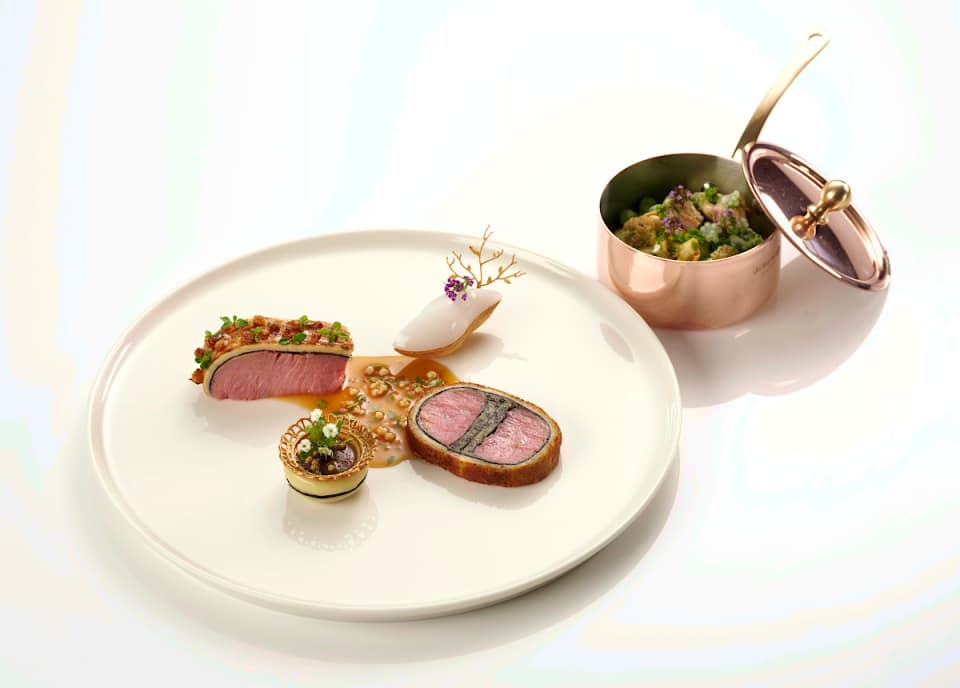
Competing at Bocuse d’Or is mentally and physically exhausting in a very different way. You are preparing two dishes within 5 hours and 35 minutes, and the level of precision required is extreme. During training, we repeat the same dishes over and over again until every movement becomes automatic, even down to knowing the exact number of steps to take within the competition box. Of course, competition day still depends on factors you cannot fully control, like ingredient condition, oven temperatures, or small unexpected issues, but overall it is a highly controlled environment built around repetition and precision.
Running a three-Michelin-starred kitchen is very different because it is far more unpredictable. Every service brings new challenges: different guests, team dynamics, ingredients, and situations, yet the expectation for consistency remains the same every single day. The challenge is not only maintaining the quality of flavour and execution, but also delivering the same level of hospitality and experience night after night. That requires not just precision, but adaptability, leadership, and trust in the entire team.
Both require discipline and precision, but leadership becomes much more important in a restaurant environment.

Discipline, focus, and patience are extremely important. You have to stay humble, be receptive to feedback, and never be afraid to learn from mistakes. And of course, to always stay consistent.
Moving abroad may sound exciting and glamorous from the outside, but the reality can be very different. You are alone in a foreign country, adapting to a new culture, language, environment, and way of working. There will be moments that feel uncomfortable and isolating. But those experiences also help you grow the most, both professionally and personally.
There’s really no shortcut, it really all boils down on how much you’re willing to sacrifice to achieve what you desire.
What makes Stavanger extraordinary is proximity to incredible ingredients. The seafood here is among the best in the world, langoustines, scallops, king crab, shellfish, cold-water fish, and everything is deeply connected to the surrounding landscape and seasons.
There’s also a strong culture of producers and craftsmen who genuinely care about quality. That relationship between restaurant and producer is very important.
What surprised me most was actually the duration and pace of dining. In Singapore, diners are used to incredible convenience, fast service, and endless variety at any hour of the day. Hawker culture is deeply rooted in everyday life, and people expect food to arrive quickly with very little waiting time. The dining culture is energetic, efficient, and fast-paced.
In Norway, dining is much slower and more intentional. Guests are comfortable spending several hours at the table, fully enjoying the atmosphere, conversation, wine, and progression of the meal. There’s a stronger focus on the overall experience, sustainability, and appreciation of local ingredients, especially seafood. It was a very different rhythm from what I grew up with, but something I learned to value over time.
I would describe my cooking as rooted in modern Nordic cuisine, but naturally infused with my Asian heritage. The foundation of my food comes from Nordic principles, seasonality, purity, technique, and respect for ingredients, while my understanding of flavour is deeply shaped by growing up in Singapore. That combination influences the way I build balance, depth, acidity, and texture in my dishes.