For decades, cottage cheese was the forgotten cheese of the American dairy aisle. Once a staple of 1970s diet culture, it gradually lost ground to cheddar, mozzarella, parmesan, and countless other cheese varieties. Production declined, consumers moved on, and cottage cheese became synonymous with bland low-fat dieting rather than exciting food trends.
Today, however, cottage cheese is staging one of the most remarkable comebacks in the American food industry.
Fueled by the nation’s growing obsession with protein, the once-overlooked dairy product has become one of the most searched cheeses in the United States, overtaking household favorites such as cheddar, mozzarella, and parmesan in online popularity. At the same time, dairy producers are ramping up production, investing millions of dollars in new capacity, and even converting facilities that once produced other cheeses to meet growing demand.
New research by Chef’s Pencil suggests that cottage cheese has transformed from a declining dairy category into one of the biggest winners of America’s protein boom.
To understand how American interest in cottage cheese has changed, Chef’s Pencil analyzed Google Trends data over the past five years, comparing search popularity for five of America’s most popular cheeses: cottage cheese, cheddar, mozzarella, parmesan, and cream cheese.

The results reveal a dramatic turnaround. Back in 2021, cottage cheese ranked last among the five cheeses analyzed. Search interest lagged well behind cheddar, mozzarella, parmesan, and cream cheese. By 2025, cottage cheese had climbed to third place. In 2026, it reached its highest level of popularity yet, overtaking cheddar, mozzarella, and parmesan to become one of America’s most searched cheeses.

Perhaps even more remarkable is how persistent the trend has been. While cottage cheese searches experienced the typical January and February spike associated with New Year’s resolutions and healthy eating goals, interest remained elevated throughout the first half of 2026 rather than falling back toward historical levels.
This suggests consumers aren’t simply experimenting with cottage cheese as part of a short-term diet. Increasingly, they appear to be incorporating it into their regular eating habits.
The answer appears to be protein.
Over the past two years, cottage cheese has become one of the most talked-about ingredients in fitness communities, health-focused social media accounts, and high-protein recipe content.
Unlike many processed protein products, cottage cheese offers a relatively simple ingredient list while delivering substantial protein per serving. And Americans appear to be more focused on protein than ever before.
Food manufacturers have started to add protein to everything from ice cream and candy to coffee and flavored water. According to market research cited by the Wall Street Journal, food companies introduced 97 new products with “protein” in the brand name in 2024 alone, more than double the number introduced the previous year. The fastest-growing grocery products are increasingly those that offer at least 25 grams of protein per serving.
The trend has also spilled into restaurants. Chains ranging from Chipotle and Subway to Starbucks and Dunkin’ are rolling out protein-focused menu items and marketing campaigns as consumers increasingly prioritize protein intake. Industry observers point to a combination of social media fitness culture, growing interest in health and wellness, and the rise of GLP-1 weight-loss medications, whose users are often encouraged to consume more protein to preserve muscle mass during weight loss.
Consumers aren’t just curious about the ingredient; they are highly brand-conscious and recipe-driven. Brand searches for Good Culture cottage cheese alone topped an incredible 135,000 searches per month. Meanwhile, health-conscious consumers drove low-fat cottage cheese to 90,500 monthly searches and low-sodium cottage cheese to 49,000.
The way Americans eat cottage cheese has also fundamentally transformed. It is no longer just eaten plain with a spoon. According to Google Adwords data, home cooks are aggressively using it as a high-protein ingredient replacement in comfort foods:
- Eggs and cottage cheese: 18,000+ monthly searches (blended into fluffy scrambled eggs)
- Lasagna recipe with cottage cheese: 12,000+ monthly searches
- Cottage cheese bread recipes: 9,900 monthly searches
- Cottage cheese ice cream: 9,900 monthly searches
- Cottage cheese cheesecake: 9,100 monthly searches
- Cottage cheese mac and cheese: 5,100 monthly searches
- Cottage cheese pancakes: Rapidly rising in search popularity
The cottage cheese boom has not gone unnoticed by producers. In February 2026, industry publication The Cheese Reporter reported that dairy cooperative AMPI plans to transition its Blair, Wisconsin plant from cheddar production to cottage cheese production. At the same time, cottage cheese brand Good Culture announced a $55 million investment to expand operations.
These developments suggest producers view the surge in demand as more than a temporary trend. And the production data appears to support that conclusion.
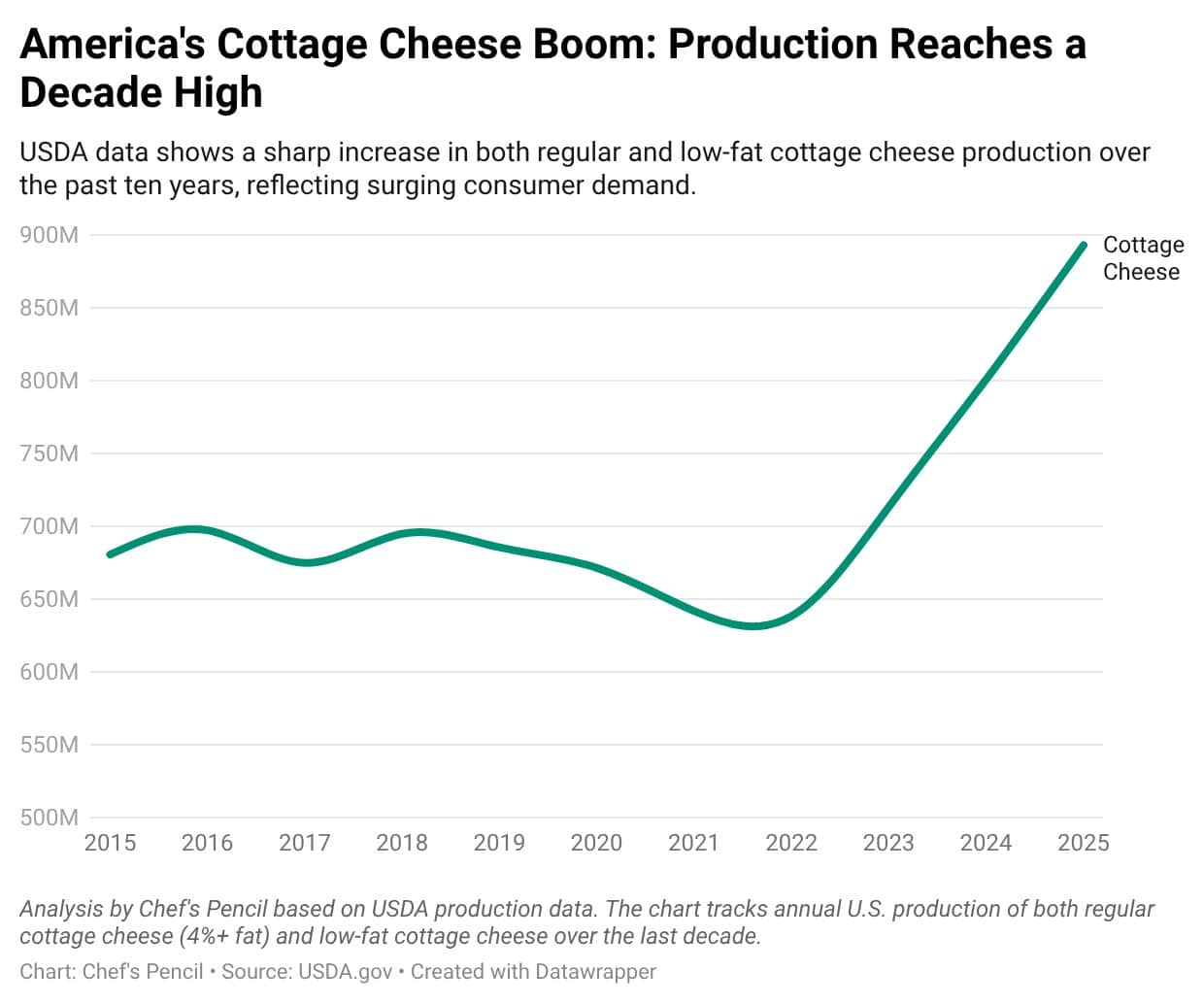
Chef’s Pencil also analyzed USDA production data covering the most recent available years. Between 2023 and 2025 low-fat cottage cheese production increased by 26%, while regular cottage cheese production increased by 25%. By comparison, overall cheese production grew by approximately 5% during the same period.

Among all major cheese categories reported by the USDA, only Gouda posted a larger percentage increase, rising 36%. However, Gouda’s production volume remains significantly smaller than cottage cheese, making cottage cheese’s growth far more consequential from an industry perspective.
The trend becomes even more striking when compared with pre-pandemic production levels. Between 2019 and 2025, regular cottage cheese production increased by 32%, while low-fat cottage cheese production increased by 29% Meanwhile, overall cheese production increased by just 13%.
While cottage cheese production has surged in recent years, it has not yet returned to the levels seen during its heyday. USDA data shows that both regular and low-fat cottage cheese production were higher in the late 1980s, while overall cottage cheese production reached its all-time peak in 1972.
In other words, today’s cottage cheese boom is better described as a resurgence than an entirely new phenomenon. After decades of declining popularity, the product is once again finding favor with American consumers, albeit for very different reasons. While cottage cheese was once associated primarily with low-fat dieting, today’s growth appears to be driven by broader interest in protein-rich foods, fitness, and healthier eating habits.
Even so, the recent growth is remarkable. Cottage cheese production has increased substantially faster than the overall cheese industry since both 2019 and 2023, suggesting the category is regaining relevance after years of stagnation.
One particularly interesting finding is that both full-fat and low-fat cottage cheese have experienced almost identical growth rates. Historically, cottage cheese was closely associated with low-fat dieting and weight-loss culture. Yet the USDA data suggests that today’s cottage cheese boom extends well beyond calorie-conscious consumers.
One possible explanation is that even full-fat cottage cheese contains substantially less fat than many popular cheeses such as cheddar. At the same time, it delivers more protein per serving than Greek yogurt while containing a comparable number of calories. For many consumers, the nutritional trade-off between regular and low-fat cottage cheese may simply not be significant enough to justify sacrificing taste and texture.
Food scientists have long noted the importance of fat to the product’s appeal. In an interview with , food scientist Isaac Rosenberg, who studied cottage cheese, explained that “the minute a little bit of cream was taken out of the product, it significantly affected its quality attributes, especially the texture.”
The production data appears to support that view. Growth has been nearly identical for regular and low-fat varieties, suggesting that consumers are embracing cottage cheese in all its forms rather than gravitating exclusively toward reduced-fat options. Rather than being viewed solely as a diet food, cottage cheese increasingly seems to be benefiting from its reputation as a high-protein, versatile ingredient that fits a wide range of eating styles. Whether eaten on its own, blended into sauces and desserts, or used as a protein-rich substitute in recipes, cottage cheese has evolved from a niche weight-loss staple into a mainstream food trend.