
Owners boosted Instagram posts, hired influencers, experimented with Facebook ads, promoted limited-time offers, and partnered with agencies hoping that increased engagement would somehow translate into more guests walking through the door. But likes, comments, and impressions never guaranteed sales, and in an industry where margins remain razor thin, operators increasingly need proof that every marketing dollar is generating measurable revenue.
That challenge has become even more urgent as restaurant and foodservice operators face mounting pressure from higher labor costs, increasing food prices, shrinking margins, delivery fees, changing consumer habits, and ongoing economic uncertainty. Marketing can no longer be treated as a guessing game. Operators want to know exactly which campaign drove traffic, which promotion generated repeat visits, and which digital ads actually converted into checks and receipts.
That growing need for measurable marketing accountability has created an opportunity for technology companies like Feast Analytics, where Co-Founder Brawner Quan and his team have focused on helping operators directly connect social media campaigns to in-store sales performance.
Quan explained that the original concept behind the company came from recognizing that many restaurant operators were surrounded by enormous amounts of data but lacked the time, tools, or expertise to use it effectively. “Restaurant owners had tons of data and they weren’t doing anything with it,” Quan said. “They were trying to keep the lights on, trying to make payroll, and solving the fires directly in front of them.”
According to Quan, the turning point came when the company worked with a New York restaurant group that had experienced years of declining revenue following the pandemic. Feast Analytics analyzed the group’s acquisition and retention metrics and discovered that guest retention was not actually the problem. Customers who visited returned. The real issue was attracting enough new guests into the restaurant.

Quan added that the data revealed a critical blind spot many operators miss. “People, if they tried the food, came back,” he noted. “All they needed was to get more people to try the food.” Using targeted paid social campaigns, the company helped the operator dramatically increase guest acquisition. Quan detailed that the results transformed the business within weeks. “We ended up doubling their revenue in 30 days from when we launched,” he said. “We took them from losing money every month to becoming profitable for the first time in years.”
The larger issue, according to Quan, is that most operators have historically lacked the ability to properly measure marketing performance. Many restaurants rely on broad sales trends rather than campaign-level attribution. If business improves, owners assume marketing worked. If sales remain flat, they often conclude the campaign failed — even if the marketing may have prevented a much larger decline.
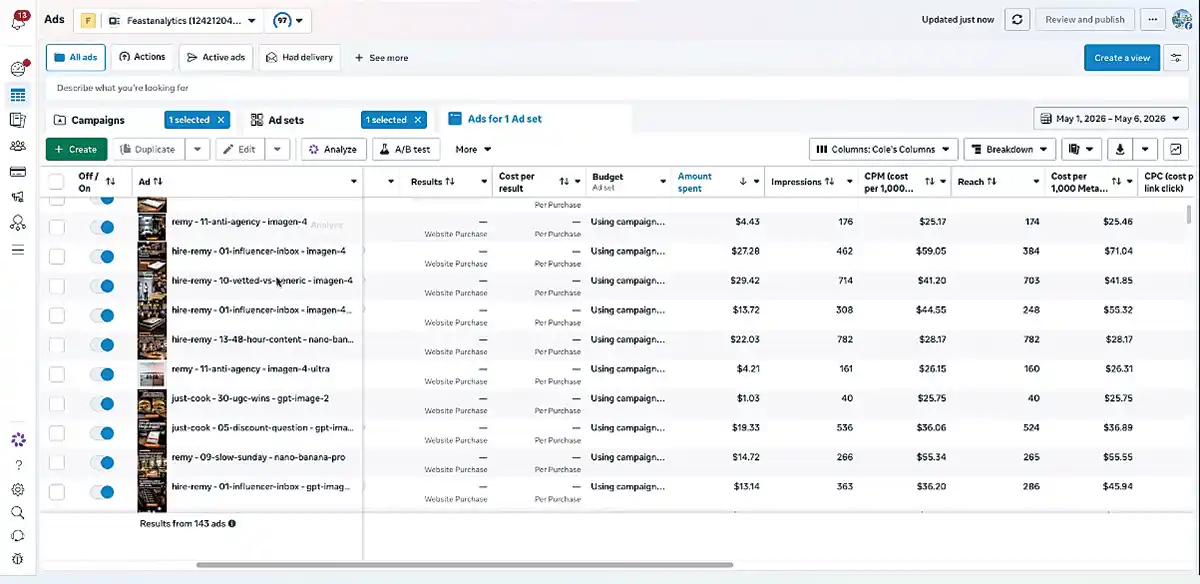
Quan continued that Feast Analytics was built specifically to eliminate that uncertainty. “No one can track the ROI of their marketing,” he said. “We figured out how to build strategies that actually have trackable ROI tied directly to receipts and transactions.” The company’s approach centers on integrating restaurant POS data with Meta advertising campaigns, reservation systems, and guest information. The platform tracks when a customer interacts with an ad, submits information, books a reservation, or later visits the restaurant using the same phone number. That connection allows operators to directly attribute revenue back to individual campaigns.
For restaurant operators looking to develop a more effective social media revenue strategy, industry experts say the process should begin with measurable goals rather than vanity metrics. The objective is not simply increasing followers or generating engagement. Operators should instead define clear business outcomes including increased guest counts, improved weekday traffic, higher average check sizes, catering growth, or stronger repeat visitation.
The next step is identifying the restaurant’s true bottleneck. Some operators struggle with guest acquisition while others need stronger retention. A restaurant with exceptional food and service but declining traffic may require aggressive acquisition marketing. Meanwhile, a concept with strong traffic but weak repeat visits may need loyalty and retention strategies.
Operators should also stop treating all marketing equally. Different campaigns serve different purposes. Awareness campaigns may build visibility, while limited-time offers, reservations campaigns, or SMS-driven promotions can create immediate measurable traffic. Understanding the distinction between brand awareness and direct conversion becomes essential. Quan outlined that the industry often overcomplicates the problem. “There are really only two ways to grow restaurant revenue,” he explained. “You either get more new customers or you improve retention with the customers you already have.”

Another important strategy involves building and understanding the role of campaigns in promoting LTO’s (Limited time offers). Feast Analytics emphasizes structured offers rather than broad discounts. Instead of promoting percentage-off pricing, operators can create value-added promotions such as complimentary beverages, appetizers, or desserts that maintain perceived brand value while driving traffic. Quan said operators must also avoid making the promotion itself the centerpiece of the campaign. “You never lead with the offer,” he added. “You lead with substance first — the food, the experience, the story, the hospitality — and then the offer simply pushes the customer over the edge.”
Industry observers note that one of the most overlooked elements of successful restaurant social media campaigns is creative consistency. Many operators post randomly, boost occasional content, or rely on influencers without any coordinated strategy. Effective campaigns require consistent messaging, strong food visuals, localized targeting, and a clear customer action path.
Quan also stressed that operators should not confuse technology overload with strategic execution. Many restaurant owners already feel overwhelmed by POS systems, reservation platforms, inventory systems, labor management software, and delivery integrations. Adding more technology only makes sense if it directly supports revenue growth. “What would an extra $20,000 a month do for an operator?” Quan said. “Revenue growth solves most problems in this business.”
One of the biggest misconceptions in restaurant marketing remains the belief that simply boosting social media posts delivers meaningful results. Quan explained that boosted posts often optimize for engagement rather than actual purchases. Feast Analytics instead builds campaigns around conversion objectives designed to drive measurable guest actions. Quan outlined that most operators never realize how sophisticated modern advertising platforms have become. “The difference is we optimize for people who actually show up to the restaurant and buy,” he said. “We’re not optimizing for likes or clicks.”
The company’s long-term vision also includes increasing automation through AI-driven campaign management. Feast Analytics currently combines human strategy with technology integrations, but Quan said the platform is rapidly moving toward autonomous campaign execution capable of managing creative, targeting, optimization, and attribution with minimal operator involvement.
He detailed that the future of restaurant marketing will depend heavily on predictive analytics and continuous testing. “We’ve turned restaurant growth into a solvable mathematical problem,” Quan said. “We help operators systematically test strategies until they find the ones that reliably drive new guests.”
As competition intensifies across restaurant, hospitality, and foodservice operations, operators increasingly recognize that simply posting content online is no longer enough. The industry is moving toward measurable performance marketing where campaigns must prove their ability to generate transactions, reservations, guest visits, and repeat business.
For operators, the lesson may be simple: social media marketing is no longer just about visibility. It is now about attribution, accountability, and revenue generation.
Quan concluded that operators who embrace measurable marketing strategies will have a major competitive advantage moving forward. “There must exist a growth strategy to get people to try your food once,” he said. “Finding it is simply a matter of systematically testing until you discover what works.”
Restaurant operators, foodservice professionals, hospitality groups, and distributors interested in learning more about Feast Analytics can visit https://feastalytics.com/ to schedule a consultation, explore the company’s marketing attribution platform, and review campaign performance strategies designed specifically for restaurant and hospitality operations. As part of an exclusive offer for Total Food Service readers, operators who sign up for Feast Analytics and mention finding Feast through Total Food Service by July 15, 2026 will receive 50% off their first month. This offer is available only through this article and will not be extended elsewhere or repeated in the future.