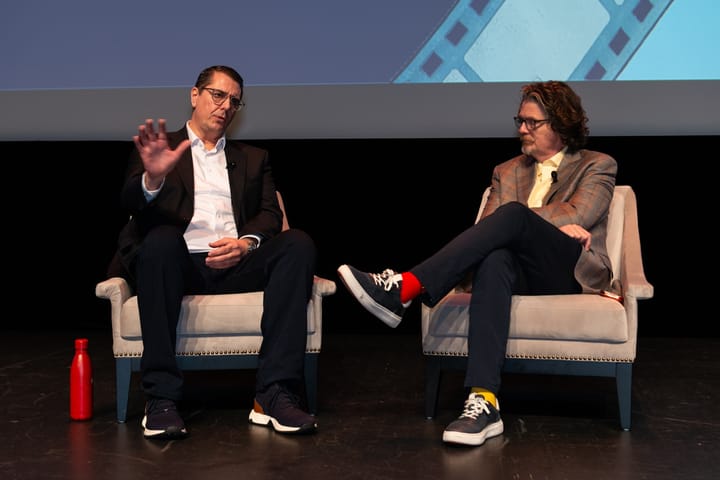
Manu Steijaert is a McDonald’s lifer. His father, an engineer who used to travel the world, decided to stay home and open a McDonald’s restaurant in their native Belgium in 1978, when Steijaert was five.
Steijaert worked in the restaurants, starting when he was 13. Later, when his father became ill, he ran the business for two years. But ultimately, after a conversation with McDonald’s managing director in Belgium, he went to work for the company. “I basically never looked back,” Steijaert said.
He’s been with the company ever since, in a variety of increasingly important roles. He spent time as the company’s chief customer officer, and is the brainchild behind some of the fast-food giant’s biggest initiatives, including the company’s innovation center Speedee Labs.
These days, Steijaert is the president of McDonald’s International Operated Markets, or IOM, a group of the company’s most developed global markets, like Canada, the U.K., France, Australia and other countries.
We interviewed Steijaert during the recent Global Restaurant Leadership Conference at the J.W. Marriott in Cannes, France. The discussion was wide-ranging, including questions on the company’s international strategies, menu development, the company’s Next strategy, and hand-breaded chicken. Here are some highlights:
Market differences
McDonald’s menu varies from one global market to the other. There are several items, like the Big Mac and its French Fries. But individual markets have flexibility to play with 30% of the menu.
That enables the chain to tailor its menu to local tastes and demands. In France, for instance, the chain has items on its menu like the Chicken Paprika and Curry Sauce. “If you look at how consumers look at us, they consider us a global brand, and they consider us part of their local communities,” Steijaert said.
The menu is one reason global consumers look at the brand that way. Another is franchisees. “I think that makes a big difference as well,” he said. We “are a big local employer, and we adapt and are engaged in local communities.”
But the menu variety does provide McDonald’s with some opportunities on the marketing front. McDonald’s U.K. last year ran a marketing promotion called World Menu Heist, offering products from different parts of the world, such as the Big Rosti from Germany (a beef patty with potato rosti, bacon, cheese, and a baconnaise/cheese sauce), or Chicken McWings from China (chicken wings with a Szechuan pepper sauce).
Bringing ideas together
Market differences aren’t just menu items, however. Daily business cycles can vary considerably by market. In France, less than 30% of sales come through the drive-thru, compared with 80% in Canada. France gets about 70% of its sales within five hours, making the peaks heavier than in other markets. That can make managing all of them complex.
But the markets are all mature, and they can share information and ideas based on their own strategies.
France was a good example of this. Because the restaurants have such large peak businesses, many of McDonald’s restaurants in the country needed more capacity to take orders than they had space for. “We could not fit any more registers,” Steijaert said. So the company could not take advantage of the opportunity during those peak times.
So McDonald’s came up with kiosks in 2007. “Kiosks were actually never a labor-saving initiatives,” Steijaert said. The kiosks were ultimately expanded into other mature global markets, and became a key part of McDonald’s global remodels in 2017, a decade later.
On McDonald’s Next
McDonald’s recently revealed its new corporate strategy, called Next, which features improvements in customer service, menu quality, technology, and marketing. It’s a 10-year strategy.
That strategy, he said, is designed to improve McDonald’s competitiveness at a time when the industry is facing a number of challenges, while providing the flexibility to remain competitive as circumstances evolve.
“The competitive environment is changing,” Steijaert said. “There’s technology. There’s geopolitics. And I think a single company, be it in the restaurant business or outside of the restaurant business, it’s really hard to predict where we’re going to be about 10 years from now. So you need a kind-of strategy where the consumer is going, but also embeds some of the challenges and risks you’re going to be seeing.”
Hand-breaded chicken
One of the biggest elements of McDonald’s Next is menu improvements. Many of the improvements are in chicken and beverages, where the company wants to increase market share.
Hand-breaded chicken, which the company is testing around Chicago, which will be expanded to more locations in the U.S. and is now in test in Ireland, is one element of that effort. “We have about 40% global share of beef,” Steijaert said. “Beef grows about 3% a year. Chicken grows about 5% a year. We only have 20% (market share in chicken). If you think about our fair share, you can see it’s a massive potential growth opportunity.”
Yet it is time-consuming, adding 90 to 100 hours of labor per store, per week. And it costs $100,000 or more per restaurant to develop. Some operators have expressed concern about the effort.
McDonald’s believes, however, that it can learn from the markets, particularly in Asia, that already have it. “We already do it in 10,000 restaurants in Asia, so we have some knowledge there,” he said. The company is taking it slow with its tests to learn the operations
“This is not a discussion about if,” he added. “It’s becoming a discussion about how. And if anybody can do it, we should be able to.”