This post may contain affiliate links. Please read my disclosure policy.
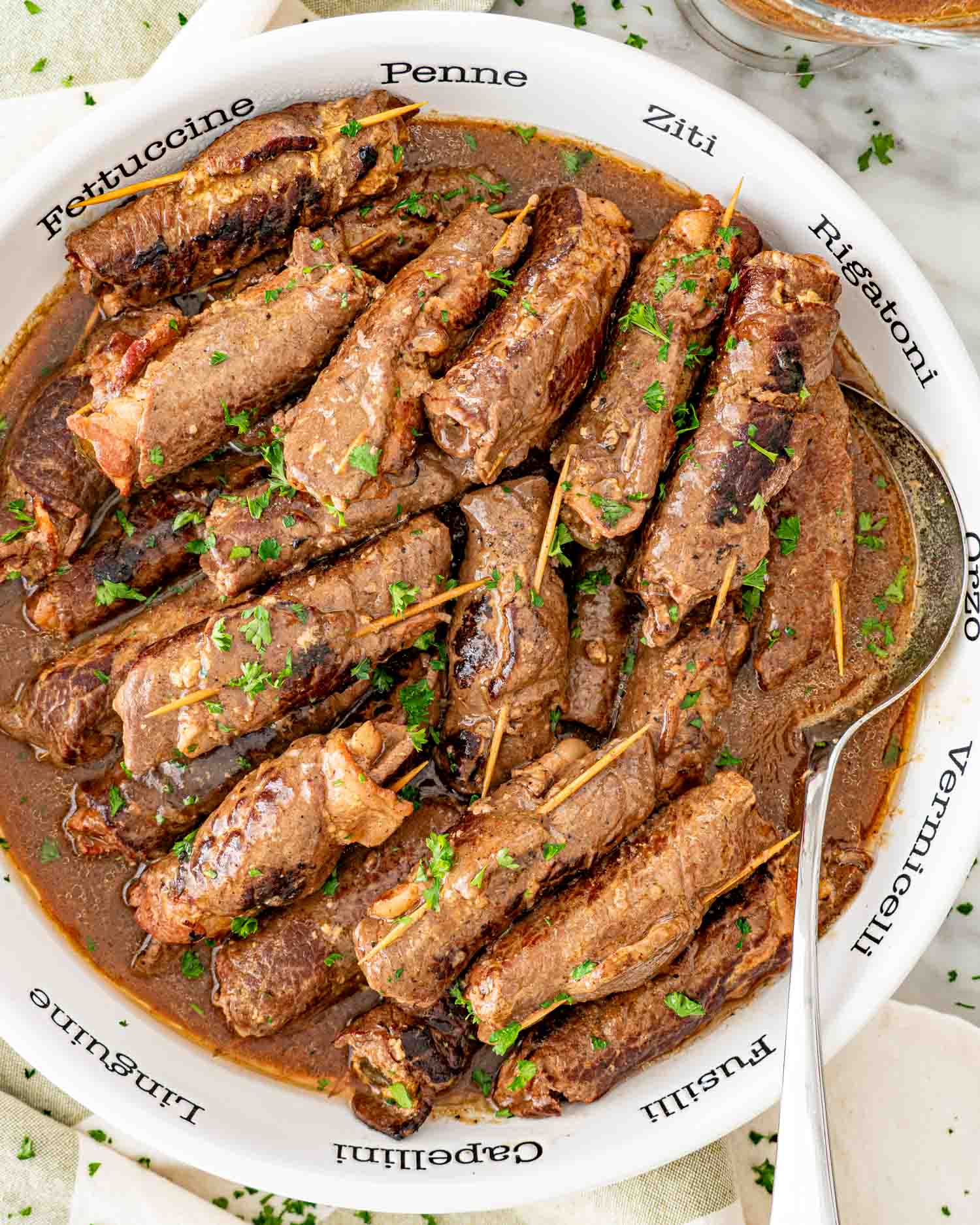
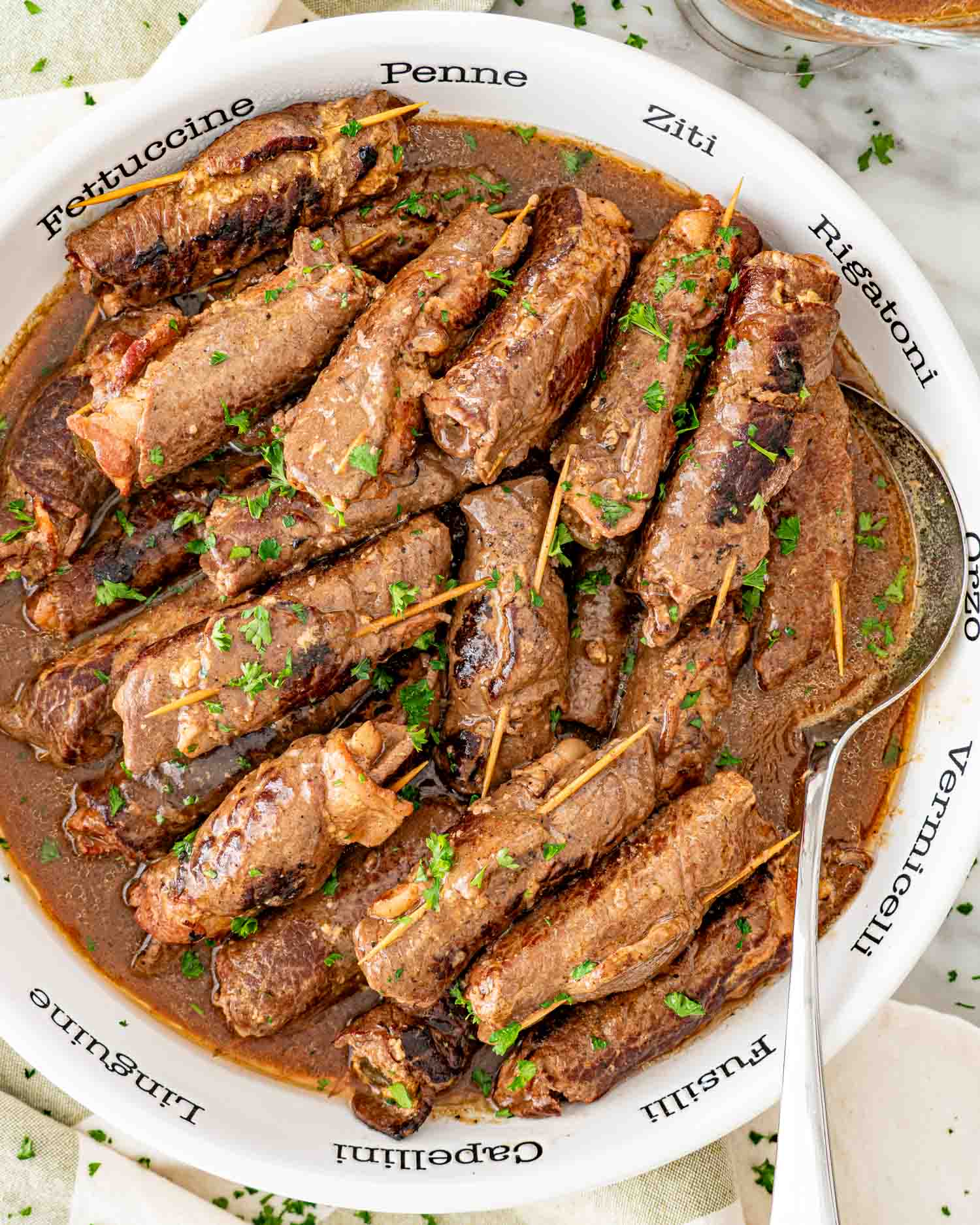
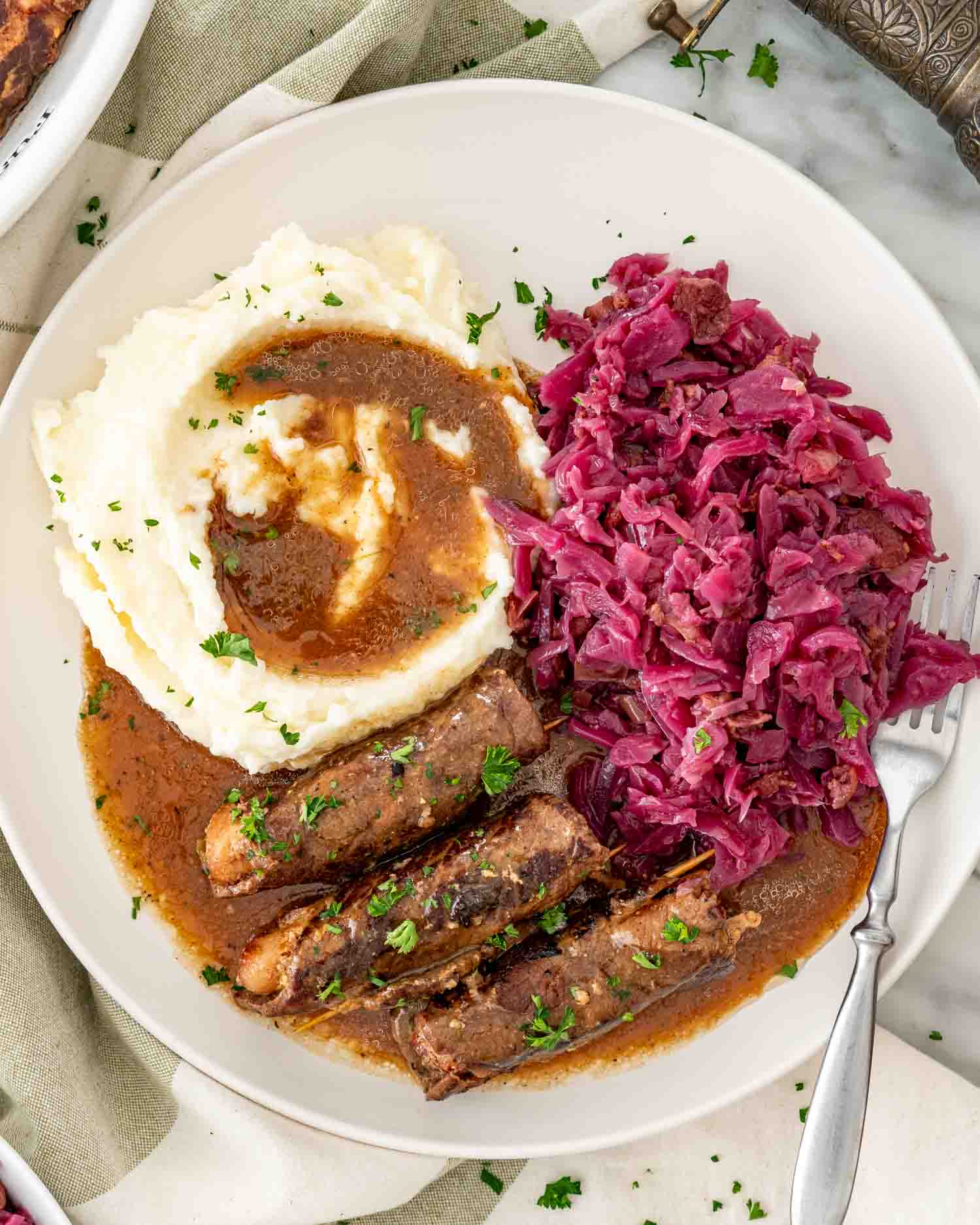
German Beef Rouladen are thin slices of beef spread with hot mustard, layered with bacon, onion, pickle and carrot, rolled up and braised for 3 hours until they surrender completely. The gravy that comes out of that pot would justify the whole afternoon on its own. This is proper Sunday dinner, and it’s been in my rotation since a friend stood in my kitchen and taught me how.
Table of Contents
I learned to make Beef Rouladen from my friend Sharon. She came over one day and we spent the whole afternoon in my kitchen cooking, laughing, and talking considerably too much over the sound of beef browning in the pan.
She taught me rouladen and German red cabbage on the same day, which turns out to be exactly the right pairing, and it’s still one of my favorite kitchen memories. A bunch of women cooking together, the house filling up with the smell of something wonderful. That’s what comfort food actually means to me.
It takes 3 hours, most of which is the oven doing the work while you do something else entirely. And it makes a lot, which is very much the point of a dish like this.
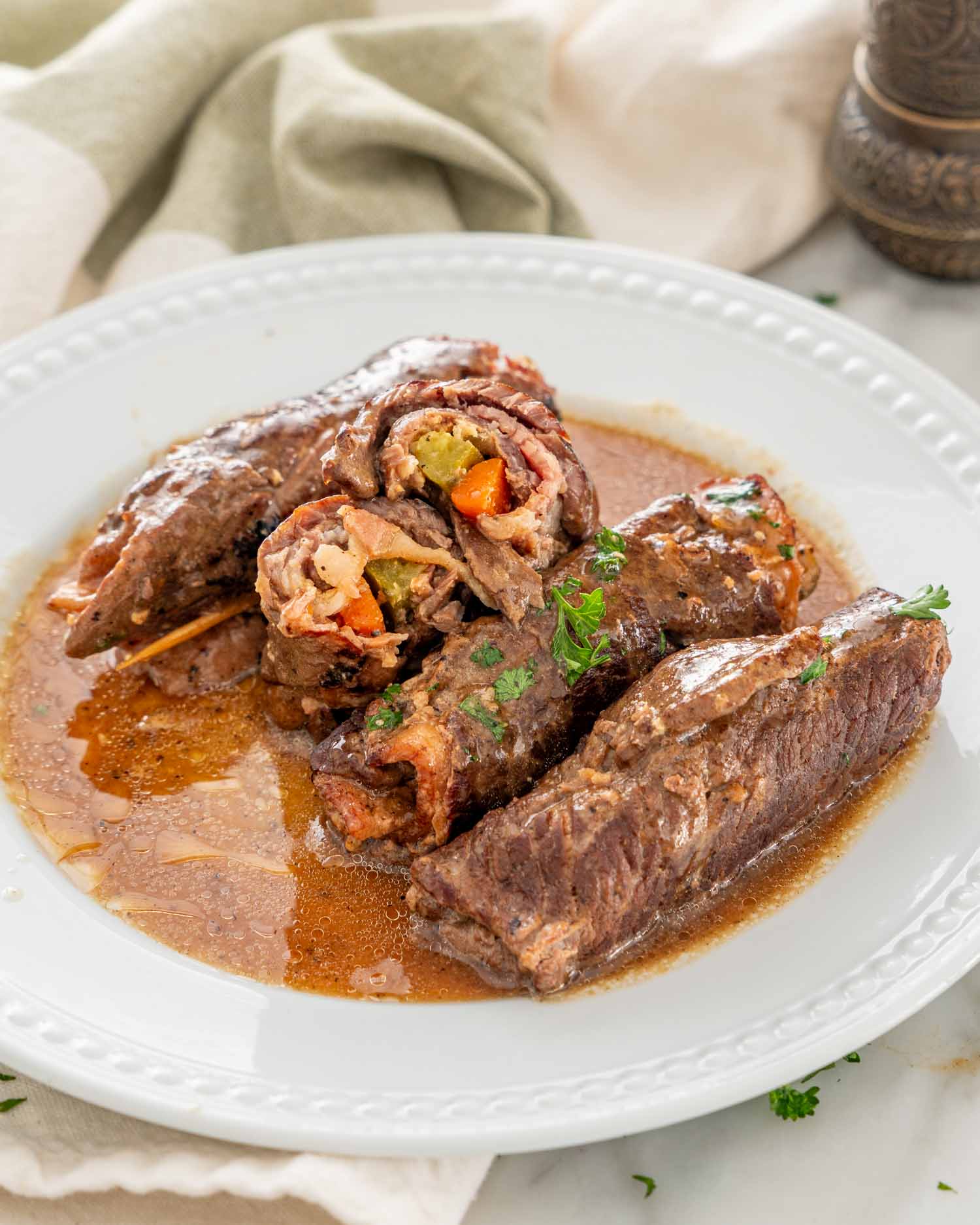
Rouladen are thin slices of beef, spread with mustard, layered with bacon and vegetables, rolled into little bundles and slowly braised until tender. The braising liquid becomes the gravy, which is the part everyone fights over.
In Germany they’re called Rinderrouladen, meaning beef rolls, and you’ll also see the singular Rinderroulade. In English you’ll sometimes see them as beef roulades or simply rolled beef. All the same thing.
They’re a Sunday and holiday dish over there, usually served with red cabbage and either spätzle or potato dumplings. Every family has small variations. Some skip the carrot, some add a bay leaf, and everyone is certain theirs is the correct version.
Here’s the thing that trips people up, and it’s worth getting right before you shop.
In Germany, and at a lot of butcher counters in Canada, you can simply ask for rouladen and they’ll hand you a package of thin beef slices ready to go. In most of the US you cannot, and asking for beef rouladen at the grocery store will get you a polite blank look.
What you actually want is top round, sliced across the grain about ¼ inch thick, in pieces roughly 4 by 6 inches. Bottom round works too, and flank is a fine substitute.
Three ways to get it:
Ask the butcher counter for top round sliced thin for rouladen, or for braciole, which is the Italian version of the same idea and a term more butchers will recognize.
Buy a top round roast and slice it yourself. Freeze it for about 45 minutes first and it slices far more neatly.
Look for packages labeled sandwich steaks or thin sliced beef round, which are often exactly the right thing under a different name.
Whichever route you take, pound the slices a little thinner between 2 sheets of plastic wrap before you fill them. Thinner beef rolls tighter and cooks more evenly.
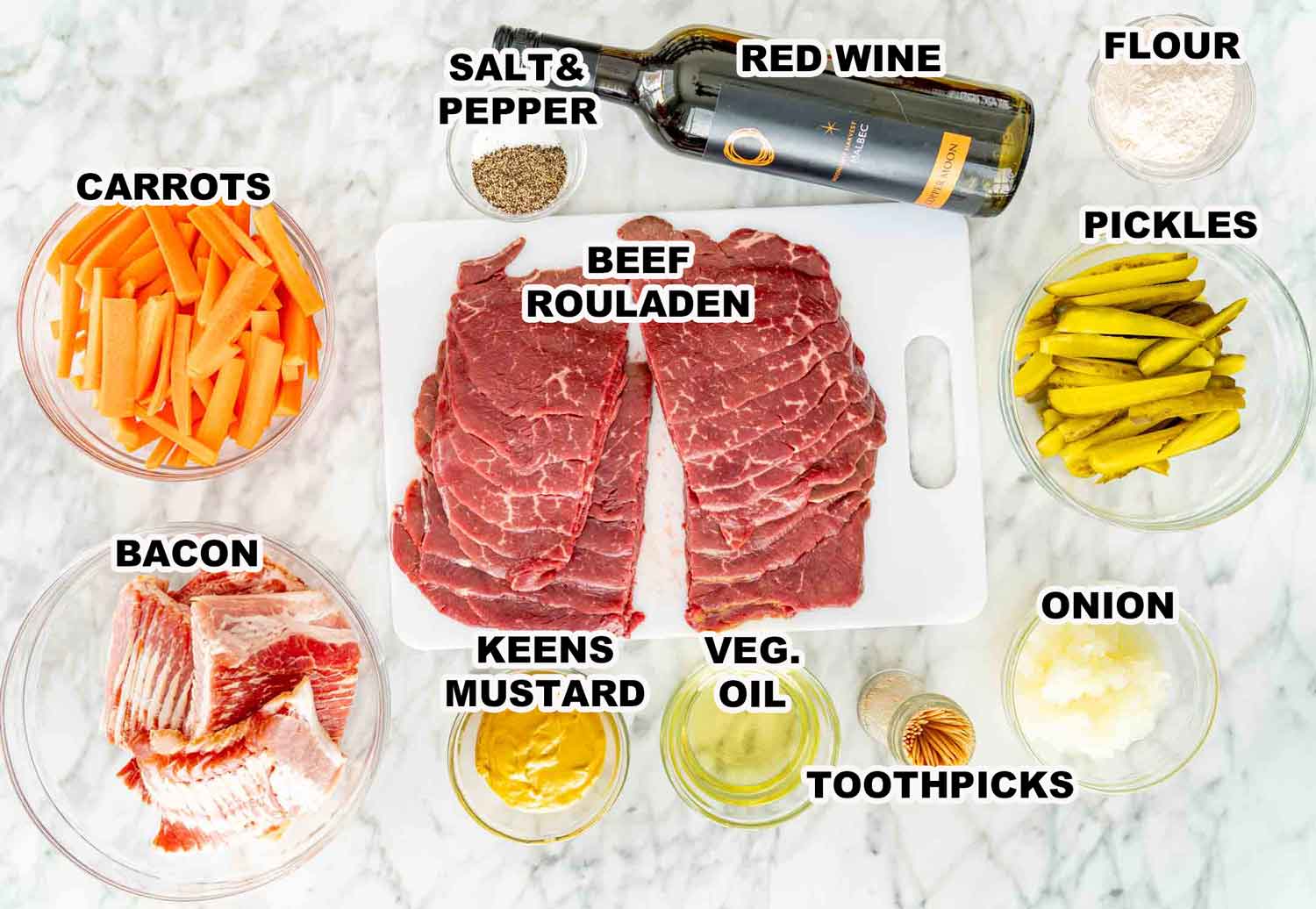
- Beef (3 pounds, sliced thin for rouladen): Top round, about ¼ inch thick. See above for what to ask for if your store doesn’t sell it by that name.
- Hot mustard (3 ounces): I use Keen’s, which is a hot English style mustard. If you can’t find it, Colman’s is the same idea and easy to get, or use a sharp Dijon. You want heat and bite here, not a sweet yellow mustard.
- Onions (2 medium, shredded or finely chopped): Some goes inside the rolls and the rest melts into the gravy.
- Carrots (3 medium, cut into ¼ inch sticks): Sweetness against all that mustard and bacon, and they hold their shape through the braise.
- Pickles (6, cut into ¼ inch sticks): Dill pickles, not sweet. The sharpness is what keeps this from being too rich, and it’s the flavor people can never quite place.
- Bacon (2 pounds, thin cut and halved): Thin cut matters. Thick bacon doesn’t render properly inside a roll and stays chewy.
- Salt (1 teaspoon) and pepper (1 teaspoon): Seasoned as you assemble, inside each roll.
- Vegetable oil (3 tablespoons): For searing. You want something neutral that can take high heat.
- Water (4 cups) and red wine (¾ cup): The braising liquid, which turns into the gravy. Any dry red you’d drink.
- All purpose flour (1 cup): Thickens the gravy into something that coats a dumpling properly.
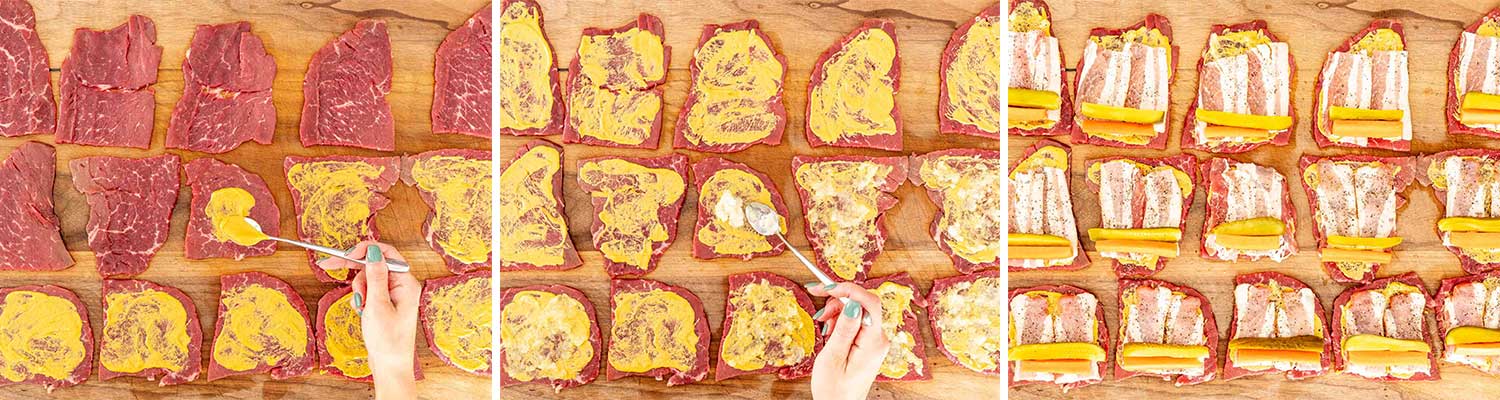
Prep the beef: Trim your slices into pieces roughly 4 by 4 inches. If they’re thicker than about ¼ inch, pound them a little thinner between plastic wrap.
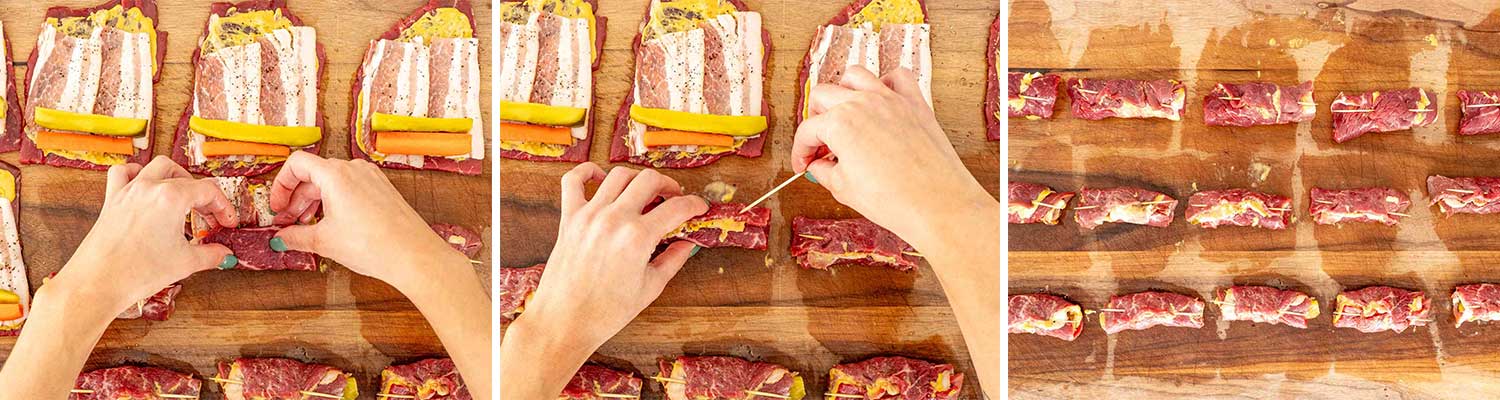
Build the rolls: Lay a slice flat and go along it in order: a swipe of mustard, some shredded onion, half a strip of bacon, a pinch of salt and pepper, a carrot stick and a pickle stick. Roll it up snugly from one short end and pin it with a toothpick. Then do it again, about 30 more times, which is where the afternoon goes.
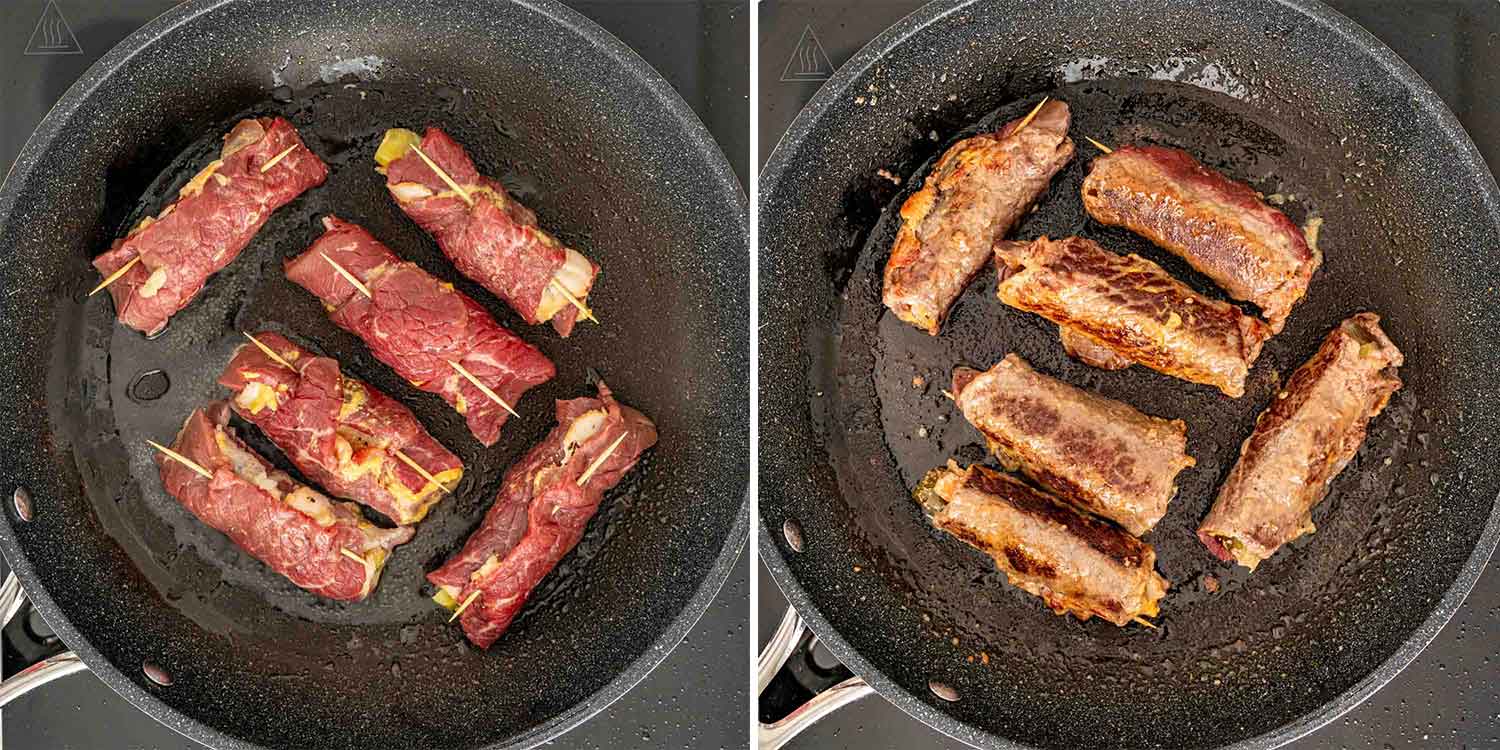
Sear them: Heat the 3 tablespoons oil in a large pan over medium high and sear 6 rouladen at a time, turning until they’re browned all over. Move them to a Dutch oven as they’re done. Don’t crowd the pan, and let it come back up to heat between batches.
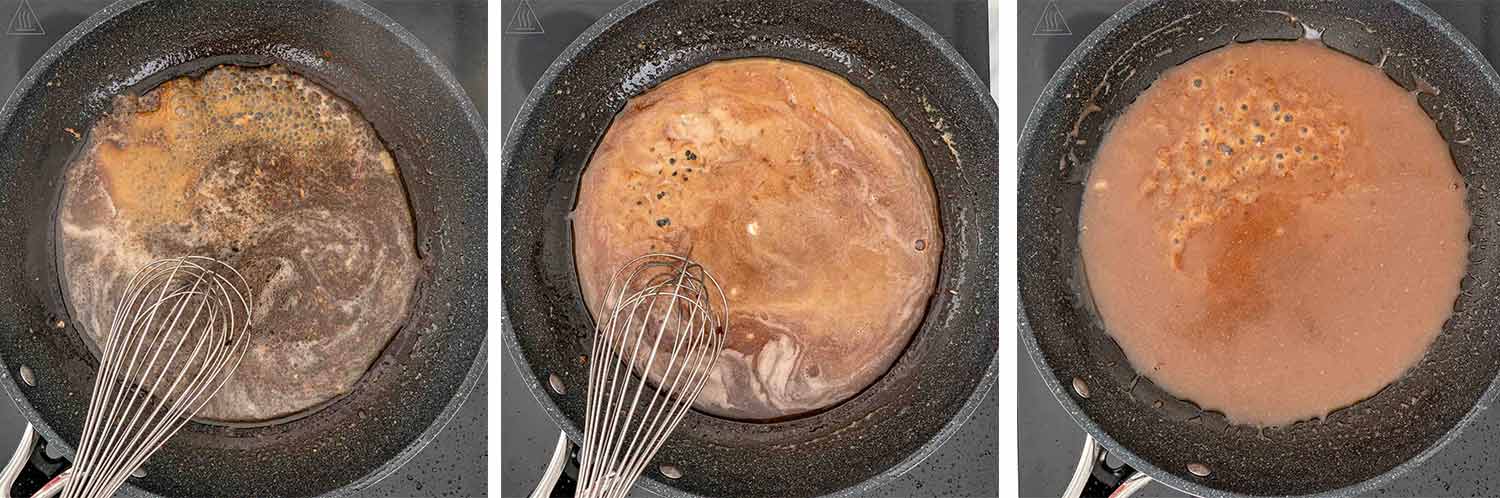
Make the gravy in the same pan: With the browned bits still in there, whisk together flour and water and let it thicken, then add the red wine. Pour it over the rouladen in the Dutch oven. Repeat as you work through the batches, so every bit of fond ends up in the gravy.
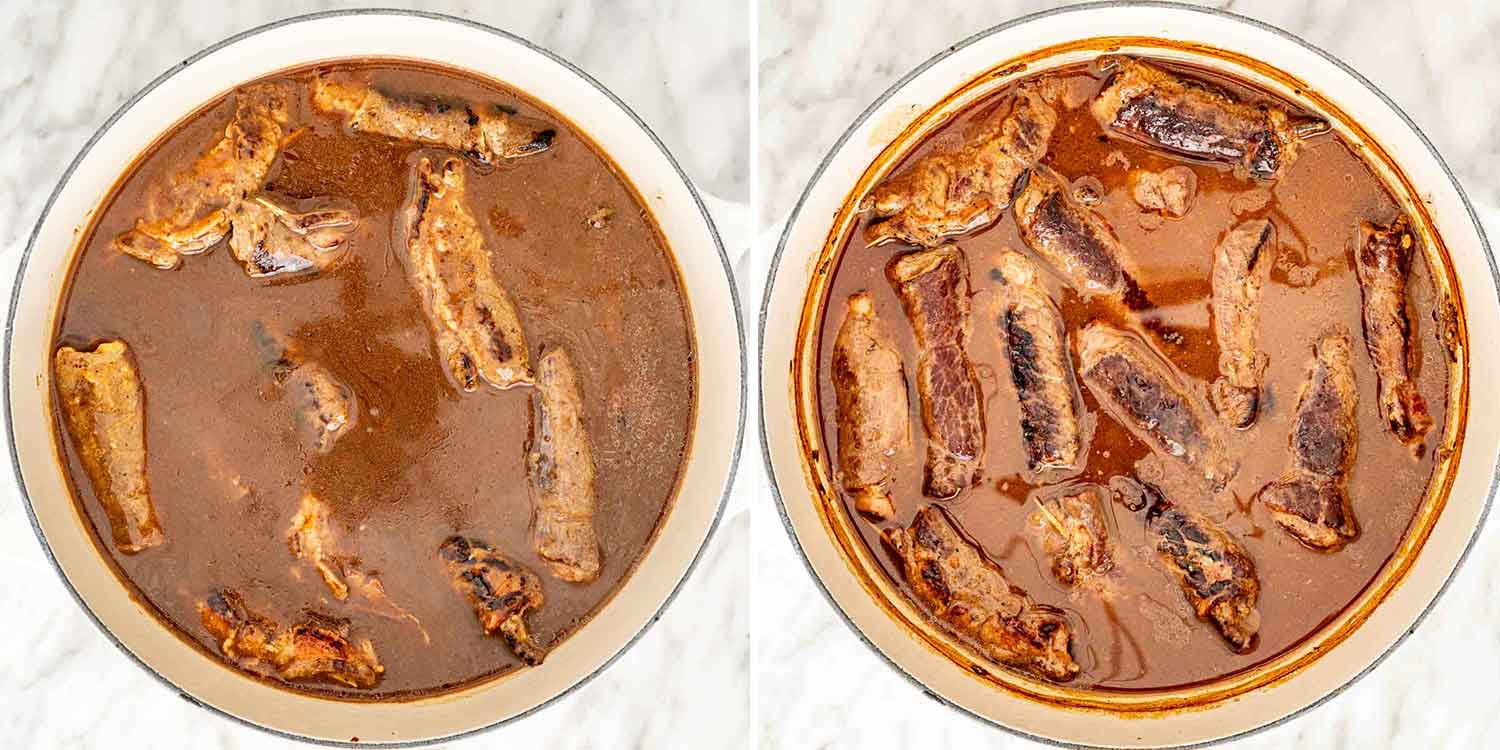
Into the oven: Cover and bake at 350°F for 2½ to 3 hours, until a fork slides into the beef with no resistance at all.
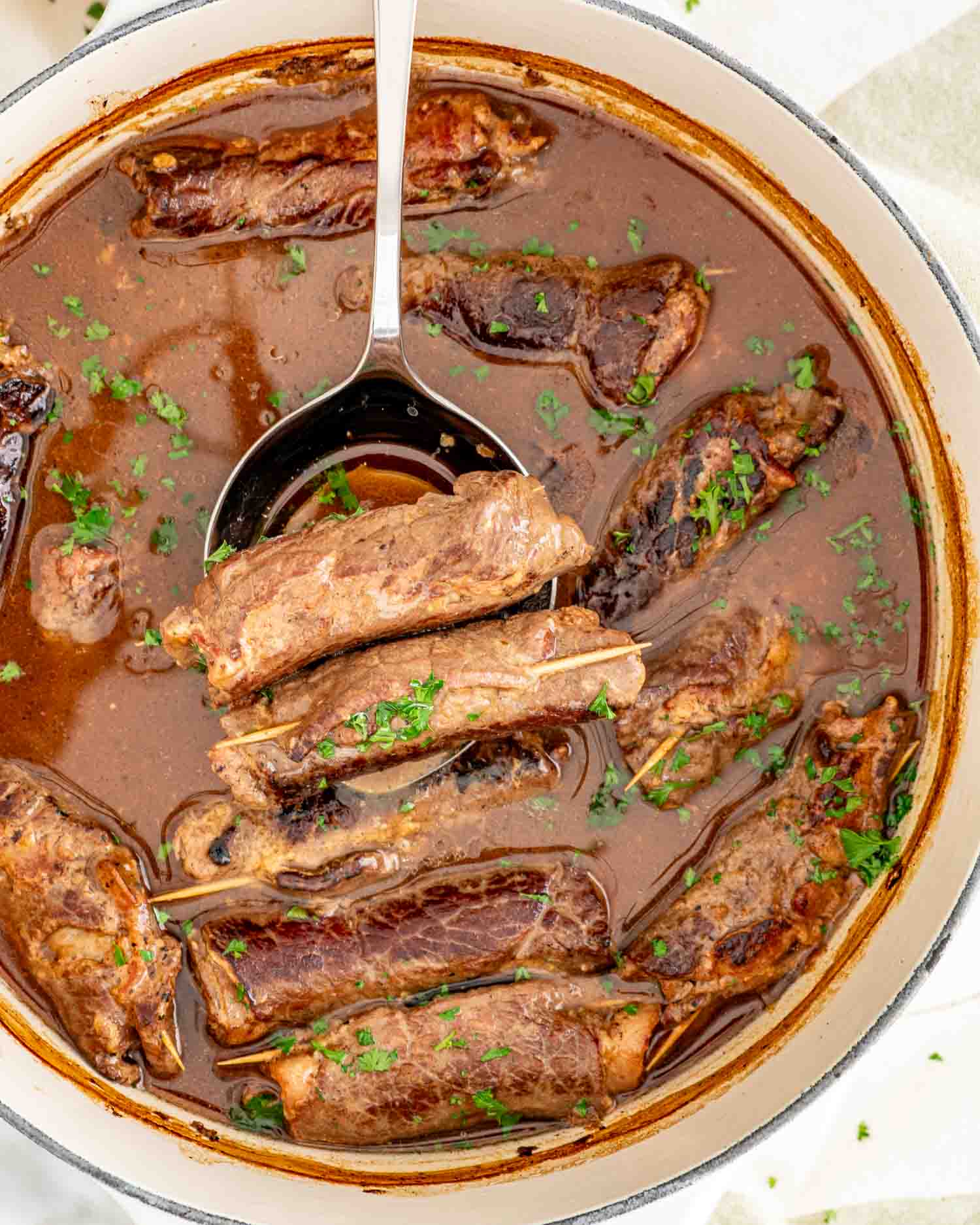
Serve: Pull the toothpicks out before anyone bites down on one. Spoon plenty of gravy over the top.
Sear the rouladen first either way. That browning is where most of the flavor lives and no shortcut replaces it.
Slow cooker: Sear, then transfer everything with the gravy and cook on low for 7 to 8 hours.
Instant Pot: Sear using the sauté function, then pressure cook on high for 35 to 40 minutes with a natural release.
- Freeze the beef for 45 minutes before slicing if you’re cutting it yourself. It makes clean thin slices far easier.
- Roll them snugly. Loose rolls unravel in the pot and you lose the filling into the gravy. Not a disaster, but not what you want.
- Count your toothpicks going in. Then you know how many to get out.
- Sear in batches. Crowding the pan steams the beef instead of browning it, and browning is the whole flavor base.
- Make it a day ahead. Rouladen is genuinely better the next day, once the gravy has had time to settle into the beef.
What To Serve With Rouladen
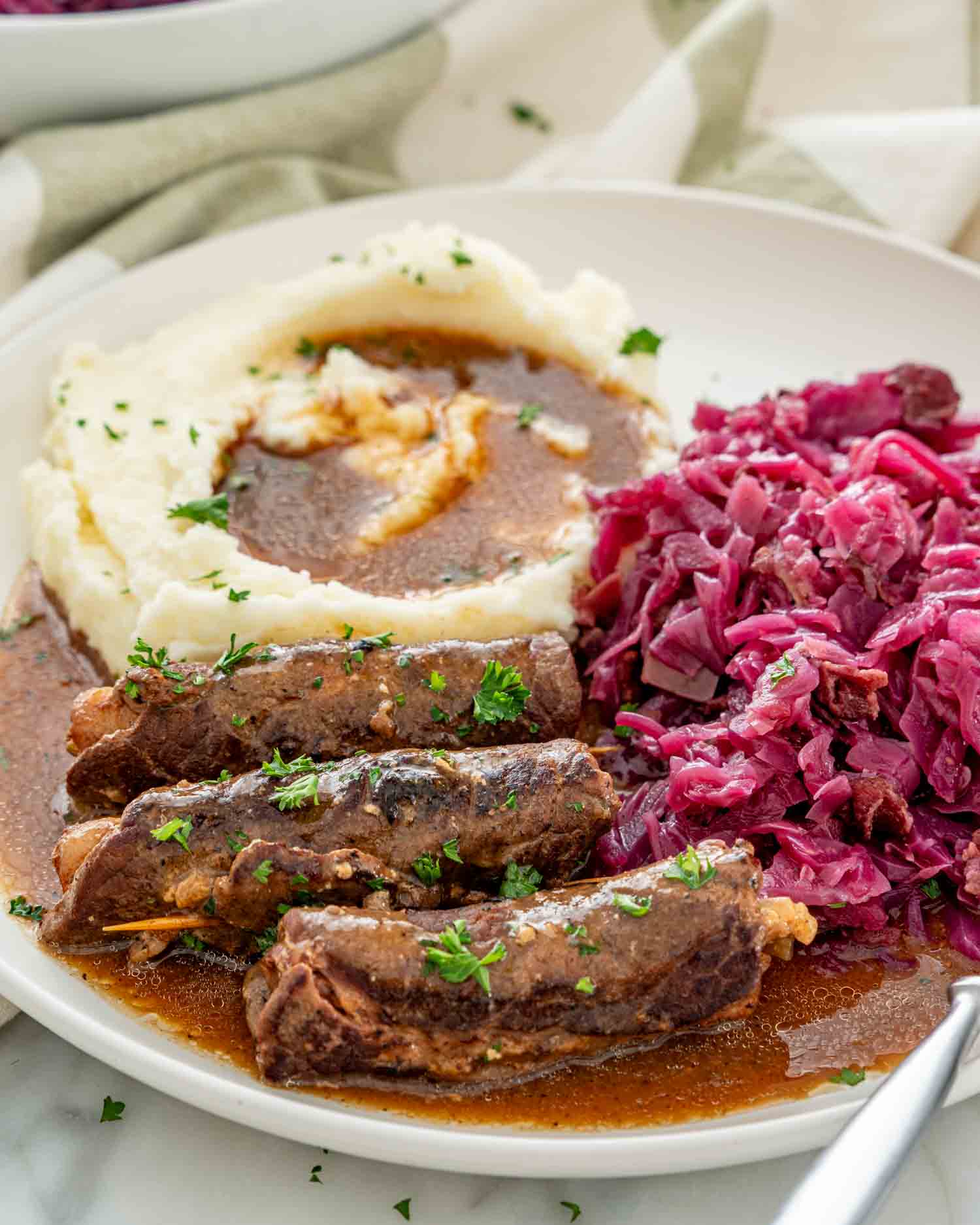
Beef Rouladen is pure cozy comfort food, so it deserves some equally cozy sides. Here’s what I love to serve it with:
Rouladen keeps beautifully. In an airtight container in the fridge it’s good for 4 days and it improves on day 2.
You can assemble the rolls up to a day ahead, keep them covered in the fridge, and sear and braise the next day.
To freeze, cool completely and freeze in the gravy for up to 3 months. Thaw overnight in the fridge and reheat gently in a covered pot on low, adding a splash of broth if the gravy has thickened too far.
Before You Begin! If you make this, please leave a review and rating letting us know how you liked this recipe! This helps our business thrive & continue providing free recipes.
Thin slices of beef spread with hot mustard and rolled around bacon, onion, pickle and carrot, then braised for 3 hours in red wine gravy until completely tender. A German Sunday dinner, taught to me by a friend in my own kitchen. Slow cooker and Instant Pot methods included.
Beef Rouladen
- 3 pounds beef rouladen (top round, sliced ¼ inch thick)
- 3 ounces keens hot mustard
- 2 medium onions (shredded or finely chopped)
- 3 medium carrots (peeled, and cut into ¼ inch sticks)
- 6 pickles (cut into ¼ inch sticks)
- 2 pound bacon (thin cut, cut slices in half)
- 1 teaspoon salt (or to taste)
- 1 teaspoon pepper (or to taste)
- 3 tablespoon vegetable oil
Gravy
- 4 cups water
- ¾ cup red wine (such as Cabarnet Sauvignon or Malbec)
- 1 cup all-purpose flour
Before You Begin! If you make this, please leave a review and rating letting us know how you liked this recipe! This helps our business thrive & continue providing free recipes.
-
Trim the beef into pieces roughly 4 by 4 inches. Pound thinner between plastic wrap if needed.
-
On each slice layer in order: hot mustard, shredded onion, half a strip of bacon, a pinch of salt and pepper, a carrot stick and a pickle stick. Roll up snugly and secure with a toothpick.
-
Heat the 3 tablespoons vegetable oil in a large pan over medium high heat. Sear 6 rouladen at a time until browned on all sides, then transfer to a Dutch oven.
-
In the same pan, whisk the flour into the water and cook until thickened, then stir in the red wine. Pour over the rouladen.
-
Repeat searing and gravy making until all the rouladen are browned and in the Dutch oven.
-
Cover and bake at 350°F for 2½ to 3 hours, until the beef is fork tender.
-
Remove the toothpicks before serving and spoon the gravy over the top.
- If your store doesn’t sell beef labeled for rouladen, ask the butcher for top round sliced thin for rouladen or for braciole. You can also slice a top round roast yourself after freezing it for about 45 minutes.
- Use a hot English style mustard such as Keen’s or Colman’s, or a sharp Dijon. Sweet yellow mustard is too mild here.
- Use thin cut bacon. Thick cut doesn’t render properly inside the roll.
- Use dill pickles, not sweet. The sharpness balances the richness.
- Sear in batches without crowding the pan. This browning is the base of the gravy.
- Slow cooker: sear first, then cook on low 7 to 8 hours.
- Instant Pot: sear on sauté, then pressure cook on high 35 to 40 minutes with a natural release.
- Rouladen is better on day 2. Make it ahead and reheat gently.
- Freezes in its gravy for up to 3 months.
Serving: 3rouladenCalories: 747kcal (37%)Carbohydrates: 16g (5%)Protein: 40g (80%)Fat: 56g (86%)Saturated Fat: 20g (125%)Polyunsaturated Fat: 10gMonounsaturated Fat: 25gTrans Fat: 1gCholesterol: 154mg (51%)Sodium: 1371mg (60%)Potassium: 817mg (23%)Fiber: 2g (8%)Sugar: 3g (3%)Vitamin A: 3188IU (64%)Vitamin C: 4mg (5%)Calcium: 72mg (7%)Iron: 4mg (22%)
Notice: Nutrition is auto-calculated for your convenience. Where relevant, we recommend using your own nutrition calculations.
Frequently Asked Questions
What is rouladen?
What cut of beef do I need?
Can I make rouladen without pickles?
What mustard should I use?
Can I make it ahead?
Why did my rouladen fall apart?