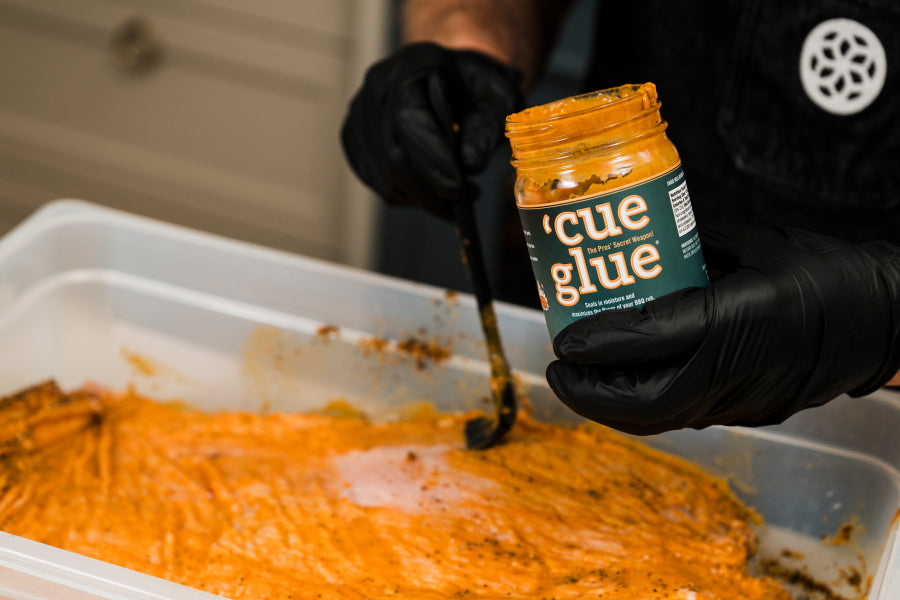
Most BBQ rubs do their job just fine–that is until the smoker dries them out, strips them off, or leaves you with a crust that crumbles instead of seals. ‘Cue Glue solves that.
A mustard-based binder made from yellow mustard, vinegar, paprika, and dill, ‘Cue Glue gives your seasoning something to grip and holds it through hours of low-and-slow heat, forming the bark that makes smoked meat worth the wait. The mustard flavor cooks off completely. What stays behind is better bark, juicier meat, and seasoning that actually makes it to the finish line.
What is a meat binder, and do you actually need one?
A meat binder, also called a “slather,” is a thin, tacky coating applied to raw meat before seasoning. Its job is simple: give the dry rub something to stick to so it stays put through the cook. Without a binder, your dry rub will slide off during handling, blow off in the early stages of the smoke, or sit too loosely on the surface rather than pressing into the meat and forming cohesive bark.
Pitmasters have used various binders for decades. Mustard is the traditional choice. Mayonnaise, hot sauce, and Worcestershire Sauce all get used too. What matters in a binder isn’t really the flavor–it’s the viscosity and the way it helps seasoning adhere and crust up under heat. Most binders cook off without leaving a detectable flavor, which is why mustard works even on people who don’t like mustard.
Do you need one? No. Well-marbled cuts like brisket or pork shoulder are moist enough that a rub will cling reasonably well. But when you use a binder, you get more even bark, better seasoning coverage on lean cuts, and a moisture seal that keeps the surface from drying out before the fat has a chance to render. It’s a small step with a noticeable payoff.
What does a BBQ meat binder actually do?
‘Cue Glue does three things at once.
It locks in seasoning. The mustard base creates a tacky layer that rub presses into rather than sitting on top of. As the exterior heats up, the binder sets around the seasoning and holds it in place, which means more of what you put on the outside stays on the outside through the entire cook. The result is a more consistent bark with better crust coverage than you’d get with dry rub alone.
It builds better bark. Bark–the dark, firm, flavorful crust on the outside of smoked meat–forms through a combination of the “Maillard reaction,” evaporation, and the slow polymerization of seasoning on the surface. A binder accelerates and deepens this process by helping the seasoning fuse into a dense, cohesive crust rather than remaining as loose granules. The bark on a brisket or pork butt applied with a slather will be firmer, darker, and more continuous than without.
It seals in moisture. The thin layer of a meat binder like ‘Cue Glue acts as a protective coating on the surface of the meat, slowing moisture loss during the early stage of the cook, and before the bark has fully set. This helps lean cuts like the brisket flat or pork shoulder cushion stay juicier through long cooks. It also helps seasoning adhere on lean cuts like chicken breast or turkey breast that don’t have the fat marbling of a pork butt to compensate.
Pitmaster ‘Cue Tip: Use 2-3 teaspoons of ‘Cue Glue per pound of meat. That amount is enough to cover the surface without building up excess. You want a thin, even coat, not a thick layer.
Where did ‘Cue Glue come from?
In 2015, our co-founder Mike Johnston set out on a six-week “Chasing BBQ” road trip across seven American BBQ regions: Texas, the Carolinas, Kansas City, Memphis, Kentucky, and the Deep South, visiting more than 85 BBQ joints.
The mission wasn’t just to eat. The goal was to spend real time with working pitmasters and come home with technique knowledge you can’t get from a cookbook: hands-on insights about meat selection, wood choice, fire control, seasoning approaches. He came back with plenty of all of those. One observation, made repeatedly in Texas, led directly to a new product.
Spend six weeks eating your way through seven BBQ regions and you quickly realize there’s no single right way to do any of it. Some pitmasters mop their meat throughout the cook; others think it’s a waste of time. Some cook low-and-slow for 18 hours; others cook hot-and-fast. Some offer sauce at the table; others consider it a personal affront. Some slather; others think it’s nonsense. Barbecue is a set of deeply personal regional traditions that don’t agree on much. However, what kept showing up in Texas consistently across dozens of BBQ joints was the slather.
“When I set out, one of my goals was to get BBQ Tips from each pitmaster I was lucky enough to talk with. I got a wide range—from meat and wood selection to heat and fire control, seasoning techniques, and more. Not surprisingly, those tips caught my attention and one of them even lead to [‘Cue Glue].” – Mike Jonhston, Co-Founder
Before the salt-and-pepper rub went on, Texas pitmasters were brushing their briskets and beef ribs with a mixture of yellow mustard and pickle juice. The ratio ran roughly 50-60% mustard, but the technique was the real point: the slather gave the rub something to grip and helped build the bark. The flavor cooked off completely. What stayed behind was a better crust.
The roots of that tradition go back further than modern BBQ culture. Central Texas–the Hill Country towns of Lockhart, Taylor, and Luling–was settled heavily by German and Czech immigrants in the 19th century, who brought their butcher-shop traditions with them. Mustard was a pantry staple, a natural companion to cured and smoked meats, and it found its way onto the meat before the smoke. That instinct stuck. By the time Central Texas BBQ became one of the most influential regional styles in the country, the mustard slather was already baked into how generations of pitmasters worked.
That observation turned into a product. After plenty of at-home tests and test kitchen trials, we launched ‘Cue Glue: a refined version of the Texas slather, made with yellow mustard, vinegar, salt, paprika, and dill seeds, ready to brush on straight from the jar.
“I love this product for a lot of reasons. First off, it has a kickass name—‘Cue Glue. Then there’s the fact that the stuff actually does what it says it will and glues the seasoning to the meat.”
Mike Johnston, Co-Founder
An accidental endorsement came from the co-packer who bottles it for us: “This stuff is a real son of a gun to clean up. It just sticks to everything.”
That’s the point.
How do you use a meat binder?
The application is a three-step process: salt and pepper base coat, ‘Cue Glue slather, dry rub.
STEP 1: Apply a salt and pepper base coat (optional, but recommended for large cuts). For brisket and big pork shoulders, many pitmasters apply salt and coarse pepper directly to the meat first and let it sit (sometimes overnight) to season the meat at depth before the rub goes on. This is how it’s done in Central Texas. Our Salt & Pepper Tableside Seasoningis perfect for exactly this, along with our newest release Texas Brisket Rub.
STEP 2: Slather with ‘Cue Glue. Use a brush to coat all sides of the meat with a thin, even layer of glue, approximately 2-3 teaspoons per pound. Work it into the surface and make sure there aren’t bare patches. The surface should look lightly glossy, not thick or globby.
STEP 3: Apply the dry rub. Press your seasoning blend generously into the coating on all sides. The binder will hold the rub in place as you handle the meat and through the first hours of the cook. For large cuts, apply a generous amount–more than you think you need. A lot of seasoning becomes the bark; what looks like too much on the raw meat will look perfect after hours in the smoker.
STEP 4: Put the seasoned meat on the smoker immediately, or let it rest in the refrigerator for up to 24 hours. The binder will hold the rub through the rest period, and the extended time in contact actually helps the flavors develop.
What meats should you use a binder on?
‘Cue Glue works on virtually any meat you’re smoking or grilling, but the rub you pair with it matters as much as the binder itself.
Beef Brisket
The brisket is where ‘Cue Glue got its start, and it remains the most natural pairing. Apply before using our Texas Brisket Rub, a Central Texas-inspired blend of salt, coarse pepper, and a few additional savory notes—for the full packer-cut treatment.
Our Smoked Texas Brisket walks through this complete technique, including wrapping in butcher paper at 170°F and the long rest that makes the difference. If you’re working with brisket point and making Burnt Ends, toss the cubed brisket in ‘Cue Glue before the Texas Brisket Rub and smoke the cubes uncovered at 225 to 300°F until bark forms on all sides, about 90 minutes.
Recipe by Mike Johnston, Savory Spice founder
You can make incredible burnt ends in roughly a third of the time it takes to smoke a whole brisket using this method.
 Grilling & BBQ
 Braising & Slow Cooking
Yields
8 to 10 servings
Prep Time
20 minutes
Cook Time
5 hours
Beef Ribs
Beef plate short ribs–the big, three-bone slabs you see at Texas roadhouses–are the original candidate for the mustard-and-pickle-juice slather that inspired this product. Apply ‘Cue Glue, then our Pikes Peak Butcher’s Rub (savory, peppery, salt-free) or Hudson Bay Beef Spice (salty, peppery, built for beef), then a heavy coating of extra coarse black pepper. See the full technique in Big Bad Beef Ribs.
Prime Rib Roasts
For prime rib roasts, our recipe for a Pepper-Crusted Prime Rib Roast uses ‘Cue Glue to help a seasoning paste of Flat Irons Prime Rib Rub, Whiskey Barrel Smoked Black Pepper, and Black Dust Coffee & Spice Barbecue Sauce adhere and form a remarkable crust. It’s proof that this binder works just as well in the oven as it does in the smoker.
Pork Ribs
For St. Louis-cut spare ribs or baby back ribs, slather both sides with ‘Cue Glue before applying the rib rub of your choice. Our Platte Smokehouse Rib Rub is smoky and savory, and Georgia Boys BBQ Rub layers sweet and smoky with a little more complexity. To follow along with our smoking method for ribs, check out the instructions for our Smoked Pork Ribs recipe.
Pork Butt & Pulled Pork
Use ½ cup of ‘Cue Glue for a full pork shoulder and apply before your BBQ rub. Try Kansas City BBQ Rub for a sweet-smoky pulled pork, or Western Carolina BBQ Rub for a more vinegar-leaning style BBQ. Our meat glue is especially valuable here because pork shoulder can develop uneven bark where the fat cap starts to pull away during the long cook. The binder holds things together early when it matters most. Find our full technique using all these products in our recipe for Smoked Pulled Pork.
Chicken and Poultry
‘Cue Glue is the missing ingredient for smoking a whole chicken. The chicken skin is notoriously difficult to season evenly because the fat renders and loosens whatever you put on the surface. Coat the whole bird with this binder before applying a chicken seasoning rub like Sweet Heat BBQ Chicken Rub (smoky, lightly sweet) or Woody Creek BBQ Seasoning (salt-free, herbaceous).
The same logic applies to whole turkey and turkey breast. ‘Cue Glue gives the seasoning something to grab onto and helps hold it through a long smoke. For whole turkey, the Smoked Turkey recipe uses 2 teaspoons per pound applied before your choice of rub; the Smoked Turkey Breast scales the same approach down for a smaller cook.
Does a meat binder work for grilling, not just smoking?
Yes, and this is one of the things that surprises people. ‘Cue Glue isn’t exclusively a product for the weekend pitmaster hunkered down with a 12-hour brisket. For hot-and-fast cooking: spare ribs over direct high heat, chicken thighs on a charcoal grill. It does the same job it does in the smoker, just faster. It keeps the rub locked to the surface through high heat and helps develop a more consistent char without the exterior stripping bare.
Burgers were one of the first things we put ‘Cue Glue to the test on, and they were a quick convert. Press the patties, brush a thin layer on both sides, season generously, and grill.
Even with a short cook time, the binder flavor disappears completely and what you’re left with is a properly encrusted patty. It’s similar the bark you’d build on a brisket, but in 10-12 minutes rather than 10-12 hours.
“Encrusting burgers is now a regular thing at our house, and I highly recommend you give it a try. I like to use a coarse rub because of the crunch it creates.” – Mike Johnston, Co-Founder
Good rub options for encrusted burgers: Hudson Bay Beef Spice (salty, peppery, built for beef), Pikes Peak Butcher’s Rub (savory, peppery, salt-free), Great Plains Bison & Beef Rub (bold and slightly smoky), or West Coast Burger Blend if you want something dialed in specifically for a patty. All four work, but more coarsely ground rubs create the most satisfying bite.
The same principle extends to everything else on the grill. Our recipe for Hot & Fast Spare Ribs uses ‘Cue Glue before applying seasoning, then cooks the ribs directly over the highest heat a charcoal or gas grill can produce. It’s ready in 45 minutes with real bark and real char.
Recipe by Mike Johnston, Savory Spice founder
This is a backyard grilling method where you cook over direct, high heat. While the backyard enthusiast can’t hit…
 All-Purpose Cooking
 Quick & Easy MealsGrilling & BBQ
Yields
4 to 6 servings
Prep Time
10 minutes
Cook Time
45 minutes
For our Beer Can BBQ Chicken recipe, ‘Cue Glue is listed as a core ingredient (¼ cup for a whole bird). It’s what holds the seasoning on the outside of the chicken through 90 minutes of indirect grill heat while the beer steams from the inside. The combination is one of the easiest whole-chicken techniques out there, and the meat binder makes the difference between seasoning that stays on and seasoning that renders off.
And in one of the more unexpected uses: our ‘Cue-bano with Chimichurri Quick Pickles recipe uses ‘Cue Glue mixed with mayonnaise as the mustard layer in a Cuban sandwich. It holds the same tangy punch that yellow mustard provides in a traditional Cubano, but with the depth of a product that was designed with BBQ technique in mind. It’s a reminder that this mustard binder isn’t just for the smoker. Anywhere you’d reach for mustard as a coating or a condiment, this product also fits.