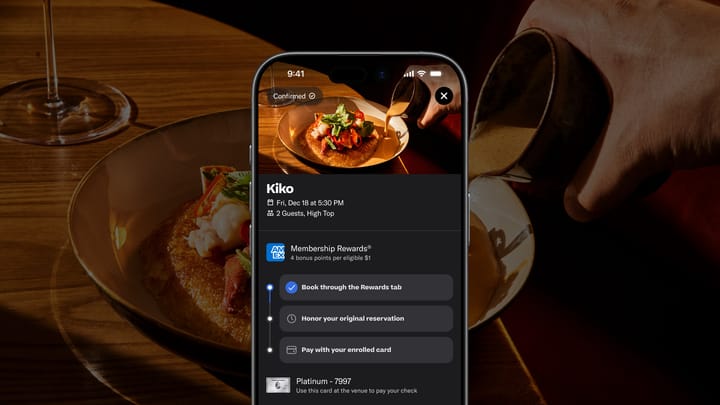
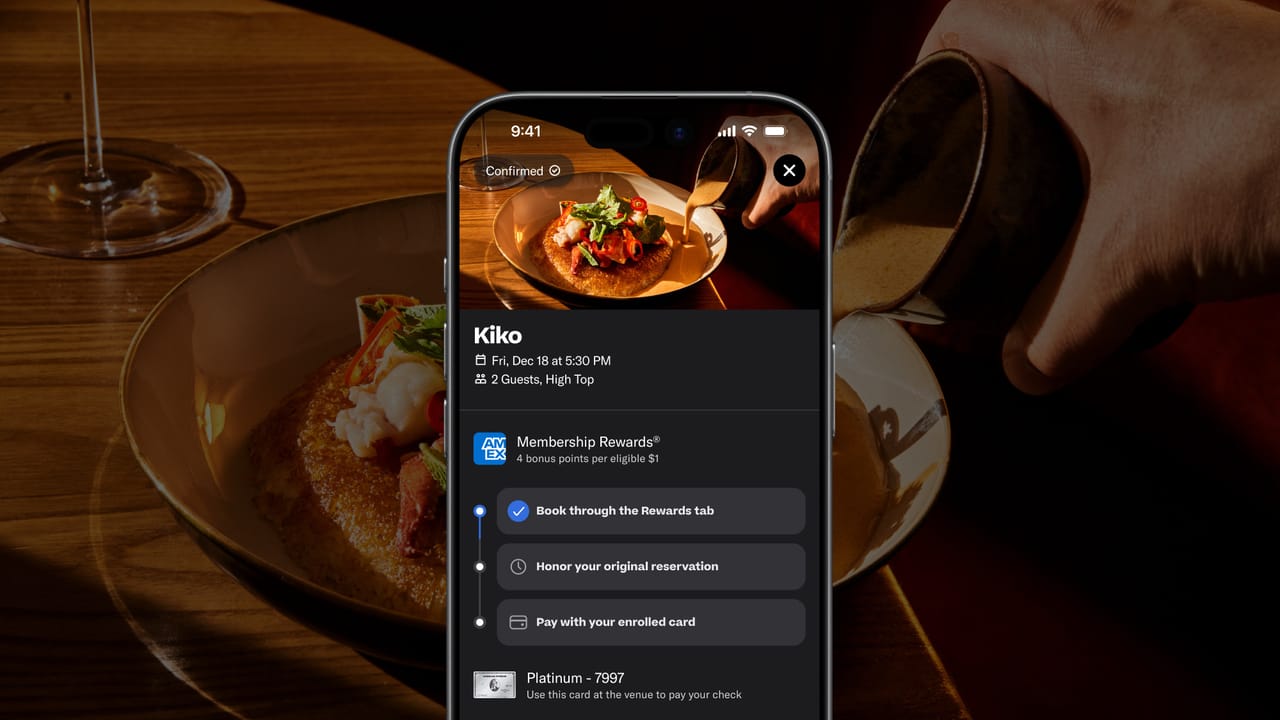
Resy Rewards will give AmEx users more points when they dine out. Image courtesy of Resy
Much like Americans after a Thanksgiving feast, the November edition of Tech Tracker is overstuffed (but far from sleepy).
There were acquisitions, executive changes, fundraises, and, of course, a new AI agent or two.
So before you slip into a food coma, here is the restaurant tech news you may have missed in November.
OpenTable to acquire Australian tech supplier
The reservations giant is buying Me&u, which offers QR code ordering and payments, marketing tools, and AI-enabled reservations for large sit-down restaurants. The price is $450 million.
Me&u will add some new tools to OpenTable’s existing reservation and marketing offering, such as ordering, customer relationship management, and voice AI. OpenTable said it will allow the company to offer restaurants “one connected set of tools” to run their business.
Me&u was founded in 2018 as a QR code-based ordering service and in 2023 merged with Australian rival Mr Yum. It recently launched a reservations system that uses voice AI to answer calls.
Related:Wonder is reportedly exploring a sale of Grubhub
Me&u will operate as a stand-alone division within OpenTable, “with potential brand alignment outside of Australia to be evaluated at a later date,” OpenTable said.
More than 6,000 restaurants currently use Me&u, including some in the U.S.
Resy adds rewards for AmEx members
The reservations service launched Resy Rewards, which will give American Express cardholders extra points when they use certain cards at certain Resy restaurants.
The program is live now in New York City, with more cities to come next year.
Eligible cardholders can enroll their card in Resy Rewards and book through a new Rewards tab in the Resy app. When they pay their bill with the card, they’ll earn 4 points per dollar spent, in addition to their standard American Express Membership Rewards points on purchases.
The value of AmEx rewards points depend on how they’re used, according to American Express.
Resy Rewards is the latest dining perk for AmEx members. They can also get Resy Credit, which offers up to $400 cash back when they visit certain restaurants, and Global Dining Access, which gives AmEx members an inside track to tables and other perks at hot restaurants.
American Express acquired Resy in 2019.
Square expands AI tools with Squaremates
The new AI agents are the “front door” to Square’s dashboard for restaurants. They’re designed to help operators answer questions, keep an eye on the business, and complete tasks such as generating marketing campaigns or updating prices.
Squaremates builds upon Square’s first agent, Managerbot. Squaremates is powered by cloud computing and is built to handle more complex tasks. For instance, it can create a full-fledged email campaign rather than just a block of text to copy and paste.
Related:AI’s invasion and another chain turnaround
SpotOn launches first AI agent
SpotOn Assistant Manager, or SAM, is designed to answer operators’ questions about sales, labor, customer data and other business metrics and recommend ways to boost revenue or cut costs. Soon the agent will be able to surface intel proactively.
Restaurants can chat with SAM within their SpotOn dashboard or mobile app, as well as via text message.
It’s the latest addition to SpotOn Intelligence, the company’s suite of AI tools.

SpotOn Assistant Manager, or SAM. | Photo courtesy of SpotOn
DoorDash launches meal bundles, expands catering
Local restaurants in more than 20 cities can now offer fixed-price, value-focused Meal Boxes on the DoorDash marketplace. Each comes with a full-sized entree for $12, plus $0 delivery fee and lower service fees. DoorDash said the boxes cost an average of 30% less than the average entree. Sides and other add-ons cost extra.
The offer is designed to help restaurants reach new customers, and comes amid a flood of value meals from chain restaurants.
DoorDash also expanded its catering service nationwide. Customers can order meal packages designed for groups of 10 to 150 people or more, from select restaurants, for a $0 delivery fee. A DoorDash driver delivers the food and helps with light setup.
Related:DoorDash pushes back on FTC pricing inquiry: ‘We don’t do surveillance pricing’
DoorDash first rolled out office catering in April. The wider rollout followed news that rival Uber plans to acquire ezCater, the workplace catering marketplace, which would greatly expand its catering business.
Gett exits stealth with ‘First Party Everywhere’ network
The 2-year-old startup aims to offer an alternative to DoorDash and Uber Eats by turning AI assistants, TVs, and social media apps into first-party ordering channels.
It is betting in particular on AI, based on the belief that apps like ChatGPT and Muse will replace delivery apps as the new starting point for restaurant orders. Gett’s technology will help connect those orders to restaurants’ direct channels rather than third parties.
More than 40,000 restaurants have signed up for Gett. Once they join, they’ll be accessible through every touchpoint in the Gett network.
Gett was founded in 2024 by two longtime tech leaders: Paul Stoltz, who founded restaurant delivery app JoyRun and later sold it to Walmart, and Arpen Desai, former CTO and general manager for restaurant tech company Ordermark.
Toast gets a new CFO
President and CFO Elena Gomez announced that she’ll be leaving Toast after more than five and a half years with the company. She helped guide Toast through its 2021 IPO and oversaw a period of rapid growth thereafter. She’ll stay on through the end of the year, and said she’d be taking a break before her next chapter.
Her replacement is Michael Senno, Toast’s SVP of finance, who has been with the company for nearly five years.
Serve gives developers access to its delivery robots
Anyone can now program Serve’s robots using the new AV Delivery Developer Portal.
The portal includes a public API as well as a sandbox environment where developers can test their creation before taking it live.
It essentially means that anyone can dispatch a delivery robot to do their bidding “with a few lines of code,” Serve said. All projects will require Serve’s approval to leave the sandbox.
Bilt launches Neighborhood OS
Bilt, which started as a rewards program for rent and mortgage payments, is expanding its platform with Neighborhood OS, “an AI operating system and commerce network” designed to help local businesses, including restaurants, grow by connecting them to Bilt members.
For example, using Neighborhood OS, a restaurant can identify potential customers in the area, send them a targeted offer, recognize them when they visit, and automatically apply the offer through the POS, Bilt said.
Neighborhood OS is designed to work with restaurants’ existing technology. It currently integrates with Adyen, Verifone, Clover, and Shift4, as well as OpenTable and Grubhub.
Bilt was founded in 2021 and is currently used by one in four apartment buildings in the U.S.
TipHaus lands growth investment
The tip-focused software company won backing from Vista Equity Partners to support its “next chapter of growth.” Terms weren’t disclosed.
Founded in 2018, TipHaus aims to automate much of the behind-the-scenes work of managing tips, from calculating tip-outs to distributing the money and creating reports. Current customers include Delaware North, Topgolf, and Puttshack.
Provi and Instacart partner for bar goods delivery
Restaurants and bars can now order beverage necessities such as garnishes and mixers through the Provi marketplace thanks to a new partnership with Instacart.
The agreement expands Provi’s selection beyond alcohol to other items that bartenders need by tapping into Instacart’s network of grocery stores and delivery workers. It’s limited to non-alcoholic products.
Ziosk hires a new CIO
Steven Klohn, formerly CIO of Dave & Buster’s, will take on the role for the tabletop ordering supplier. Klohn spent nearly 10 years with Dave & Buster’s and Main Event Entertainment, which Dave & Buster’s acquired in 2022. Before that, he was CTO of Chili’s parent Brinker International, where his relationship with Ziosk began.
He’ll bring an operator’s perspective to the company as it works to develop new products for sit-down restaurants, Ziosk said.