The global restaurant industry is growing, largely thanks to Asia

5 Min Read
Jason Gardner
Geopolitical strife and supply-side shocks resulting from war and climate change may be rattling the global foodservice market, but it hasn’t stopped the industry from growing.
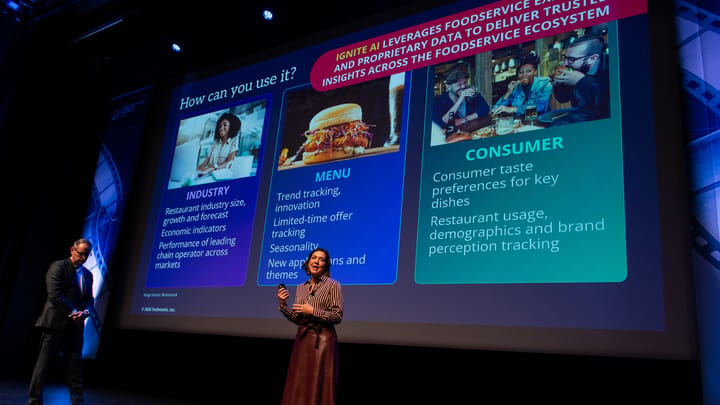
According to Technomic Ignite data, presented last week at the Global Restaurant Leadership Conference (GRLC) in Cannes, France, the global restaurant industry should close 2026 with around 5.2% nominal growth, or 1.9% real growth adjusted for inflation.
But that success isn’t consistent across the globe: While the Asia-Pacific region has experienced 4% real growth, Europe and North America only registered about 1% growth, with Latin America at 0.6% and Africa and the Middle East — which has been affected by war in Iran — declining by 0.8%.
“We talk a lot about the resilience of the industry and how, despite a lot of headlines that we’re seeing right now, this industry is very resilient,” said David Henkes, senior principal and head of strategic partnerships at Technomic, while presenting the data at GRLC. “Consumers have a pent-up demand to go out to eat and they love it. … But some of that previously seen resilience is starting to fade.”
Henkes added that while inflation has decelerated over the past couple of years, it’s still much higher than historic norms. And that continues to drive an affordability crisis.
“All of us are facing food prices that are collectively 25, 30, 35, 40% higher than they were even four, five, six years ago,” he said. “So this has become the central challenge, I think, to the restaurant industry right now: the affordability issue.”
While visits to restaurants had remained relatively consistent since a Covid-related drop, Henkes said the average consumer globally is starting to pull back. Today, 66% of global consumers report visiting a restaurant at least once a week; prior to Covid-19, that was around 74%.
The Asia-Pacific region, however, remains a bright spot. In China, 92% of consumers visit a restaurant at least once a week — the highest rate in the world — while Thailand clocks in at No. 2 with 85% and Singapore at No. 5 with 80% (Saudi Arabia and Mexico land at Nos. 3 and 4).
“The Asia-Pacific region is growing like crazy … [with] 4% growth — and again, this is real [growth], so this does not include any type of price increase or inflation,” Henkes said. “There’s no question that, like for a lot of the global economies, Asia Pacific is really driving restaurants and broader food service.”
That’s also true of the chains and menu categories that are growing fastest around the world.
According to Technomic, the top 150 global restaurant brands grew to a combined 596,561 units in 2025, an 8.8% increase over the prior year, while growing sales by 5.7% to $637.4 billion. China-based chains led the charge with 19.1% sales growth while Japan-based chains grew sales by 10.8%. Brands from the Philippines (8.8%), Thailand (7.4%), and South Korea (7.2%) rounded out the top five.
U.S.-based chains grew sales by 4.6%. Ann Hufford, senior vice president of business development at Technomic, noted during the presentation that U.S. companies are growing much more rapidly in international markets.
Seven of the top 10 chains based outside the U.S. are headquartered in the Asia-Pacific region, while five of those — Luckin Coffee ($7 billion in 2025 sales), Haidilao ($6 billion), Gu Ming ($4.9 billion), Chagee ($4.7 billion), and Mixue Ice Cream & Tea ($3.5 billion) — are based in China.
The Chinese chains in particular are accelerating growth at breathtaking speed. Luckin’s sales grew by 48.9% last year while it opened a net 8,708 units; Gu Ming opened a net 3,640 stores and grew sales by 46.1%; and Mixue topped the list of most net openings with 10,996 added locations in 2025, alongside 33% sales growth.
“Asia-based chains have become the major drivers in global growth, both within Asia and beyond,” Hufford said.
This incredible growth coming from the Asia-Pacific region is making an impact on menu trends globally, as well, especially in beverage; Hufford noted that the top six global chains by net openings were Chinese beverage concepts.
Mixue, Gu Ming, and Chagee in particular are redefining the tea-café category, which, according to Technomic, was the fastest-growing category by sales, jumping 20.9% to $17.7 billion total.
“Last year, we didn’t even capture tea cafes as a cuisine type,” Hufford said. “Brands such as Chagee illustrate the international expansion that is happening in this space. It’s bringing modern tea concepts to new markets.”
Coffee-café was the third-fastest-growing category, growing sales by 7.3% to roughly $100 billion.
Meanwhile, the second-fastest-growing category fits the narrative around where all the restaurant excitement is originating; the Asian/noodle category grew by 9.4%.
“There’s a brand, Marugame, it’s an udon [noodle] concept based out of Japan. They are taking that traditional Japanese noodle experience and then expanding into additional markets,” Hufford said. “They’ve seen significant growth in China, in Indonesia, and also in the U.S.”
Henkes said this surge in the popularity of international flavors is a great opportunity for restaurant operators: Some six out of 10 consumers globally report that they choose restaurants that are bringing new ideas to the table, he said.
“What we’ve seen over the last several years is that global flavor and product trends are no longer confined to certain regions,” Henkes said. “They’re spreading fast and being incorporated into restaurant menus across the world.”
There’s reason for optimism in the year ahead. Henkes said consumers expect to increase restaurant visits in 2027, and the real growth trend should at least slightly accelerate. Technomic forecasts real growth of 1.3% for North America in 2027, plus 0.8% in Latin America, 0.6% in Europe, 2.7% in the Middle East and Africa, and 3.4% in Asia Pacific.
“This still is an industry in growth. Now, it’s a mature industry; we’re not a high-flying tech sector that’s growing 10, 15, 20, 25% a year,” Henkes said. “But conversely, we’re also not declining 15, 20, 25, 30% a year.
“Consumers are still very cautious with their discretionary spending,” he added. “But despite all the headwinds, they are still using restaurants and still using foodservice. So I think we all have to feel very good about the industry we’re in.”