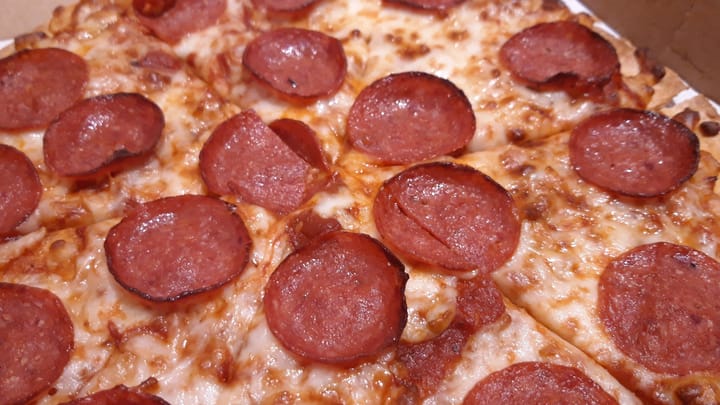
Consumers looking to get the most bang for their buck when dining out may want to check out the Domino’s app.
The pizza chain’s loyalty program, Domino’s Rewards, offers members the cheapest path to earning their first reward among large chain loyalty programs, according to a new report from rewards-focused media outlet The Points Guy.
The Points Guy analyzed 10 of the largest restaurant loyalty programs and found that Domino’s members can get a reward after spending $11.56. That gives them 20 loyalty points, which can be redeemed for a free 20-ounce soda, a cash value of $2.89. That equates to a 25% return on spending.
That was more than 8 points higher than the next best value, MyMcDonald’s Rewards, which offers a return of 16.6%. Members must spend $15 to earn 1,500 points, unlocking free hash browns. (Cash value: $2.49.)
Subway’s Sub Club, meanwhile, offered the lowest spend-based value. Sub Club members have to spend $40 to get a $2 cash back reward, a 5% return.
Chipotle Mexican Grill also came in on the lower end, with a 5.6% return. Members have to spend $35 to get free chips. (Cash value: $1.95.)
The median return rate among dining rewards programs was 9%, according to The Points Guy. That was much higher than retail loyalty programs, where the maximum return was 5%, from Aeropostale, and the median was around 3%.
This is likely because retailers sell higher-priced products and have lower profit margins, making it more difficult for companies to justify freebies, according to The Points Guy.
For restaurant loyalty programs, consumers say it’s free food or bust. In a survey, the vast majority (84%) told The Points Guy that free food is the top benefit of joining a dining rewards program. A clear second was getting dollar-amount price discounts applied to the entire bill, selected by 74%.
And yet free food is not the only thing driving program usage: The most popular programs are not necessarily the ones that give away free food the fastest, The Points Guy found.
Among survey respondents, Starbucks Rewards came out on top, with 35% saying they actively use the program. That was followed by MyMcDonald’s (27%), Dunkin Rewards (10%), Burger King Loyal Perks (9%), and Chick-fil-A One (8%).
Starbucks Rewards offers a return rate of 6%, lower than the median and well below Domino’s.
The Points Guy concluded that there are other things that go into a program’s value besides freebies, such as status benefits like fee waivers or added simplicity.
And in the case of Starbucks, size also matters. With nearly 17,000 U.S. locations, it has about five times as many stores as Chick-fil-A. Coffee also lends itself to frequency, so Starbucks Rewards members may naturally use that app more regularly than others.
Overall, consumers use restaurant rewards programs more often than many other types of loyalty programs. Nearly half (47%) of consumers are enrolled in a restaurant loyalty program, and 22% regularly redeem rewards, according to The Points Guy. That’s more than fuel programs (46% enrollment, 25% redemption), retail (46%/19%), airline (40%/12%), and hotel (39%/10%).
Only grocery and credit card rewards programs see more active usage than restaurants. And it makes sense, as food and gasoline are everyday purchases.
Still, a loyalty program alone is not enough to get a customer to visit a restaurant. Just 50% of dining rewards members said a loyalty program impacted their dining decisions, according to The Points Guy.
Indeed, consumer research from Technomic finds that other factors matter far more to consumers, particularly food taste and food quality. Ninety percent of consumers say those are either important or very important to them when deciding where to eat.
Portion size, accuracy, service, cleanliness, value, and visual appeal also outrank loyalty programs, per Technomic.
So while free food might be nice, good food is even better.