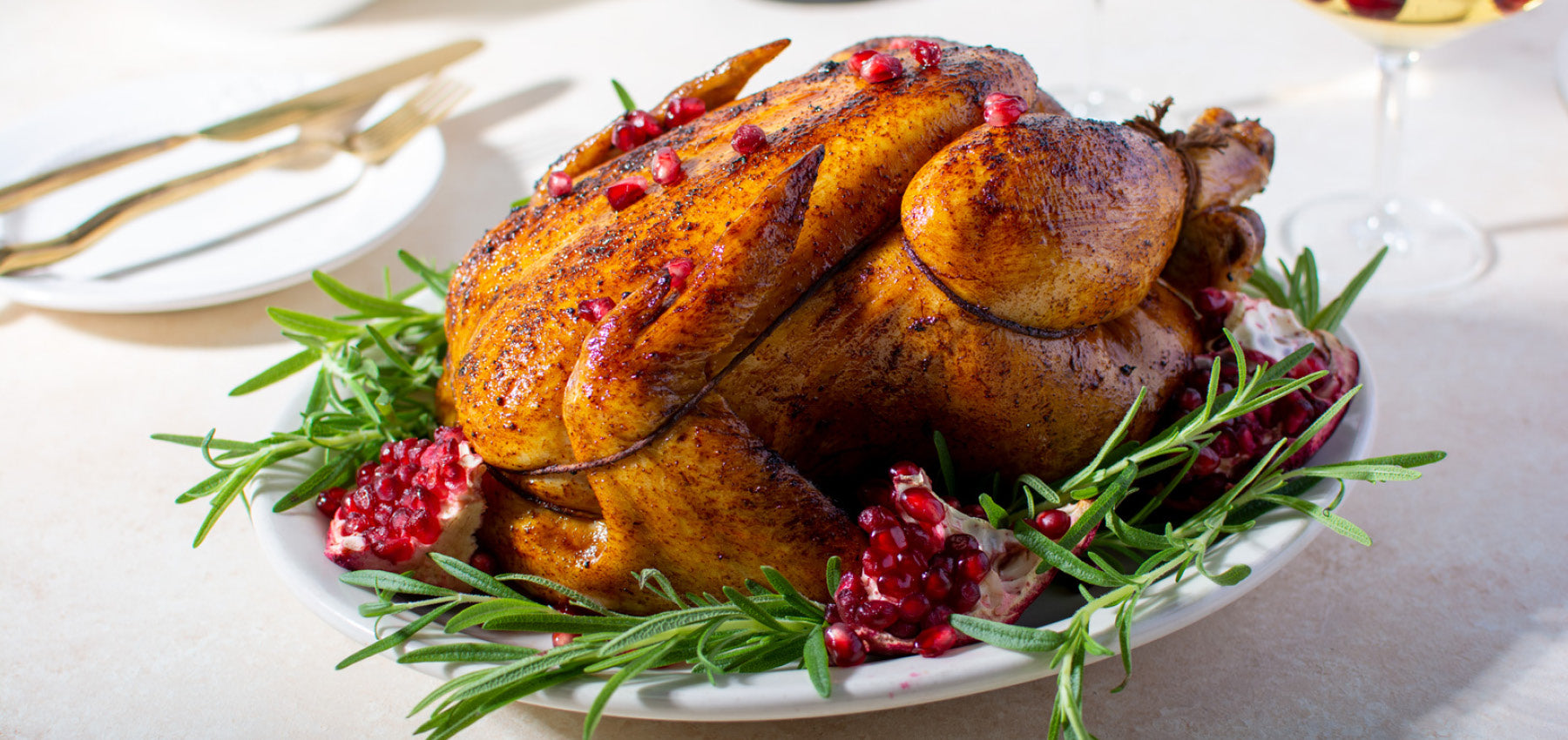
A great roast turkey comes down to a few simple steps: brine it, season it, roast it to the right temperature, and let it rest before carving. This guide covers each one, from planning your timeline to making the gravy, so the turkey comes out juicy and golden.
Your Turkey Timeline
Most turkey trouble starts with timing, so work backward from when you want to eat.
- Thaw: about 24 hours in the refrigerator for every 4 to 5 pounds. A 15 lb. turkey needs 3 to 4 days.
- Brine: about 1 hour per pound for a wet brine, or 2 to 3 days for a dry brine.
- Season and dry: at least 1 hour in the fridge, uncovered, before roasting.
- Roast: roughly 3 to 4 hours for a 12 to 18 lb. turkey. Use the chart below.
- Rest: 20 to 40 minutes before carving.
Step 1: Brine It
Brining is the secret to a turkey that’s juicy from breast to drumstick. Our Brining Spiceis a ready-made mix of salt, sugar, and spices that works as either a wet brine or a dry brine. Plan on about 1 hour per pound for a wet brine, so most people start the night before.
Brining is also worth doing if you plan to smoke or grill your turkey, since it locks in moisture before the turkey ever hits the heat. For step-by-step instructions, ratios, and timing, read our guide to how to brine a turkey.
Step 2: Season It
The brine flavors the inside of the turkey, so the skin needs some attention of its own. Pat the turkey dry, brush it with melted butter, which helps the spices stick and the skin brown, and season it generously.
Roast Turkey Rubbrings classic holiday flavor with paprika, sage, rosemary, and thyme. Poultry Seasoning and Bohemian Forest are both salt-free, which makes them great for a brined turkey that’s already salted on the inside.
Prefer a glaze? Simmer equal parts maple syrup and orange juice with a big pinch of dried herbs, like Summer Savory, Marjoram, Rosemary, Sage, or Thyme, until it’s sticky. Then brush it on during the last hour of roasting. Or for the flavor of a glaze with the ease of a rub, season the turkey with Park Hill Maple & Spice before roasting. It cooks into a sweet, herby glaze on its own.
Step 3: To Stuff or Not to Stuff?
The stuffing debate runs deep, but there are good reasons to bake your stuffing (or dressing, depending on where you’re from) on the side.
- It’s safer. Stuffing inside a raw turkey soaks up its juices, and the center needs to reach 165°F to be safe. By the time it does, the breast meat is often overcooked.
- It makes room for flavor. Fill the cavity with aromatics instead, like sliced apples and onions, citrus peel, and fresh herbs. They flavor the turkey from the inside out. Discard them before carving.
- It tastes better. Baking stuffing on the side gives you more control over the texture, plus plenty of crispy edges.
Still want that stuffed-turkey flavor? Take a tip from Alton Brown and spoon the baked stuffing into the turkey while it rests, so it soaks up the drippings safely. Try our Sage and Savory Stuffing, made with Poultry Seasoning, or Cornbread Stuffing for a Southern spin.
Step 4: Roast It
A good thermometer is the most important tool for roasting a turkey.
Skip the pop-up timer that comes with most store-bought birds. Instead, use a digital probe thermometer that stays in the turkey while it roasts and alerts you at a set temperature. Insert the probe into the thickest part of the breast, set the alarm for 160°F as your cue to start checking, and keep the display on the counter. You’ll get accurate readings without opening the oven door and letting heat escape.
Start hot. Roast the turkey at 450°F for 30 minutes to start browning the skin.
Turn it down. Without opening the oven, lower the heat to 350°F and keep roasting.
Protect the browning spots. If the wing tips, drumsticks, or breast start to get too dark, cover just those spots loosely with foil. Leave the rest uncovered so the skin crisps.
Check the temperature. The turkey is done when the thickest part of the breast reads 165°F and the thighs reach 170°F to 175°F.
Roasting Times for an Unstuffed Turkey at 325°F
| Turkey weight | Approximate roasting time |
|---|---|
| 8 to 12 lbs. | 2¾ to 3 hours |
| 12 to 14 lbs. | 3 to 3¾ hours |
| 14 to 18 lbs. | 3¾ to 4¼ hours |
| 18 to 20 lbs. | 4¼ to 4½ hours |
| 20 to 24 lbs. | 4½ to 5 hours |
These USDA times are for roasting at 325°F the whole way. Our hot-start method usually finishes a little sooner, so go by the thermometer, not the clock.
Step 5: Rest and Carve
Let the turkey rest, loosely tented with foil, for 20-40 minutes. The juices settle back into the meat, and you get your oven back for the sides.
To carve:
- Remove the legs. Cut through the skin between the leg and the body, then pull the leg away and cut through the joint. Separate the drumstick from the thigh.
- Remove the breast. Cut along one side of the breastbone, then follow the rib cage down to lift off the whole breast half. Repeat on the other side.
- Slice and serve. Slice the breast crosswise against the grain, then remove the wings at the joint.
Step 6: Make the Gravy
Don’t skip the gravy. Our French Onion Gravy is a quick, foolproof sidekick to a perfectly roasted turkey. If you’d rather use the pan drippings, taste them first. Drippings from a brined turkey are saltier than usual, so use low-sodium stock and wait until the end to add any salt. For something richer, try our Cheesy Turkey Gravy.
Complete the Feast
A perfect turkey deserves sides to match. You can keep it classic or swap in one or two new flavors this year.
Green Beans and Brussels Sprouts
No holiday table is complete without something green. Green Bean Gratin is a creamy, crunchy take on the classic casserole. For something brighter, try Bucktown Mustard Brussels.
Potatoes and Sweet Potatoes
Mashed potatoes are the side everyone fights over. Ours are fluffy and full of fresh herbs. For a sweet potato dish that isn’t buried in marshmallows, try Maple Whipped Sweet Potatoes or Orange & Maple Whipped Sweet Potatoes.
Cranberry Sauce
Skip the can this year. Homemade cranberry sauce takes about 15 minutes, and warm mulling spices give it a cozy holiday flavor. Make it a few days ahead to free up the stove.
Pumpkin Pie and More
Save room for dessert. Old-Fashioned Pumpkin Pie is the classic for a reason, and our Pumpkin Pie Spice is what makes it. That blend is only available in the fall, but you can add a pinch of ground cloves to Baking Spice for a similar flavor any time of year. Want more than one pie on the table? Try Grandma Menard’s Pumpkin Chiffon Pie, Pumpkin Cheesecake Bars, or Espresso & Cocoa Pecan Pie.
For more sides, desserts, and drinks, browse all of our Thanksgiving recipes.