It was a very important recognition and an incredibly emotional moment for us. Reaching No. 14 in the United States, especially in a city as competitive as New York, confirms that our daily work on quality, dough, and identity is moving in the right direction. It makes us proud, but above all, it motivates us to work even harder. We do not see it as a final destination, but as a new starting point.
We wanted to create a contemporary pizza that was light, aromatic, and enjoyable down to the very last bite. The crust should be high and airy, but not hollow or purely theatrical. For us, it should be slightly crisp on the outside, soft inside, properly baked, and able to express the aromas developed through fermentation and the natural character of the wheat.
Tradition is our starting point. Technique, respect for the dough, ingredient quality, and balance of flavors are essential principles. At the same time, Italian cuisine has always been capable of evolving. We give ourselves freedom when choosing combinations and presentations, but without losing the identity of the pizza. Innovation must have a purpose and, above all, it must taste good.
Italian cuisine has always been capable of evolving. We give ourselves freedom when choosing combinations and presentations, but without losing the identity of the pizza.
The management of time and temperature. Many people focus only on the recipe or hydration percentage, but the same dough can behave very differently depending on the temperature of the flour, water, kitchen environment, and even the season. You have to learn how to observe and feel the dough. It should not have to adapt to our schedule; we must learn to recognize when it is truly ready.
We work with different preferments and maturation periods ranging from 24 to 48 hours, carefully monitoring both time and temperature. We do not rely solely on the clock. We observe the dough’s development, aroma, elasticity, and internal structure. When it is ready, it should feel alive but stable, be easy to stretch, and develop properly in the oven. We are looking for aromatic complexity, lightness, and digestibility.
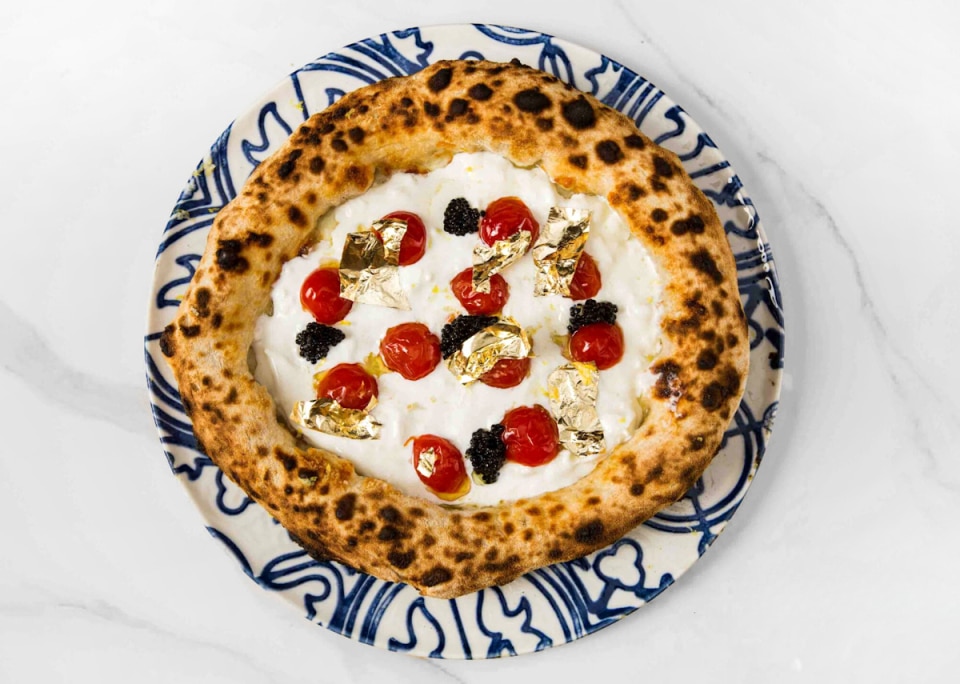
We wanted to create a pizza that fully represented the name Audace: elegant, surprising, and daring. The burrata provides creaminess, the sun-dried cherry tomatoes add sweetness and intensity, the lemon brings freshness, and the caviar introduces salinity and a delicate marine note. The gold completes the presentation, but it is not the protagonist. A luxury ingredient should improve the flavor and serve a clear purpose. If it is used only to impress, it loses its meaning.
Absolutely. There is nowhere to hide with a Margherita. The dough, baking, tomato, mozzarella, basil, and olive oil must all be of the highest quality and perfectly balanced. One small mistake—too much moisture, excessive salt, or just a few extra seconds in the oven—can compromise the result. Simplicity demands great precision.