His path took him from restaurant work in New Orleans to the Culinary Institute of America, then to kitchens in France and Italy, and ultimately to the Bay Area, where formative stops at Stars, Chez Panisse, and Oliveto helped shape his cooking and his approach to ingredients.
But this conversation is about more than accolades. Tusk reflects on taking the financial risk to open Quince, moving the restaurant, creating Cotogna next door, working directly with farms, and turning a farm relationship into an immersive extension of the restaurant experience. He also speaks candidly about San Francisco’s recovery, rising rents, the difficulty of housing hospitality workers, the need to cultivate the next generation of culinary talent, and what recognition such as a James Beard Award really means after decades in the business.

For TFS readers, Tusk’s perspective connects culinary ambition with the operating realities that define today’s restaurant industry at the very highest professional level.
My path wasn’t a straight line from high school into culinary school. I went to Tulane University and spent time working in restaurants in New Orleans, which was a great city to be around food and hospitality. From there, cooking became more serious for me. I eventually went to the Culinary Institute of America, and after that I traveled in Europe and worked in France and Italy. Those experiences exposed me to a level of discipline and tradition that stayed with me.
When I came back to the United States, I settled in the Bay Area. I worked at Stars, then spent several years at Chez Panisse, and after that worked with Paul Bertolli at Oliveto. Each place added something different. You start to understand ingredients, seasonality, technique, the importance of the dining room, and how a restaurant develops its own point of view. Over time, I knew I wanted to create something of my own. The creative part came from all of those experiences, but also from being curious and wanting to keep pushing.

The Bay Area became home. Working at Stars, Chez Panisse, and later Oliveto put me in environments where ingredients and relationships with producers really mattered. At Chez Panisse especially, the connection between the kitchen, the season, and the people growing the food was part of the culture. At Oliveto, working with Paul Bertolli gave me another long stretch of serious cooking and helped deepen my understanding of Italian food.
Those years were also a kind of laboratory. You are learning from chefs, cooks, farmers, purveyors, and the city around you. You begin to see how a restaurant can have a very specific identity rather than just serving dishes. Eventually, my wife Lindsay and I reached the point where we wanted to take that accumulated experience and put it into a place of our own.
It was a very different time. We maxed out credit cards, had a little bit of family money, searched around the Bay Area, and finally found a property that felt like it matched what we could do. The first Quince was small—roughly three dozen seats—and we just went for it. There was a lot of throwing caution to the wind.
What was amazing was that it was busy from day one—almost too busy. We didn’t have the kind of capital structure or development machine that people often associate with opening restaurants now. You could still pull something like that off with a relatively modest build-out and a huge amount of personal risk. Today it is much harder. But at the time, the size of the room, the concept, and what we wanted to cook all came together, and that gave us the confidence to keep moving forward.

We kept looking at what the restaurant could become. When we found the Jackson Square property, I had a feeling of familiarity—almost like I had been there before and it was home. The building gave us room to think differently. It also created the possibility of having two restaurants together, with Quince and Cotogna next to one another, while still allowing each to have its own kitchen and identity.
The move was tough. A restaurant builds habits around a neighborhood and a location, and when you change that, it can take time for people to follow. We had already received Michelin recognition, and after the move we had to build momentum again. Eventually we got that recognition back and kept going. Looking back, the persistence mattered. We believed in the restaurants and continued to work on them rather than assuming past success would carry us.
It means you can’t just protect what worked yesterday. You have to keep asking what can be better, what can be more precise, and what can feel new without losing the identity of the restaurant. That can show up in ingredients, technique, equipment, pastry, bread, service, or the way the kitchens flow.
Even small traditions matter. We have a tradition of making a little omelet for the first customer of the night. One of the cooks makes it, and it has become part of the rhythm of the restaurant. At the same time, we use technology where it makes sense and continue to think about how the physical kitchen supports the food. For me, pushing is not change for the sake of change. It is staying engaged enough that the restaurant never becomes automatic.
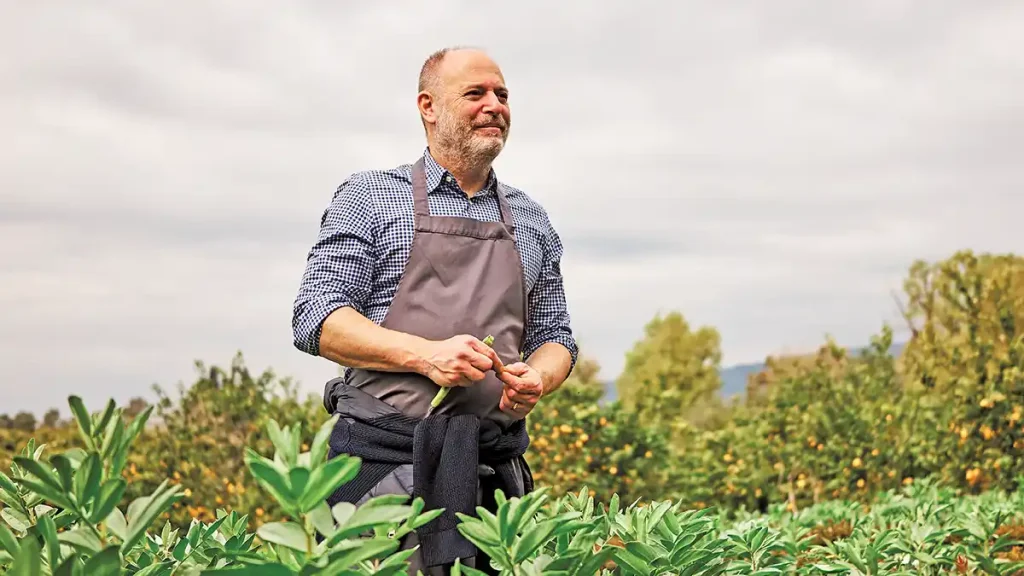
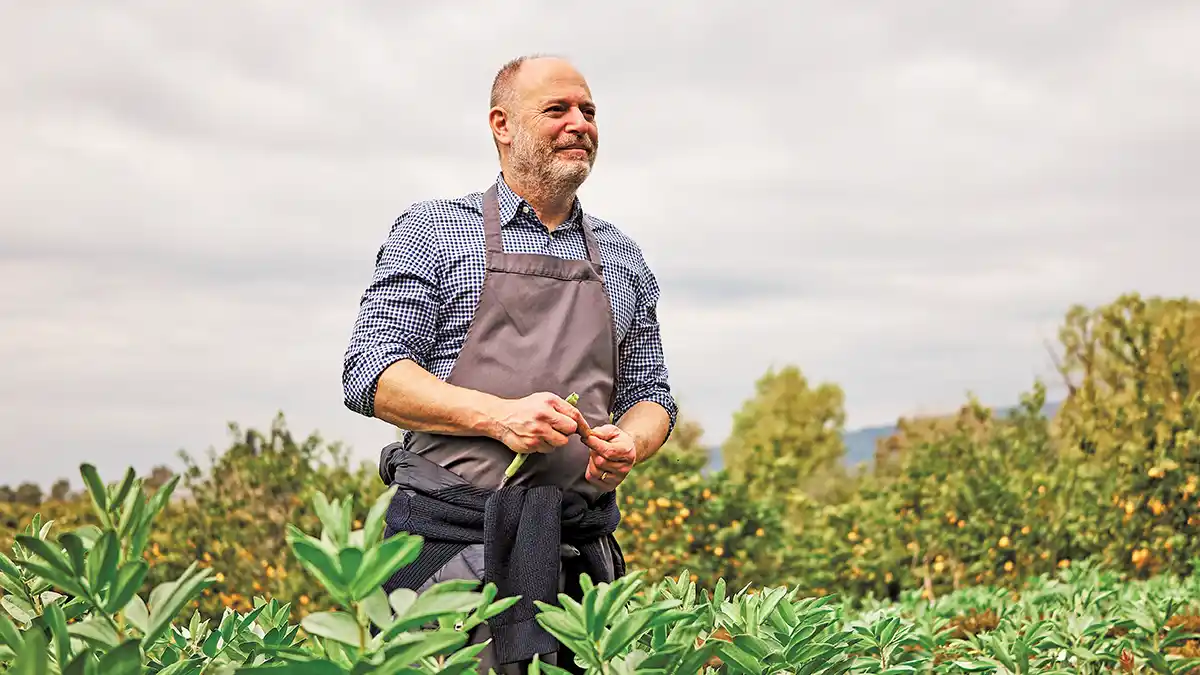
I was always interested in going directly to the source. Farmer’s markets were fun, but if I had a choice between walking to a market near the restaurant or getting in the car, driving out through the forests toward the coast, and ending up near Bolinas, I liked going to the farm. I would bring a film camera because I was interested in photography again, and the whole experience connected the restaurant to a place.
I got to know [first-generation farmer] Peter Martinelli through mutual friends and through a property in Marshall near Hog Island where chefs would gather, cook, eat, and spend time together. He would call when the season started and ask if I wanted to buy things. Over time, the relationship became much more collaborative. Instead of simply asking what was available, we started asking what might be possible to grow specifically for the restaurant.

At first, it was closer to a one-and-a-half or two-season farm. We wanted to see whether it could become more of a four-season project, so we started talking about fall crops and other things that could extend the relationship through the year. Farmers know their land and know what they want to grow, so the conversation had to be respectful, but we also pushed.
Peter had a strong sense of what historically grew in Bolinas. I might ask, ‘Can you try this? Can you plant sunchokes? What about asparagus?’ Sometimes the answer was yes, sometimes he would tell me what was realistic, and occasionally there would be a conflict. There were also water issues that had to be solved. Once the state and the neighboring property helped address that, the possibilities opened up. It became a twelve-month-a-year project, and that was exciting because the farm and the restaurant could evolve together.
We were determined to make it work. We moved out there for a period and did seasons at the farm. Eventually we became pretty sophisticated about how the meals unfolded. Before dinner I might give guests a tour, then take them into an artichoke field with a glass of rosé from Sicily. We could serve three preparations of artichoke right there, next to the fava beans, and build a course around what people were literally standing beside.
Then guests would return to the table and find the next course preset. By fall, we were carrying things out into the field—fish soup in a cauldron, for example—and connecting the food to pumpkins, fields, weather, and the landscape. It was action-packed, but people still ask me about it. The point was never just novelty. We wanted to do it properly. If we were going to create an experience, it had to feel complete and generous. It made people happy, and that made me happy.
Not in the same way. Part of that is simply that when a place becomes connected to events and people are constantly there, it changes your relationship with it. You need some privacy too. The farm was incredibly important and gave us a way to think about food, agriculture, and hospitality together, but over time the role it played in my life changed. That does not mean the connection to farms or local produce disappeared. It means the experience evolved.
There are real challenges, but the picture is more complicated than the negative stories suggest. From where we are in Jackson Square, there is a positive feeling and an uptick. You can see activity coming back and a sense of momentum. The city has gone through a difficult stretch, and restaurants obviously feel everything that happens around them—office patterns, tourism, neighborhood traffic, costs, housing, all of it.
What matters is whether people are willing to invest in making the city better. Lindsay and I feel strongly about staying local and being part of that. We have been here a long time. Rather than looking at every outside opportunity, we are interested in helping make San Francisco a better place to live, work, cook, and dine.

Rent and housing are enormous issues. Rents are going up again, and that makes everything harder. It is not only the rent on the restaurant itself; it is also whether the people who work in restaurants can find a place to live. If you want talented people to come to the city, they have to be able to live here without facing impossible barriers.
The old model of very large restaurants with 90 to 150 seats and huge footprints is difficult in this environment. You have labor costs, occupancy costs, and all the other expenses of operating at a high level. I also think about the pipeline of young cooks. A vibrant culinary school presence on the West Coast would be valuable because the industry needs the next generation. Restaurants cannot only talk about guests; we have to think about where cooks come from, how they are trained, and whether a city gives them a realistic way to build a life.
Awards are meaningful, but they are not exactly what makes you get up and do the work every day. What affected me was being there, seeing people I had not seen in a long time, and seeing what the organization had become. The United States is incredibly diverse, and hearing the stories of people from across the industry was powerful.
I came away impressed by the passion people had for restaurants, for their employees, and for doing the right thing. I went in with one frame of mind and left with a different one. That was probably the most meaningful part. Recognition is nice, especially after years of work, but what stays with you is the community around it and the reminder that the industry is much bigger than any one chef or restaurant.
There have been opportunities over the years, including ideas that would have taken us outside San Francisco. But Lindsay and I know ourselves. If I am going to make something and serve it to people, I usually feel like I need to be there. I have no problem with chefs who build restaurants in many cities—it can work wonderfully for them—but with our personalities, staying local makes more sense.
Being in Jackson Square has also mattered because we are around talented designers and creative people. That neighborhood energy helped us through difficult periods. If things had become much worse, I might have thought about doing something different, but we are persistent.
So ‘next’ does not automatically mean expansion. Right now, it means continuing to make the restaurants better, staying connected to the city, and putting our energy into San Francisco. Opportunities can be attractive, but they have to feel like us. If they do not, there is no reason to do them.
All photos courtesy of Quince & Co unless noted