Has plant-based seafood reached an inflection point after years of mixed results in the broader plant-based category? And what has changed that makes it worth another look?
For insights, I reached out to Ofek Ron, Co-Founder and CEO of Oshi, formerly Plantish. Ron embarked on a mission in 2021 to rethink seafood, ultimately leading to the creation of Oshi and its plant-based salmon.
But what happens when plant-based seafood reaches the restaurant kitchen? Chef Blenlly Mena shared her experience working with Oshi, while previously published comments from Chef Guy Vaknin offer another perspective on what chefs are looking for from the category.
“The biggest lesson was humility about the product bar,” Ron said. Early plant-based products often asked diners to compromise on taste, texture and ingredients in exchange for their values, he noted — an approach that may appeal to early adopters but not necessarily mainstream diners.
“At Oshi, we decided we would never launch a product that has to be graded on a curve: if it doesn’t stand on its own next to conventional seafood, it isn’t ready.”
Ron also pointed to consumers’ increased scrutiny of ingredient labels and said Oshi’s products contain no seed oils and are certified vegan, kosher, non-GMO and gluten-free. Another lesson: avoid overpromising. “We would rather let chefs discover that the product performs than promise a revolution in a press release.”

Ron sees fundamental differences between seafood and other animal proteins.
“Plant-based beef and chicken compete against cheap, abundant and extremely consistent commodities, and that’s a hard fight. Seafood is the opposite,” he said, pointing to limited wild-catch supply, price volatility, inconsistent quality and concerns surrounding mercury and microplastics.
As a result, he believes plant-based seafood can address practical issues for operators, including supply and price stability, while opening seafood-style dishes to some diners who cannot eat conventional fish.
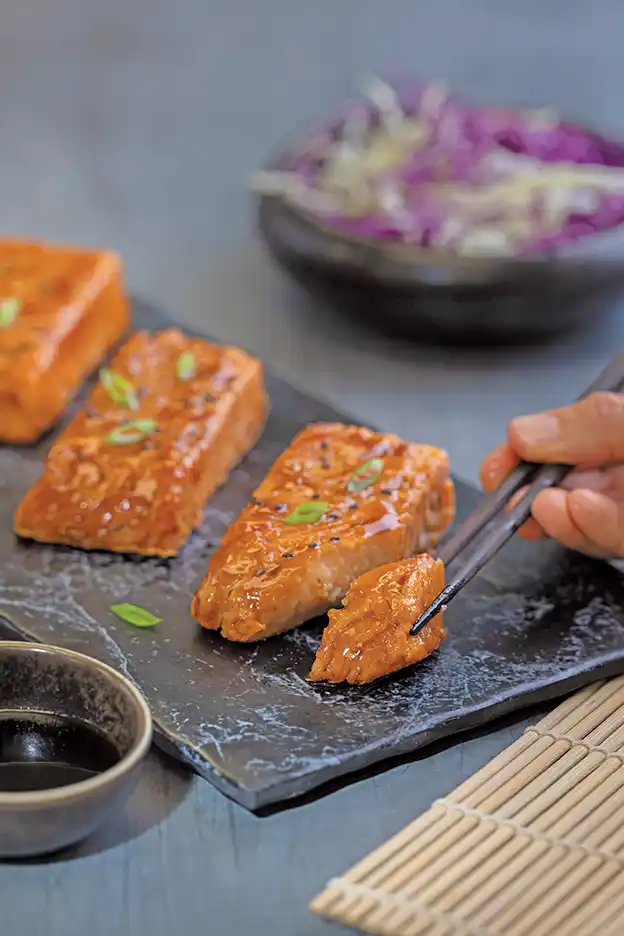
Ron also credits advances in technology. Oshi uses an additive manufacturing process that builds its fillets layer by layer to create the flake and structure associated with fish.
“The strongest applications are the ones where the fish is the hero and texture matters,” Ron said.
Among them are seared salmon fillets as center-of-the-plate entrées, poke bowls, sushi-style preparations and tacos. He said the product takes marinades, sears and holds up on the line, allowing chefs to incorporate it into existing approaches rather than designing dishes around its limitations.
Ron points to several converging trends: increasing seafood demand, constrained wild supply, sustainability commitments and changing diner preferences.
“Most of the people buying Oshi are not vegan; they’re flexitarians who want great food with a better footprint,” he said.
He also sees an opportunity emerging from what he describes as “burger alternative fatigue,” as chefs, diners and the media look beyond the plant-based burger for the category’s next chapter.

Predictability is one of the biggest, according to Ron. Oshi arrives frozen with a long shelf life, while its uniform fillets provide consistent portions. There is also no skin, bones or trim.
“For the operator, that adds up to a stable food cost and a consistent plate, every service,” he said.
Ron said Oshi’s September retail launch with Hy-Vee will bring the brand to shoppers across the Midwest in 120 stores. Currently, Oshi is available in more than 100 restaurants and 100 retail stores.
“Start with one dish you already sell well and make a plant-based version of it,” Ron advised.
Rather than creating a separate vegan section, he recommends presenting the offering as food first, emphasizing the dish, flavors and preparation. Staff education matters as well: servers should have a simple explanation ready for guests who ask about the product.
For Chef Mena and Javier Saba, co-founder of NSV Creative Caribbean Kitchen, plant-based seafood offers another way to reinterpret the flavors and dishes central to Caribbean and Dominican cooking.
NSV’s roots go back to Mena’s time teaching English in South Korea, where she began exploring food more intentionally. After returning to the Bronx, she launched NSV in 2017 as a small meal-prep business inspired by the flavors of home.
“As Dominicans and Caribbeans, food is memory, identity and culture for us,” Mena said.
Today, NSV reimagines dishes such as mofongo, chimi, sancocho, paella and ropa vieja through a plant-based lens. But Mena doesn’t want diners simply saying, “This is good vegan food.”
“We want them to say, ‘This is really good Caribbean food.’”

Because seafood plays an important role in Caribbean cuisine, Mena and Saba had wanted to explore plant-based seafood more deeply. But they weren’t interested in adding a product simply to fill a vegan seafood slot on the menu.
“When we tried Oshi, the texture immediately got our attention,” they said. Instead of thinking only about replacing fish, the question became: “What Caribbean dishes can we create with this?”
One result is Salmon con Coco Mofongo, now offered at both NSV locations. More recently, they introduced Oshi Fried Fish, prepared with NSV’s seasonings and Caribbean approach.
“We’re not interested in simply putting a plant-based fish fillet on a plate,” they explained. “We want to transform the ingredient and create an experience around it.”
Guest response has been encouraging, particularly because plant-based seafood is still unfamiliar to many diners. Mena and Saba said the combination of Oshi’s texture with recognizable Caribbean seasonings and flavors can create a welcome moment of surprise.
What has surprised them most is Oshi’s versatility.
“When you find a product that has a strong foundation in texture and consistency, you can stop thinking about it only as a ‘replacement’ and start treating it as an ingredient.”
Their advice to other chefs is equally straightforward: “Don’t just try to recreate a conventional seafood dish and swap the fish. Make the product yours.”
Chef Vaknin, the visionary founder of City Roots Hospitality — the powerhouse group behind New York’s premier plant-based concepts: Beyond Sushi (2 locations), Anixi, Willow, Sentir, Le Basque, Reverie, and Coletta — has integrated Oshi into the menus at Beyond Sushi, Willow, Sentir, Le Basque, and Coletta.
While introducing an Oshi salmon dish at Coletta, Vaknin described the product simply: “This is the real deal.” The dish paired the salmon with creamy polenta, scorched broccolini, seared lemon and balsamic glaze.
His enthusiasm for Oshi also reflects something Vaknin has emphasized more broadly about plant-based seafood: texture. In a 2023 interview with Scientific American, he explained why getting that element right gives chefs more creative freedom.
“When the texture is enjoyable, you can take the dish in many directions. It’s a great canvas.”
That idea echoes Mena and Saba’s experience with Oshi: Once a plant-based seafood product provides the texture and consistency chefs need, it can become more than a substitute for fish. It becomes another ingredient with which chefs can create.
Vaknin’s relationship with Oshi has since extended beyond the kitchen. Oshi has identified him as one of the industry leaders investing in the company’s commercial scale-up.