Got an unused storage space? A basement alcove? A hidden corner that’s not serving any purpose? Why not open a sushi bar there?
That’s the idea behind Sushi by Bou, which opened its first restaurant in 2017 in a 300-square-foot luggage storage room at the Sanctuary Hotel, a boutique property in Times Square in New York City. It seats nine guests.
Since then the concept has grown to 22 locations, with more restaurants slated in the coming year.
“The goal was always to be an affordable luxury,” said CEO Erika London, who founded Sushi by Bou with business partner Michael Sinensky and chef David Bouhadana (the Bou in the restaurant’s name).
Guests can get in and out in less than an hour at a starting price of $60.
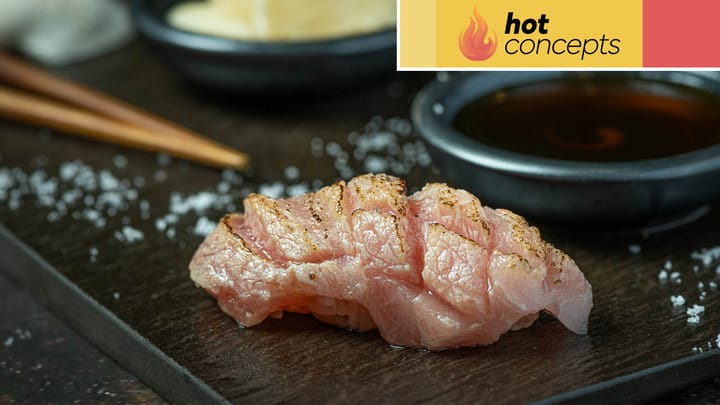
The products are the same as what you’d find at other omakase restaurants, and the meals are prepared by trained sushi chefs — who also have to be personable since they’re working at a high-energy sushi counter — but by operating in tiny spaces that no one else wants, the overhead is low.
Most of the restaurants are in hotels and function as amenities for guests as well as cool, hidden spaces that locals enjoy discovering.
And the venues thrive when they’re kind of quirky and a little hard to find.
“We’ve taken a liquor room, a corner of a hallway that we kind of just built a room into … for our Salt Lake City location you have to walk through a bookcase,” London said. “At our Times Square location you have to walk down the sidewalk and go literally underground into this speakeasy-like room.”
And that’s part of the fun, she said.
“For the hotels, it’s a win-win, because the more undesirable a space it is for them, the more desirable it is for us,” London said. “And the cost is negligible.”
Generally the hotels pay for the build-outs, which London said average $400 per square foot, and most spaces are 500-750 square feet.
They also generally have profit-sharing arrangements with the hotels, although London said it varies by location.
The concept started as a series of pop-ups at restaurants and other venues. “We used to be in Gianni Versace’s bedroom, for example,” London said.
At other times they took over private party rooms or a corner of a bar. And in fact their Albany, N.Y., location is in a corner of The City Beer Hall.
But soon they landed on the hotel model, partnering with Marriott and Hyatt, among others.
Today they operate in Florida, Illinois, New Jersey, New York, Ohio, Puerto Rico, Tennessee, Utah, and Washington, D.C., with openings slated for later this year in Arizona, Georgia, North Carolina, and Virginia, as well as expansion within existing markets.
One Sushi by Bou is at the PGA National Resort in Palm Beach Gardens, Fla., and London expects similar locations going forward.
“We have a couple of golf resorts that we are opening this year as well, but they can’t be named yet,” she said.
Although customers can get in and out in an hour for $60, they don’t have to, and they often don’t.
“We always have a lounge in the space, and guests are encouraged to come before their seating and enjoy some cocktails, or stay after the seating and enjoy more cocktails or some dessert,” London said. “And a lot of our locations have karaoke, so they stay for that.”
They can also upgrade to a 17-course tasting or add premium items such as wagyu beef, bone marrow, caviar bumps, and spiked “Bouzy” ice cream developed in collaboration with Aubi & Ramsa, which specializes in that.
The main menu is consistent across all locations, but chefs get to be creative with the extra five dishes.
“Those are typically seasonal fish flown in from Japan,” London said. “So there’s a lot of variety, and that’s exciting for the regulars as well as for the chefs.”
And there are quite a few regulars. Because it’s comparatively affordable, and fun, London said some guests visit frequently.
“We have people coming in weekly, biweekly, once a month. We have a great number of regulars that we love seeing often at all the locations,” she said.
Many of the chefs are hired at the recommendations of chefs that currently work there.
“They’re getting paid well, the hours are good, and I think the best part is that the chefs behind our counter, because they’re customer-facing, they need to love what they’re doing. Because if they don’t, our experience kind of falls flat,” London said.
“So the beauty is that we keep our team happy and they’re engaging with the customer base, and that makes for a really memorable experience.”
Contact Bret Thorn at [email protected]
Follow him on TikTok and Instagram: @foodwriterdiary