Photos courtesy the author.
This story is part of our ongoing series From the Ground Up, a collaboration between Narratively and ScottsMiracle-Gro exploring the lives, memories, and connections rooted in the yards, fields, and green spaces we call home.
Ati and her daughter Roxana are putting down a picnic blanket in the front yard. It is a beautiful April afternoon, uncharacteristically warm for a spring day in Canada, and we want to soak it up as much as we can.
It’s the early aughts, and Roxana and I met at our college in Washington State a couple of years ago, when I was 19 and she was 21. A few months later, she invited me to spend the weekend with her parents, “just across the border.” I’d agreed immediately; Roxana is my best friend, and she had described Ati and Massoud as loving and kind, and their home as a perfect weekend getaway from the stress of school.
My own mother had abused and disowned me. Ever since I was a little girl, I have always loved being around my friends’ parents and other adults. The sense of security I feel around safe adults heals my childhood wounds little by little. Within a few months, Ati learned about my childhood, and immediately welcomed me, an American, into her Persian family as an adopted daughter.
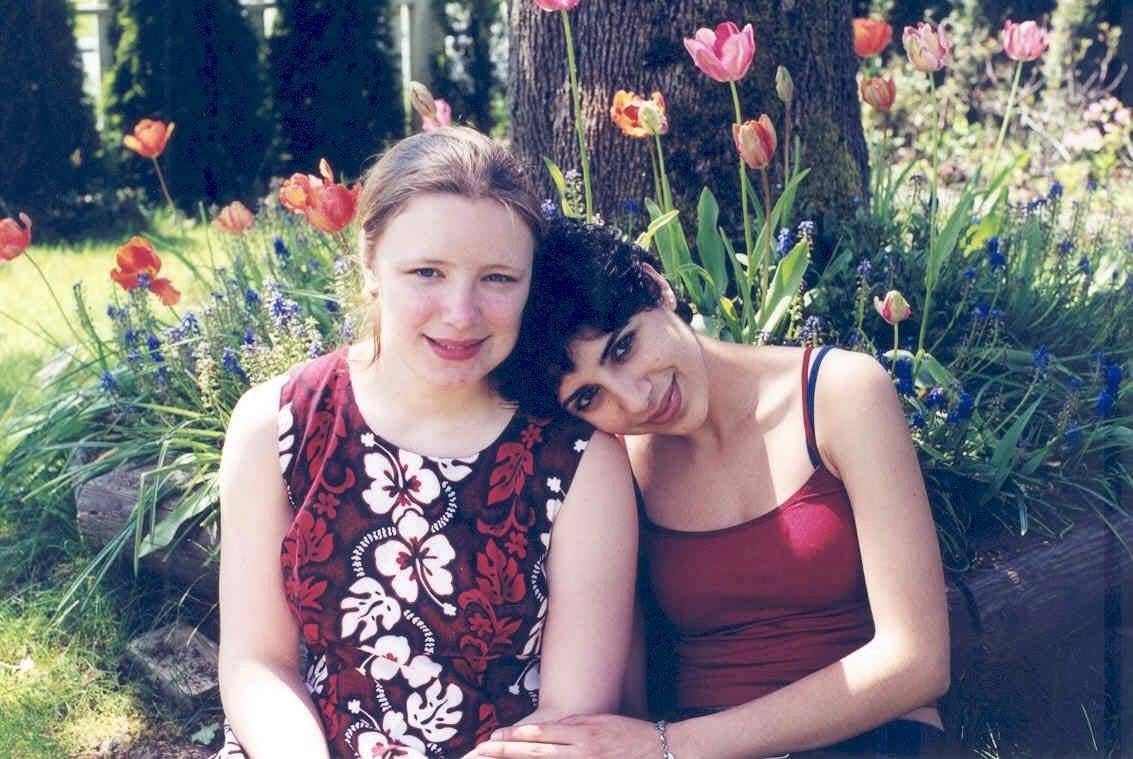
“Katharine, come sit here by the flowers. I want to take some photos of you and Roxana,” Ati says, beckoning me to her beautiful garden. The soft floral fragrance mixes with the fresh scent of cut grass. She has cultivated her garden so carefully, creating a magical scene between the white picket fence and their front porch — a vibrant display of tulips, daffodils and rhododendron bushes. As an artist, everything has been thoughtfully placed and planted by Ati, to create aesthetically alternating hues and textures that span the entire front yard.
Roxana is already sitting on the blanket in front of a string of tulips, their colors weaving together under a sturdy maple tree. We sit here sometimes on sunny afternoons, while Ati gathers up fallen leaves, pinecones and interesting-looking sticks that are on the ground. She makes art out of things that are thrown out or left behind, using elements from nature to represent the idea of renewal — celebrating the cycle of life where everything gets used and nothing is wasted: the soil, tree trunks and bulbs, all the way down to the roots. I think about my past and feeling discarded by my own mother whenever I see Ati collecting bits of the garden for her art.
Even though I don’t like photos of myself, I have gotten used to Ati always having her camera nearby. Whether it’s a celebration, a special event or some random Sunday at home, the moment is inevitably captured on film. It’s as if she’s trying to make up for lost time, the first couple decades of my life before we met. Secretly, I’m touched that she takes so many photos; it makes me feel cherished and loved.
I join Roxana on the blanket, and she puts her head on my shoulder as we smile at the camera. Ati starts snapping pictures, also capturing the beautiful red and yellow tulips behind us.
Soon, we all stretch out on the blanket and chat about the upcoming summer. Roxana and I are both heading overseas, although separately: she will visit her extended family in Iran, and I will go to Spain to immerse myself in the Spanish language before my Spanish finals next year.
“What are you and Massoud going to do?” I ask Ati.
“We will be here. Waiting for you both to return.” Ati’s voice sounds wistful.
“We’ll be back before you know it!” Roxana says.
She never likes to leave her mom for long, and I don’t either. My days in Canada are among the best moments of my life, even when we are just sitting around the house playing gin rummy and drinking tea, or relaxing under this maple tree and feeling the grass under our feet. It tickles, and I’m reminded how much time slows down when I’m in Ati’s garden. The only thing we have to do is enjoy each other’s company, listen to the birds sing, feel the whisper of the grass on our skin. Spending so much time at their place may be a bit atypical in terms of a social life for two young women, but I have never felt more loved than I do in Ati’s home. I try to be here as much as possible; Roxana and I visit her parents almost every weekend.
“I want something to snack on,” Ati says, looking toward the front door of the house. “I’ll be back.”
“I have a couple of magazines in my bag. I’ll be right back, too,” I say.
“I’ll stay out here. I’m trying to get a tan before going to Iran,” Roxana says.
I grab the magazines and head back outside. Ati has reemerged with a bowl of pistachios and a few mandarin oranges. As I sit down on the blanket, I toss the magazines in the middle of our little circle.
“Oh, good!” Ati says, flipping one open and seeing a story about Katharine Hepburn in anticipation of her 96th birthday next month. “I love her.”
Ati’s decade of living in Los Angeles in the 1970s has made her a lifelong fan of Hollywood.
“I love her, too!” I reply. “And I love that she and I have the same first name!”
As Ati and I discuss all things movie-related, Roxana, never having much of an interest in celebrity, starts making a bracelet out of little daisies she plucks from the grass. After a few minutes, she ties it around my wrist.
Even though Roxana and I will be dispersing in a couple of months to the other side of the globe, I’m happy right here and now. Sitting with my best friend, chatting with my adopted mom, the occasional bird or butterfly flitting by.
I’m safe here. Outside in nature, by the beautiful garden, with my chosen family.
The birds continue to chirp and sing, a soft breeze floats over us and rustles the maple leaves, and I close my eyes as I ease into the peace and serenity of Ati’s garden, away from university exams, Vancouver traffic, memories of my childhood. All those things just fall away as I sit on the grass, and a feeling of contentment and healing fills my entire being, just as the fresh air fills my lungs. This setting has become my happy place, in front of the tulips with Roxana and Ati, chatting about the Golden Age of Hollywood and eating pistachios from Iran.