Happy Pride Month, readers! June is a time to celebrate the diversity of our queer community around the world — and to acknowledge and uplift the queer people who have always been here throughout history, even if they kept their identities under the radar. Today, Jake Hall has a fascinating new Hidden History story that does just that. A special thank you to our paid subscribers who help us report and publish untold stories like this one. Happy reading! 🌈
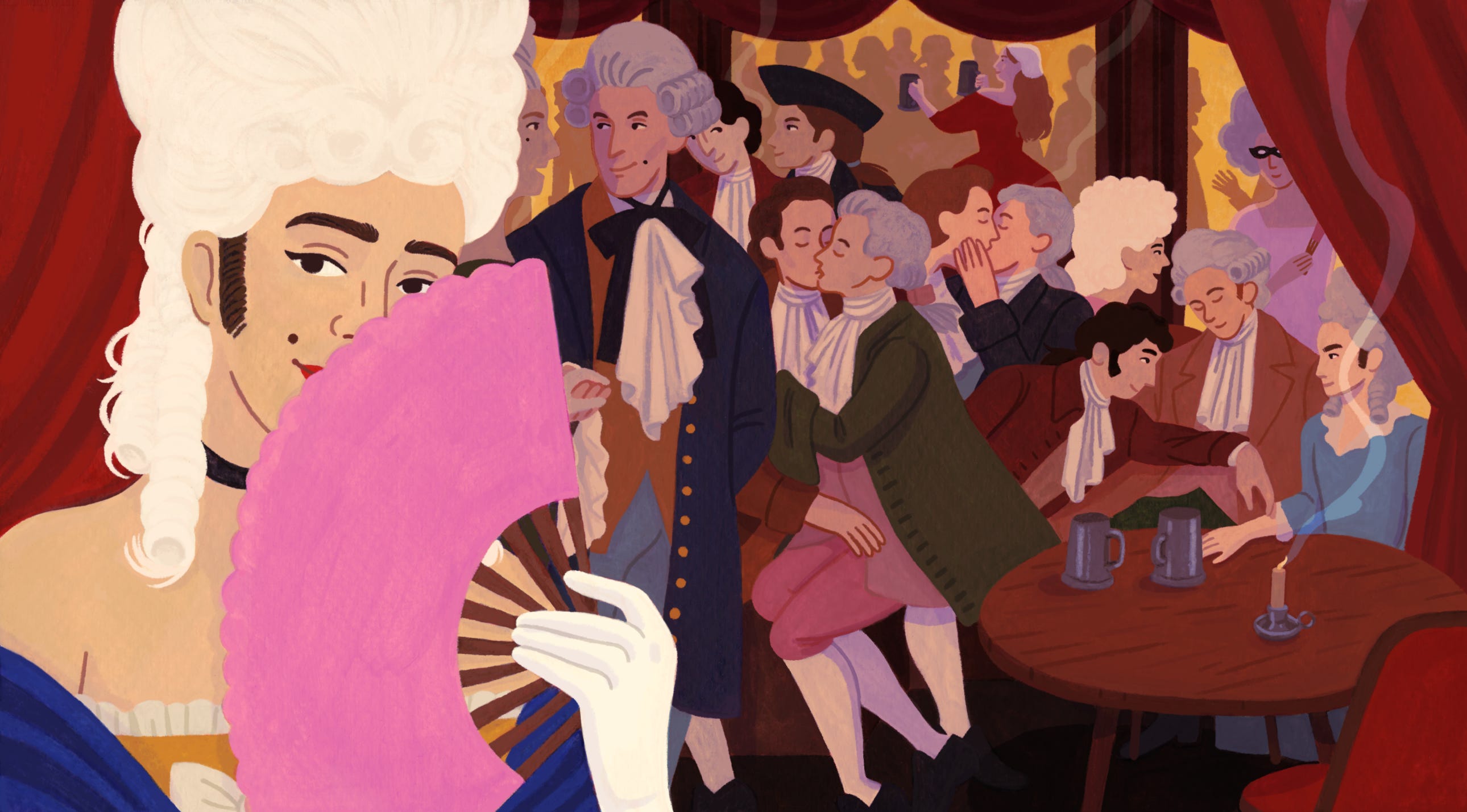
It was late on a frosty Sunday night, and yet the hazy glow of lamplight still illuminated Mother Clap’s molly house, the gleeful squeals of patrons bleeding through the walls. Inside, the atmosphere was so raucous that nobody heard the clattering hooves of police horses on the cobblestones. Constables surrounded the building, blocking off all potential escape routes. Alternating turns, they stormed inside and searched the dozens of bedrooms, rifling for any trace of vice. As evening melted into the early hours of Monday morning, some 40 men were dragged out onto the street. They were hustled out roughly in varied states of undress and dishevelment; some still had their breeches half-unbuttoned, their faces reddened by shame as they were hauled off to Newgate Prison.
This was London, February 1726. The city’s winding, garbage-strewn streets were choked with smog. Mortality rates were on the rise, with declining health attributed partly to the infamous Mother’s Ruin, a cheap gin strong enough to destroy even the hardiest of livers. Around the world, seeds of the British Empire were being planted, yet this wealth hadn’t trickled down here. Poverty was rife. Beneath the gleaming facade of a city in bloom was a hedonistic underbelly — and a thriving queer scene.
The raid on Mother Clap’s remains the most comprehensive proof we have of that queer subculture in 18th-century London, centered in so-called “molly houses.” These were early hubs of nonconformity, clandestine premises in back rooms of taverns, inns and nondescript storefronts, where “mollies” — a slur for effeminate men, later reclaimed by the mollies themselves — could meet. We can find glimmers of this hidden world, mainly in the pages of courtroom trial transcripts, but also in scandalized publications at the time, with titles like The He-Strumpets: A Satyr on the Sodomite Club and Satan’s Harvest Home.
Depending which sources you believe, molly houses were akin to early gay bars, or they were salacious quasi-brothels, where young male sex workers could be picked up by older men. What we know for sure is that booze flowed freely as these outcasts found love, lust and companionship. Mollies cross-dressed gleefully as they sank pints of hot ale and gin, before retreating to private bedrooms where they could, if they wished, sink into the hazy, drunken euphoria of temporary sexual freedom.
Margaret Clap was viewed as somewhat of a guardian angel. “Mother” is an honorific bestowed upon her by the men who sought refuge under her roof. In various court transcripts, she appears to be an elusive and mischievous character, a married woman with an anti-authoritarian streak. Historian Anthony Delaney became fascinated by Clap in the research process of his book Queer Enlightenments: A Hidden History of Lovers, Lawbreakers, and Homemakers.
“We can’t help but fill in those gaps and say she was an ally,” he tells me, “and actually, I think she was.…But what we can see on paper is that she was actually a very savvy businesswoman, especially in this 18th-century context. That gets overlooked.”
Clap ran a business from her own home, which was registered under her husband John’s name. He’s an elusive figure, a silent partner who seemingly watched from the sidelines as his wife rented out their spare bedrooms to hustlers and misfits — Delaney says that many mollies lived there long-term — and sold them cheap booze, which she would scurry out to a nearby tavern to buy. Although Clap turned a profit, her business was not an empire. It was enough to earn a decent living, but she wasn’t in search of riches. Instead, she built a close rapport with her patrons, shouldering the burden of making mollies feel safe in her house, earning their trust and loyalty. She was a near-constant presence, and hard to shock; one undercover police officer said the mollies “talked all manner of gross and vile obscenity in her hearing, and she appeared to be wonderfully pleased with it.”
Clap’s intelligence and social skills were clear, too. Months before the raid, she attested in court to the good character of a molly known by his surname of Derwin, her testimony playing a key role in his acquittal. According to the constable, she spoke with pride of outsmarting the courts, a detail which seems to confirm an accusation made in trial, that Clap “knowingly created a place of rendezvous for sodomites.”
Samuel Stevens, a morality crusader who infiltrated the molly house to secure evidence, testified that “I have seen 20 or 30 [mollies] together, kissing and hugging, and making love (as they called it) in a very indecent manner,” his statement thick with contempt. “Then they used to go out by couples into another room, and when they came back, they would tell what they had been doing, which, in their dialect, they called ‘marrying.’”
Stevens’ clear implication is that “marrying” meant “sodomy.” At least in some cases, this was probably true. Mollies spent long, drunken nights in each other’s company, dancing and laughing into the early hours of the morning before retiring into private boudoirs. Clap’s house even boasted a grand room — known as “the Chapel” — with a double bed, manned by a doorman to ensure maximum privacy.
But there’s a more nuanced reading to be parsed from historical context. Queer historical lives show up predominantly in courtroom transcripts that reduce multifaceted people to their suspected sex lives, and not much else. Usually, we see only scant evidence of their intimate friendships, their personalities and routines. Delaney believes the molly houses were a space of community first and foremost, and he reads the mollies’ use of the term “marrying” more holistically.
“I think ‘marrying’ can mean sex, and that it does at times,” he says. He posits that there’s a more sentimental reading, too. “The fact that these mollies say they’re ‘marrying’ is interesting because it goes beyond the sex act. It says something about bonds, and it says something about love.”
In 18th-century London, sodomy was a crime punishable by death. Joyous nights spent in molly houses were tainted by the shadow of a repressive society. Mother Clap’s was far from the only molly house; it just happened to hold the dubious honor as the place where the era’s best-documented raid took place. It’s become one of our only windows into a hidden historical world, but in the trial transcripts we see allusions to similar molly houses of the time, many of which were run by mollies themselves.
In the trial of Thomas Wright, one of the men apprehended on that fateful night at Mother Clap’s, we learn that he sold ale to various different molly houses for a small profit before eventually opening up one of his own, on London’s Beech Lane. Wright, a lifelong Christian who worked as a woolcomber, ran a much smaller operation, but those accusing him described men “fiddling and dancing, singing bawdy songs, kissing and using their hands in a very unseemly manner” under his roof.
According to records referenced by London Museum Docklands, there were around 20 molly houses under investigation by the morality crusaders known as the Society of Reformation of Manners in the mid-to-late 1720s, a figure which outstrips the number of British gay bars recorded in the 1950s. And there were many types of molly houses. Molly was a word reclaimed by communities who found commonality in what society viewed as their deviance, used as a term of endearment by the people who had it hurled at them as an insult. As such, molly house was a similarly vague descriptor. Anywhere that mollies could meet in relative safety, be it the upstairs function room of a progressive tavern or the decadent lounge of a well-connected proprietor, became known as a molly house, which makes the scale of this phenomenon hard to trace.
This elusiveness was precisely the point. The streets of Georgian London were policed by a patchwork force of night watchmen, paid constables, bounty hunters — known as thief-takers — and moral crusaders, who tasked themselves with upholding law and order. Rumors spread quickly; if their reach was wide enough, they could prove lethal.
Newly-arrived mollies in London would have to pound the stinking streets to catch wind of these fabled molly houses; to find one required immersion in the underbelly of a growing metropolis. Proprietors of these much-surveilled establishments tried to keep themselves safe by acting as members’ clubs and using word-of-mouth door policies. Only if you dropped the right name would the proverbial velvet rope be lifted. Later court records also suggest that mollies relied on trusted messengers to communicate without raising alarm bells. In a 1732 trial transcript, we hear John Cooper — also known by her glamorous alias, Princess Seraphina — described as a “molly cull,” a “runner that carries messages between gentlemen.” According to the witness, Seraphina earned “many a crown” through these “sodomiting errands.”
Princess Seraphina is the earliest recorded British example of what we might now call a drag queen, or perhaps even a trans woman — what we know for sure is that people referred to her with feminine pronouns even outside the molly houses, and that her high-femme attire often had an outing on the streets. When she took her robber to court, the women around her rushed to give glowing character references, describing her with awe: according to Mary Poplet, her neighbor, Seraphina “commonly used to wear a white gown, and a scarlet cloak, with her hair frizzled and curled all ’round her forehead; and then she would so flutter her fan, and make such fine curtsies, that you would not have known her from a woman.”
There are many other such fabulous, feminine pen names preserved in history books, among them Plump Nelly, Susan Guzzle, and the Duchess of Camomile. In a 1728 newspaper report announcing the arrest of “nine male ladies,” we glimpse the fantastical world of Miss Muff’s molly house in Whitechapel, where mollies regularly dragged up in their finest regalia.
This was an era in which elaborate masquerade balls were held on a regular basis, offering hope of cross-dressing in public without being caught. According to historian Randolph Trumbach, this pageantry also played out in molly houses. “There are descriptions from 18th-century sources of elaborate transvestism, mock male marriages, and even mock births, in which a molly would deliver a wooden doll that was then baptised,” he stated in a 2002 interview with Cabinet magazine.
Mother Clap’s belonged to the same world as Princess Seraphina, one molly house in a wider, but little-known network of fabulous characters who stalked the streets of London in search of belonging.
While revelers gathered under Mother Clap’s roof in merriment, they had little idea that they were under surveillance for months before the raid, with undercover constables posing as the lovers of molly house regulars to infiltrate the building.
The most notable informant was a man named Mark Partridge. In today’s world, he would be the stuff of reality TV gold. His tongue was notoriously sharp, and he didn’t hesitate to use it. In one infuriated argument, he witnessed a man named Mackintosh repeatedly try to seduce an undercover police constable. After Mackintosh’s come-ons were rebuffed, he dropped his breeches and offered to sit naked in the constable’s lap. By this time, Partridge, who was acting as the constable’s mole, had snapped. He stepped in and threatened Mackintosh, snatching a red-hot poker from the crackling fire and promising to jam it up his butt if he didn’t give up.
Mark Partridge’s journey from molly house regular to undercover informant was embroiled in drama. In late 1724, Partridge had a nasty row with his ex-lover, known only as Mr. Harrington, after he discovered that Harrington had betrayed his trust by revealing their affair to his loved ones. Partridge was enraged, furious that his cherished confidante had potentially endangered his life with this revelation. The now-former couple had a blazing row, and Partridge started to spread rumors of his own about Harrington’s frequenting of molly houses. The lovers’ spat wound up with Partridge being sought out by constables as an informant.
By late 1725, suspicion of Partridge was mounting in the molly houses. One night, he brought two constables to a molly house to gather evidence. There, an argument broke out. The other mollies berated him as a “treacherous, blowing-up, mollying bitch.” He succeeded in throwing them off the scent by blaming his ex-lover, and the row was resolved with a series of kisses — including one for the undercover constable.
Such scandals, betrayals and bickering were key precursors to the raid, but they paled in comparison to the ever-looming presence of a nationwide organization known as the Society for the Reformation of Manners. The original Society was founded in 1691, in London’s Tower Hamlets. Members were evangelical Christians who viewed themselves as morality crusaders, and were therefore willing to invest countless time and energy into cleaning the city’s streets. News of their mission spread quickly, and by 1701, London alone had nearly 20 branches of the Society, with others cropping up across the country.
The Society’s modus operandi was entrapment; members would loiter in well-known molly hotspots in the hopes of seducing and then prosecuting their victims. They regularly succeeded. In 1707, acolytes positioned themselves across four different London locations, and managed to facilitate the mass arrest of 40 men willing to engage in “lewd and scandalous” behavior. Tragically, three of the men killed themselves before trial, two by hanging, one by slicing his throat with a razor.
If the entrapment wasn’t enough, the Society also produced a comprehensive “Black List” of so-called sinners in 1706, a bulging index of defendants prosecuted for crimes including prostitution, petty theft and “keeping a disorderly house.” It was a jam-packed compendium of vagabonds and scarlet women, the magnum opus of an organization determined to stamp out any trace of immorality.
In the wake of the raid on Mother Clap’s, law enforcers began to examine and investigate the alleged crimes of the sheepish mollies hustled out of Clap’s notorious establishment. In some cases, this questioning was quick. Many were soon released due to lack of evidence, although in lieu of a formal sentence, the shame attached to such controversy remained punishment enough. But some were put on trial.
Word of Clap’s disgrace spread quickly, and as trial dates were set, public interest mounted. In 18th-century London, a hanging wasn’t a tragedy; it was a family’s weekly entertainment. The distance from Newgate Prison to the gallows in Tyburn was just a few miles, but horse-drawn carts loaded with prisoners had to make their way through large crowds feverish with excitement at the prospect of witnessing justice. Those lucky enough to escape the gallows could still be ordered to serve a sentence in the pillory, a torture device designed for public humiliation. These crude wooden structures were fitted with holes for prisoners to put their head and hands through, before being locked into place. A bloodthirsty public would pelt the prisoners with makeshift missiles, everything from rotten fruit and animal manure to heavy stones and the carcasses of small dead animals.
Mother Clap was found guilty of keeping a disorderly house. She was ordered to pay a hefty fine and sentenced to two years’ imprisonment — and ordered to stand in the pillory. Outraged onlookers treated her so brutally that she fell off the wooden structure twice and fainted several times, convulsing as she was dragged away to prison.
Here, she disappears from historical records.
As for the mollies themselves, they were tried in a series of trials which gave us the majority of the insight we have today into life at Mother Clap’s. Members of the Society for Reformation of Manners, like Samuel Stevens, gave scathing and salacious testimonies, which tragically led to the death penalty for several of Mother Clap’s regulars. Gabriel Lawrence, William Griffin and Thomas Wright, all of whom were rounded up during the raid, were hanged on Monday, May 9, 1726, their limp bodies lined up in a gallows, their joint execution a symbolic statement.
Despite the Society’s decades-long mission to eradicate molly houses for good, they continued to exist, just in slightly different guises. In 1810, scandal once again ensued with the raid of the White Swan, which was remarkably similar to early molly houses. There was the designated ‘chapel,’ the multiple bedrooms, the whispers of sex work.
Mother Clap’s raid caused great scandal and illuminated the more carefully-obstructed corners of 18th-century London, but it also stands as one of the few concrete records we have to show that some early iteration of what we’d now see as queerness existed. Gay bars are just like molly houses; we gather, we drink, we drag up, we get merry. The few tales of Mother Clap’s are drenched in salacious language, accusations that reduce these men to their sex lives only, posing just one question: Are you a sodomite?
Delaney sees more depth in these records, viewing them as concrete proof that queer community is a centuries-old lifeline for those who need it. “In all iterations of molly houses, they’re places of solace, camaraderie and identity formation,” he concludes. It’s there in the complexities written across the court transcripts. It’s in the hints of betrayal and fragmented relationships, but also in the love and the reverence, the transient moments of freedom.
The term “molly house” clearly meant different things to different people. The only constant was the search for respite in the face of a society that viewed innocent people as deviant creatures, their desires worthy of a death sentence.
Jake Hall is a freelance journalist and the author of two books, The Art of Drag (2020) and Shoulder to Shoulder (2024). More on the web and Instagram @queerbooktakes.
Claire Wyman is a Brooklyn-based illustrator. She likes to pet dogs and bake too much banana bread.
Brendan Spiegel is Narratively’s co-founder and editorial director.
MORE STORIES:

The Gay Black American Who Stared Down Nazis in the Name of Love
·
September 5, 2018