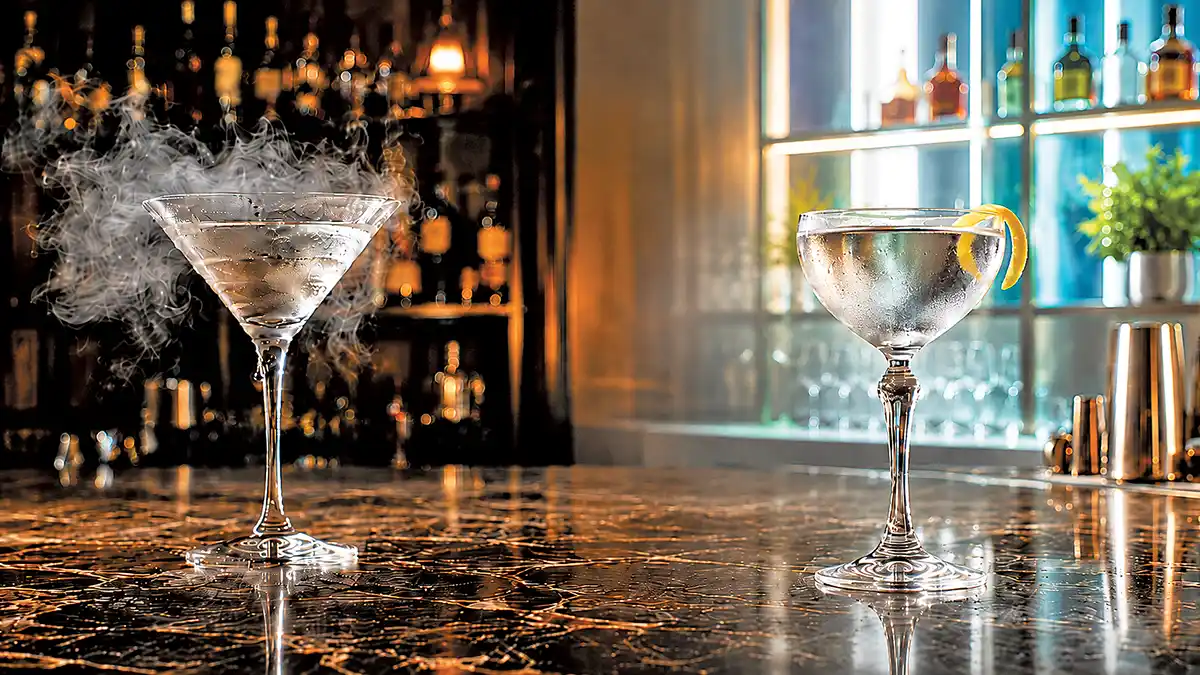
For decades, the classic V-shaped martini glass was the industry standard. It was an iconic silhouette you could spot across the bar. While mid-century aesthetics have taken over and Nick and Nora glasses are becoming more popular than ever, there’s science to back the idea that they should take over completely—and that signals a death knell for the V-shaped glass.
A paper published in Analyst by Takahiro Arakawa, titled “A sniffer-camera for imaging of ethanol vaporization from wine: the effect of wine glass shape,” proves that the shape of a glass actually changes how alcohol vapor, or ethanol, behaves—and affects the way we experience the drink.
The researchers used what they call a “sniffer-camera” system to map how ethanol vapor travels within different kinds of glasses. They compared how ethanol moves in a traditional wide-mouthed cocktail glass, a straight-sided glass, and various wine glasses; they discovered that the shape of the glass can make the sharp scent of ethanol more or less noticeable.
The classic V-shaped martini glass is characterized by its wide, open bowl that doesn’t taper in at all. The study found that when alcohol was served in those wide, open-mouthed glasses, ethanol distributed evenly across the top of the glass, meaning that when you take a sip, you’ll encounter a higher ethanol concentration, effectively making the drink seem stronger and more caustic. That higher concentration of ethanol also masks the drink’s delicate aromatics, like the juniper in a gin-based martini or the expression of a lemon peel over a martini with a twist. Since the ethanol isn’t directed anywhere, it goes… everywhere, and forces the drinker to inhale that burning, alcoholic scent. Compare that to a glass with a curved bowl and a tapered rim, like a Nick and Nora glass, which naturally brings the ethanol’s vapors to the edge of the glassware, creating a ring shape of vapor, and leaving the center of the glass with much lower levels of ethanol, about 50% less than what’s focused around the rim. What does this mean? That when we lower our mouth toward the drink to sip, our nose naturally finds itself in the center of the glass—the area with the least amount of ethanol—making it seem smoother than the martini served in a V-shaped glass.
Temperature and evaporation play into this, too. When a liquid is chilled, the ethanol naturally follows this course along a tapered glass. However, when it’s at room temperature, that pattern breaks down, and ethanol floods the entire opening, making a drink seem stronger. Because Nick and Nora glasses have a smaller bowl, where there’s less surface area for the cocktail to meet the air, they insulate the drink better, keeping it
colder longer.
So a Nick and Nora glass makes a martini seem smoother, keeps it colder longer, and slows evaporation. But that’s not all. If you’ve ever had to cross a crowded bar while holding a martini, you know the dangers of a V-shaped glass. It’s so prone to spillage that you might say a quick prayer, hold the glass with both hands, and point your elbows out to make extra room around the glass. Because once you bump into someone, half of that martini is going to find its way to the floor. That slight inward curve in the lip of a Nick & Nora glass helps contain sloshing liquid, not only making it easier for bartenders to hand them off to patrons but also for patrons to make it to their seats with a complete martini in hand.
The traditional V-shaped martini glass had its time in history—but it’s time for it to retire. Let it live on in Sex and the City and James Bond, in scenes where mysterious characters wear slinky dresses, and, thanks to movie magic, don’t spill on themselves. Modern science has proven that there’s better glassware out there—one that will make your martini more aromatic and less prone to warming, evaporating, and spilling.