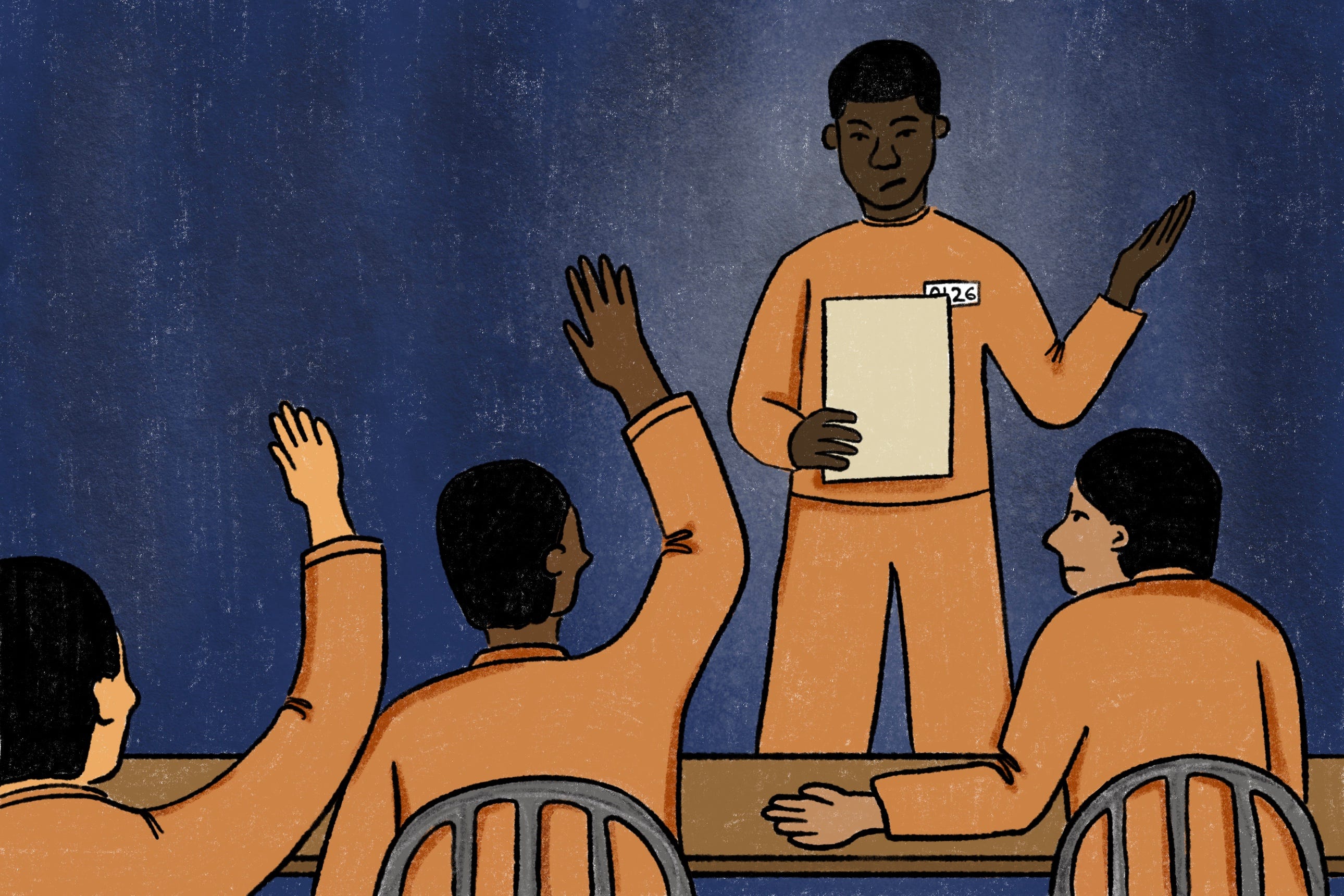
I stood at the head of a cramped classroom at Nash Correctional Institution in rural North Carolina as 12 students walked in.
A linebacker-sized brute named Mondo entered and snarled at me. “Yo. Where Kwame?”
I wore the same brown prison-issued pants as him, my skin was brown, too, but I was different, and I couldn’t hide it.
“His wife came to visit,” I said. “I’m filling in.”
Mondo rolled his eyes. “I’da stayed in bed had I known that shit.” He lumbered to his seat in the back, then sat slouching with his arms crossed. “I came to see Kwame, not your white-talkin’ ass.”
Kwame had achieved fame in the early 2000s after penning Dutch, a trilogy about Black urban street life. His success attracted prison writers to the creative writing workshop the warden allowed him to teach. Kwame was a charismatic people person whom everyone admired.
Me? Sixteen years of serving life without parole for murder turned me into a recluse. I spent my time in a cell writing. I had few friends. Nobody liked a hermit in prison because antisocial behavior signaled either arrogance or cowardice. I said as much to Kwame when I initially declined to teach his class.
“Listen bruh,” he said. “Nobody knows writing better than you. Just play The Story Game.”
Kwame devised The Story Game to ease the fear of class participation. Each student told a story, from the top of their head, and everyone had to guess if it was real or made-up. The game enabled shy men to peek out of their shells because they weren’t singled out.
“Good morning,” I said to the class. “Kwame isn’t here today, so we’re going to play a game.”
As I stuttered out the rules of The Story Game over a din of grumbling complaints, fear churned my belly. Most of those men came from rural or urban ghettos. I didn’t, so I kept to myself. But I didn’t fear being bullied by them because their upbringing was different. I feared them not heeding what I had to teach because they didn’t respect me as one of them.
No student volunteered, so I decided to go first and tell a story I hadn’t shared with anyone in years.
I said, “I was 14 when my family moved into an upper-middle-class subdivision called Arden Lake in Kennesaw, Georgia, the Deep South. It was 1992. I was the only Black kid for miles…”
Growing up around people who didn’t look like me added to my already fragile self-esteem. I had to be Sammy Davis Jr.–funny to tap-dance into their tight Rat Packs. Even though I became a master of racial assimilation, I couldn’t count the birthday parties I wasn’t invited to or school dances I attended alone.
But my first summer there gave me experiences to remember.
I smoked weed for the first time with Chad and his sisters, Bethany and Amber. We snickered at MTV’s The Grind with red, drowsy eyes while dunking Oreo cookies in cold milk. Amber giggled when holding a half-eaten cookie and said, “This is you, Phill. Black on the outside, white on the inside.”
One blazing hot afternoon, I hung out at the pool with some neighborhood kids. I stood at the edge firing a Super Soaker water gun at Chad as he swam. In a brief, unfortunate moment, a young girl named Jessica stepped in the line of fire before I could ease off the trigger, and the blast caught her right in the eye. A couple of older girls helped her out of the pool while I apologized. She said she was OK before flip-flopping home in thonged jelly sandals.
Ten minutes later, I was lying on a lounge chair when a shovel-sized hand clamped around my throat and jerked me up until my feet Flintstoned in the air.
I recognized Mr. James, Jessica’s gigantic father — who once served me hot dogs on the Fourth of July — just as his fist slammed into my face over and over again.
Hot piss soiled my swim trunks as I begged, “Please, please, please just let me go! I won’t do it again! Please!”
My wild eyes darted to my few friends, but they just stared slack-jawed as Mr. James dragged me to the gate and launched me through it.
“Don’t fuck with me and mine, boy!” he shouted.
I scraped my bare feet while running the half-mile home and left a trail of bloody footprints across the hardwood floor on the way to my room, where I curled into a sobbing heap on the bed.
My mom stormed in behind me. “Why are you stomping in here like you’ve lost your damn mind?” she asked. She grabbed my arm to turn me. The sight of my battered face made her gasp. “David!” she called to my stepfather. “Bring some ice in a bag and a towel! Hurry!” To me she asked, “Who did this?”
I couldn’t tell. Being attacked by a grown man meant I was in the wrong.
My stepfather returned. He dabbed my swollen eyes and bloody lips. “Tell us who did this, Phillip.”
I didn’t like lying to my parents, and they wouldn’t let it go, so I decided to tell the truth.
With tears singeing my cheeks, I confessed.
My mother’s mouth yawned open, but only a soft creak escaped, like the slow wail of a bow drawn amateurishly across the strings of a violin. She stalked off to her bedroom, footsteps pounding loud as bass drums. My stepfather followed. Their door slammed. Shouts rose in a crescendo of rage — “Baby put that gun down!” my stepfather screamed. “I ain’t tryin’ to be hangin’ from no tree!” — then descended into a somber humof uncertainty as they argued about what to do. I could almost hear cymbals crash when she yelled, “This wouldn’t have happened to a white family!”
An hour later, we sat at our dining room table across from two white policemen.
The heavyset one with a graying brown mustache questioned me. “This man you’re talkin’ ’bout punched you after you accidentally shot his daughter…with a water gun?”
I nodded. “Yessir.”
“Didja try to kiss her?”
“No, sir!”
“Didja say anything sexual?”
“Sir?”
Until then, my parents had sat still as silent spectators awaiting each answer as if I were a sweating contestant on some cruel game show.
My mom asked, “Why are you questioning my son like a damn sex fiend? Look at his face. He’s the victim.”
The fat cop winced. “Well, it don’t rightly make sense for a respectable man to whup a kid for something so petty. I think your boy is lyin’.”
My mother’s rage curled into a tight black fist, but she stayed calm. “Officer. You’re going to arrest that man, or I’ll find someone to arrest you.”
That night, Mr. James slept in a jail cell.
My friends never mentioned the incident. My family didn’t either. No one wanted to remember. Not even me. But carrying on as if it had never happened didn’t help me. My bruises healed. I didn’t.
Weeks later, Mr. James pulled up in his white work truck as I walked to the pool alone on a steamy afternoon.
He leaned out of his window on folded arms. “I owe you an apology,” he said. “My daughter came home crying, man. I overreacted.”
I searched the road for a car — a witness — but no car came. My teeth chattered; my bladder suddenly felt swollen and hot. Sweat beaded on my palms just as it would on a cold glass.
“Phillip,” he continued. “Is your mama goin’ to court? They’ll drop the charges if she don’t. My lawyer said I’m facin’ five years. Hell, I ain’t even hit you that hard. Not five years’ worth. Goddamn. I could lose my business over this.”
I stared into sizzling heat waves dancing up from the smoldering blacktop. When he beat me, his brutality had been just as searing and merciless. When I lay in bed remembering, I never thought of his fists, only my warm piss dripping down my legs in front of my friends.
I looked at him in the truck. He stood taller than me, stronger. Yet now I had a hand clamped around his throat as he pleaded for mercy.
“Well?” he asked. “Y’all goin’ to court?”
I let out a deep sigh and kept walking.
“Phillip?”
I walked on, thinking: Be. Afraid.
In the end, I didn’t testify against Mr. James in court. I didn’t want to hurt him, no matter what he did to me. I just wanted to be treated like everyone else.
When I finished telling my story to Kwame’s class, I noticed Mondo slyly wiping away a tear while sniffling. I kept it to myself.
I said, “Writing helped me understand the feelings that landed me in prison: alienation, powerlessness, fear and being different. No matter who you are or where you came from, these themes connect us, because we’re all hindered by them. We feel. We hurt. I learned to make better decisions by writing about the root causes of my problems. I want to teach you how to do the same, if you’ll let me.” I smiled devilishly. “But remember, this is a game. Who wants to tell me if my story was real or made up?”
Every hand shot up in the air.
Phillip Vance Smith, II is serving life without parole in North Carolina. He is a Smart Justice Fellow with the ACLU of NC and an advisor with The Bridge, an arm of Look2Justice that supports incarcerated writers. Visit his website: phillipvancesmith2.com and read his personal essays describing the esoteric side of prison life on his Substack, Prison Life Unlocked.
Jesse Sposato is Narratively’s executive editor. She has also written about feminism, friendship, culture and parenting for a variety of outlets, including Vanity Fair, InStyle, Slate, HuffPost, Memoir Land, The Rumpus and more. She is currently working on a collection of essays about coming of age in the suburbs, discovering punk rock and being boy crazy.
Aradhita Kedia is an illustrator who recently graduated with a BFA in illustration from the School of Visual Arts. Her work is rooted in narrative storytelling, drawing inspiration from everyday life and her Indian heritage.