In honor of the 25th anniversary of September 11, 2001, surely there has been no shortage of 9/11-related content.This piece, though — the latest in our Personals section — looks at this event that is heartbreaking and meaningful to so many, from an unexpected angle, as we always aim to do with our essays. I was intrigued by this one from the moment I first read it, and sure I wanted to assign it when I found myself telling my cousins about it on a weekend outing over the summer. We’ll let Pat take it from here… —Jesse Sposato, executive editor

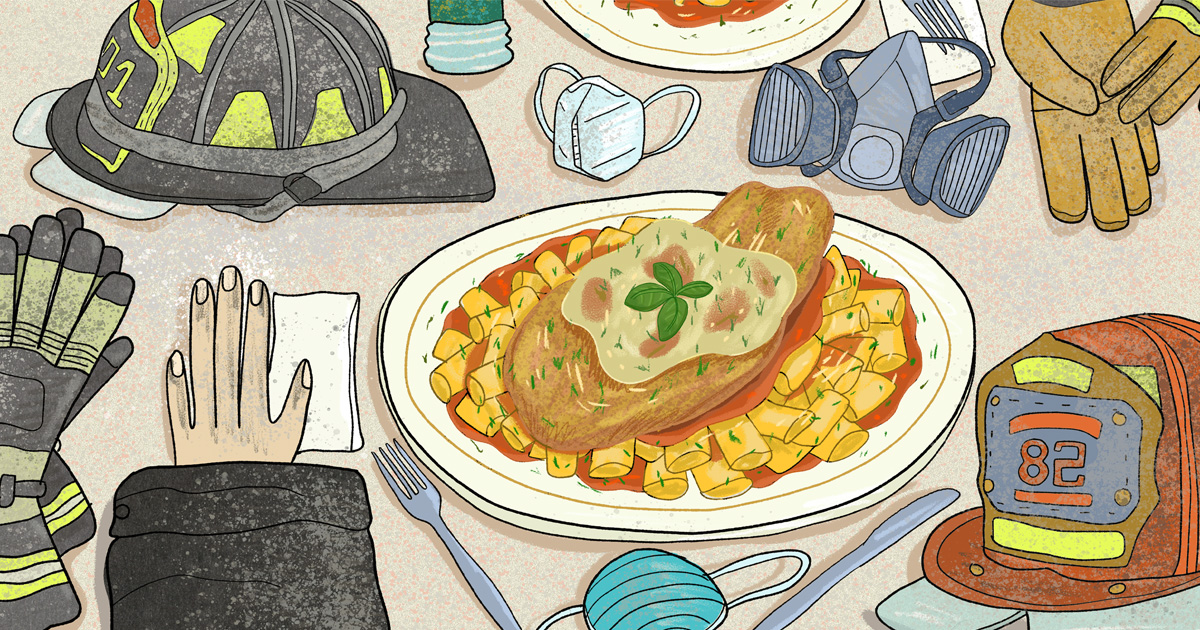
For nearly 25 years, I have carried guilt over a meal of chicken parmesan and rigatoni.
On September 13, 2001, lower Manhattan was still burning. Thousands of people were missing, and rescue workers from across the country were pouring into New York. Two days earlier, freshly 23 and having recently risen to the rank of lieutenant, I had watched the attacks unfold on television like everyone else. Six years before that, wanting to follow in my father and my uncle’s footsteps, I had joined the Wyndmoor Hose Company in Montgomery County, Pennsylvania, as a volunteer firefighter.
That Thursday, without hesitation, a small group of us led by my uncle, Chief Francis DePaul, formed a task force and reported to Jersey City. We were mostly expecting to be turned away — thousands of first responders were converging on New York City — but to our surprise, we weren’t. Instead, we found ourselves on the next Port Authority patrol boat to Manhattan.
The sky was dark as we crossed the Hudson River, which was eerily quiet. As we approached Manhattan, the skyline looked incomplete. Where the twin towers once stood was now a cloud of smoke illuminated by portable lighting. Something that had always been there was suddenly gone.

The first thing I noticed upon our arrival was paper. There was paper everywhere.
Paper covered sidewalks and collected against curbs. Sheets of paper hung from trees. Some pages had charred edges. Others looked untouched, as if they had simply drifted to the ground. Thick dust coated nearly every surface. The air smelled like a smoke-filled construction site and made it difficult to breathe.
With the buildings crumbled and debris scattered throughout the area, it looked like normal life had been erased.
We were soon assigned to what our supervisor referred to as Southwest Supply, a supply depot located at Battery Park. It was one of several supply stations strategically positioned around Ground Zero, perpetually stocked with goods from a nearby warehouse. Firefighters and rescue workers arrived constantly looking for equipment and supplies. Water, batteries, gloves, flashlights, respirators, snacks and even cigarettes.
Especially cigarettes.
When we got there, the supply tent was in disarray. Boxes were scattered everywhere. Inventory was incomplete. Nobody appeared to be tracking what was coming in or going out. One of our first tasks was organizing the operation.
Within a short time, we had supplies sorted, inventory documented and requests being tracked. It wasn’t glamorous work, but it was essential. Every firefighter who stopped at our tent needed something. Some arrived covered in dust. Others looked exhausted. Most grabbed what they needed and headed straight back toward the pile. Others knelt down to say a prayer.
The operation never stopped, and neither did the requests.
As a young firefighter, I had responded to serious incidents before, like house fires and even fatal car crashes, but I had never witnessed anything on this scale. Firefighters moved through Battery Park with a quiet determination that was impossible to ignore. Many of them had lost friends. Some had lost entire companies. Yet they continued working.
The pile was still smoldering as hope began to fade. Nobody wanted to say it out loud, but everyone understood what that meant. For the next day and a half, we worked almost continuously. Then someone told us it was time to eat. Food had become an afterthought, as had rest.
The meal was aboard the Spirit of New York, a dinner cruise ship that had been transformed into a floating support center for first responders. It was the first and only break we took during our assignment.
Inside, exhausted rescue workers grabbed food from the buffet and quickly filled the tables. I stood in the line and took chicken parmesan, rigatoni and a dinner roll. Looking back, it seems strange that I remember the menu at all. There are countless details from this whole experience that have faded with time. That meal never did. I carried my plate to a table occupied by members of an urban search and rescue team I’d been working closely with, and sat down.
For the first time since arriving in Manhattan, I wasn’t moving. I wasn’t organizing supplies, I wasn’t filling requests and I wasn’t solving problems. I was simply trying to eat a meal.
And suddenly I felt sick. Not because of what was on my plate, but because of who wasn’t eating with us.
While I sat in an air-conditioned dining room eating a late-night meal, FDNY firefighters were still working the pile. Many of them were searching for friends, members of their companies and family members they already suspected they would never find alive.
They hadn’t stopped, yet I had. The guilt hit me immediately.
Objectively, I knew the meal was necessary. We had been working for hours. We were instructed to eat. Nobody expected us to work indefinitely. But guilt is rarely interested in logic. I finished eating as quickly as I could and headed back to the supply depot.
In the short time we had all been aboard the Spirit of New York, our inventory had already been depleted. Firefighters continued arriving, and supplies were disappearing almost as quickly.
Fortunately, a U.S. Army Corps of Engineers vessel was docked only a short distance from our tent. I compiled a list of needed supplies and sent four members of our team aboard. They crossed the Hudson River to the warehouse in Jersey City where additional inventory was being staged. Within a few hours, Southwest Supply was stocked again.
The requests continued. The firefighters continued. The operation continued. Everyone simply did what needed to be done.
After working 36 hours straight, our assignment came to an end. Fresh crews were arriving. Others would take our place.
As the sun began to rise over Manhattan, we boarded another Port Authority boat and headed back toward Jersey City.
No one talked much. No one needed to. We were proud of the work we had done, but there were no words for the devastation we had witnessed.
As the boat moved across the Hudson River, the smoke still hung over lower Manhattan. The city was waking up to another day, while rescue and recovery operations continued behind us.

Twenty-five years later, when people ask what I remember most about Ground Zero, they expect stories about smoke, twisted steel and devastation.
I remember those things. But what I remember most is a plate of chicken parmesan and rigatoni.
Not because of the food. Because of what it represented.
At 23 years old, I believed service meant never stopping. I measured myself against firefighters carrying burdens I could barely comprehend. Sitting down for a meal felt like I had somehow fallen short.
Today, I understand that even firefighters need to eat. I understand that nobody expected us to carry the weight the New York City Fire Department was carrying. Yet some part of me still remembers that meal and wonders if I should have done more.
For nearly 25 years, I have carried guilt over a plate of chicken parmesan and rigatoni.
I suspect I always will.
Pat DePaul has served in the fire service for more than 30 years and currently works as the fire marshal and deputy emergency management coordinator for Springfield Township in Montgomery County, Pennsylvania. The helmet he wore during that deployment is now part of the permanent collection of the National September 11 Memorial & Museum.
Jesse Sposato is Narratively’s executive editor. She has also written about feminism, friendship, culture and parenting for a variety of outlets, including Vanity Fair, InStyle, Slate, HuffPost, Memoir Land, The Rumpus and more. She is currently working on a collection of essays about coming of age in the suburbs, discovering punk rock and being boy crazy.
Jane Demarest is an illustrator based in Philadelphia. Some of Jane’s clients include McSweeney’s, Courtney Barnett, Field Meridians, Off Assignment, Phish and Wilco. Their work has been recognized by the American Illustration Awards.