You can smell green chile season from a parking lot away.
For a few weeks every year, propane roasters show up outside grocery stores and at farmers markets across Colorado and New Mexico, tumbling drums of chiles over open flame while a line forms and the whole block starts smelling like late summer.
If you have never bought a bag, the window is short and the payoff lasts all winter. A batch of roasted green chiles in the freezer is the single best thing you can do for your cooking in September, and it turns green chile from a seasonal treat into something you reach for in February.
Here’s how to buy them, roast them at home if there is no roaster near you, get the skins off without a fight, freeze them properly, and what to cook with the first batch.
When is green chile season? Where can you buy them?
Fresh green chile season runs roughly mid-July into October, with the peak in August and September. That is the whole window. Outside of it, fresh chiles are essentially unavailable, which is why people who grew up around this buy in volume and freeze.
Farmers markets and roadside stands are the best source, and in Colorado and New Mexico many grocery stores run a roaster in the parking lot during peak weeks.
Chiles are usually sold by the bushel (around 30 pounds), the half bushel, or by the bag. A half bushel is plenty for most households and cooks down to a surprisingly manageable amount of freezer bags.
If a roaster is available, use it. Paying someone with a propane drum to do 25 pounds in ten minutes is a genuinely good deal, and the results are more evenly blistered than a home broiler will manage. Bring a cooler or a few paper bags, because they come off the roaster screaming hot and need to steam anyway.
And if you are nowhere near a roaster, which describes most of the country, you are not out of luck. Our dry blend Hatch Green Chile Powder exists for exactly this problem, and we get into how to use it at the end.
Hatch or Pueblo: What’s the difference?
If you shop for chiles in Colorado you will run into both, and there is a real and mostly friendly rivalry about it.
Hatch chiles come from the Hatch Valley in New Mexico, a stretch of Rio Grande floodplain that calls itself the Green Chile Capital of the World. The soil, altitude, and warm days with cool nights produce a chile with an earthy depth that the same botanical variety grown elsewhere does not replicate. Heat runs medium to medium-hot depending on the crop. These are the chiles behind our Hatch Green Chile Powder, so if you have cooked with the jar, you already know the flavor you are shopping for.
Pueblo chiles are grown in the Arkansas Valley around Pueblo, Colorado, and are typically the Mirasol variety. They tend to run hotter than Hatch, with thicker, meatier flesh, which makes them excellent for stuffing and for stews where you want the chile to hold its shape. Colorado is proud of them for good reason.
Both roast identically, and both freeze the same way. If you like more heat and more body, go Pueblo. If you want that classic earthy Southwestern green chile flavor, go Hatch. Buying a bag of each and tasting them side by side is a genuinely fun way to spend a Saturday.
Do green chiles need any seasoning before roasting?
No, and this is the most common thing people get wrong. Roast them completely bare: no oil, no salt, no seasoning at all.
The goal of roasting is not to cook the chile through or to brown a spice crust. It is to blister and char the tough outer skin so it separates from the flesh underneath. Adding oil causes flare-ups and acrid smoke without helping the skin lift, and salt pulls moisture to the surface, which works directly against the dry blistering you want. Both make the job harder.
Season after peeling, once you know what you are making. That is when salt actually helps, and it is when the classic partners come in. Chopped roasted chiles tossed with salt, cumin, and Mexican oregano is the base of almost every green chile dish in the Southwest.
Mayan Sea Salt is what our own green chile recipes call for, a clean, mineral-rich sea salt that seasons without tasting sharp. And Mexican Oregano is not optional here if you want the flavor to read as authentically Southwestern. It comes from a different botanical family than Mediterranean oregano, with citrus and mild licorice notes instead of minty pungency, and it is the herb that makes green chile taste like green chile.
How can you roast green chiles at home?
No roaster nearby, or only working with a few pounds? All three of these work, and all of them are looking for the same result: skin blistered and blackened in patches, flesh softened but not collapsed.
On a gas grill (best for volume)
Heat the grill as high as it goes. Lay the chiles directly on the grates in a single layer and turn them with tongs every 2 to 3 minutes as each side blisters. The whole batch takes roughly 8 to 12 minutes. This is the closest home approximation of a commercial roaster and the only method that handles real quantity comfortably.
Under the broiler (works in any kitchen)
Arrange chiles in a single layer on a sheet pan and set it 4 to 6 inches under the element. Turn them as the skins blacken, usually every 3 to 5 minutes, for about 10 to 15 minutes total. Watch them closely, since broilers vary wildly and the line between blistered and incinerated is thinner than you would think.
Directly on a gas burner (best for two or three)
Set a chile right on the burner grate over a medium-high flame and turn it with tongs as each side chars, about 1 to 2 minutes per side. Fast and effective, but only practical for a handful, and your stovetop will need a wipe afterward.
Ventilation Tip: Roasting chiles indoors releases capsaicin into the air, and a big batch under the broiler will make everyone in the house cough. Run the hood on high, open a window, and if you are doing volume, do it outside on the grill. This is not a suggestion so much as a warning.
How do you peel and freeze green chiles?
The peeling step is where most people struggle, and it is almost always because they skipped the steam.
Steam them first
The moment the chiles come off the heat, pile them into a bowl and cover it tightly with a plate or plastic wrap, or seal them in a paper or plastic bag. Leave them 10 to 20 minutes. The trapped steam separates the skin from the flesh, and afterward the skins slip off with your fingers instead of requiring a knife. Skip this and you will spend an hour scraping.
Wear gloves
Capsaicin transfers to your hands and stays there through several washings, and it will find your eyes hours later. Disposable gloves cost almost nothing. Pull the stem, slip off the skin, and scrape out the seeds and membrane if you want to dial the heat down.
Freeze them unpeeled
Here is the trick worth knowing: if you are freezing rather than cooking right away, freeze them roasted but unpeeled. The skin acts as a wrapper that protects the flesh from freezer burn, and it slips off even more easily after thawing than it does fresh. You save yourself the entire peeling session on roasting day and do it later, a bag at a time, as you need them.
Either way, portion before freezing. Press them flat in freezer bags with the air squeezed out, in amounts that match how you cook: a cup or so per bag, or chopped into ice cube trays for spoonful-sized portions. Label with the date and the variety. They keep well for about 9 to 12 months, which gets you comfortably to next season.
Batch Tip: Buy more than feels reasonable. Roasting is the entire labor cost and it takes the same afternoon whether you do 5 pounds or 25. Everyone who does this once comes back the next year and buys double, so save yourself the year and buy double now.
What do you cook with roasted green chiles?
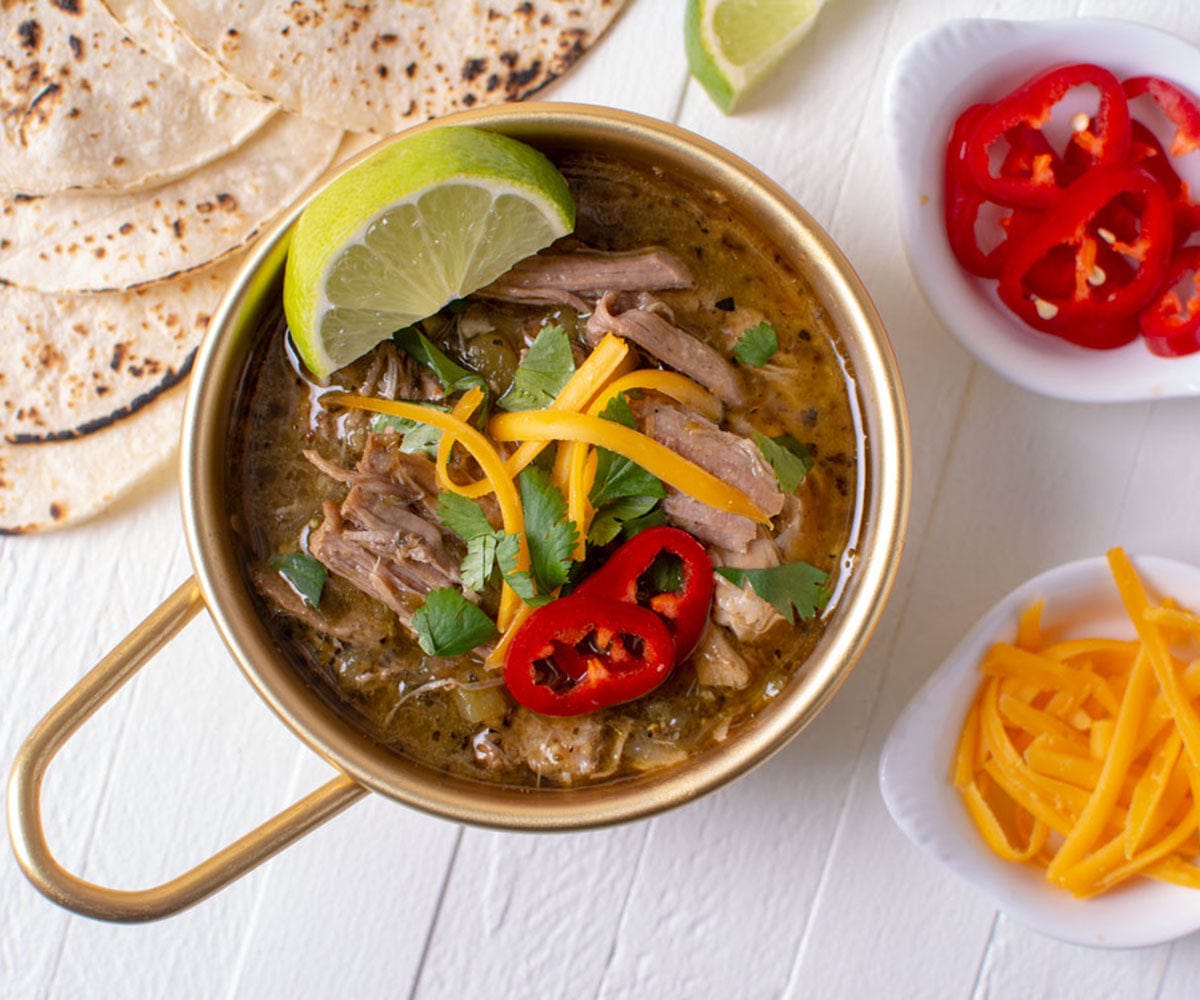
Start with the dish this state is built on. Colorado Green Chili is a specific thing, and worth distinguishing from red chili: it’s a pork-based stew built on tomatillos and green chiles, looser and more savory, designed for smothering burritos, potatoes, and eggs rather than eating from a bowl on its own. Our version browns a bone-in pork shoulder, blooms cumin, green chile, and Mexican oregano in the pot, then simmers everything with stock, crushed tomatillos, your roasted chiles, and a couple spoons of honey for two hours until the pork shreds.
Worth noting what the recipe does with the powder: it goes in alongside the fresh chiles, which sounds redundant and is not. The powder disperses through the broth over a two-hour simmer in a way chopped chiles never do, so you taste green chile in every spoonful instead of only when you hit a piece. Fresh gives you texture and char, the powder gives you a base layer, and using both is better than either alone.
Cumin is the other non-negotiable in green chile cooking. Ground Cumin Seeds is the convenient version for stirring straight into a pot, while whole Cumin Seeds are worth keeping alongside it, because toasting and grinding them yourself takes three minutes and the difference is not subtle.
The most useful thing to make with a fresh batch, though, is sauce. Green Chile Sauce came from our founder Mike Johnston, and it is the condiment that goes on enchiladas, smothered burritos, huevos rancheros, and anything else needing that earthy backbone. The method is worth noting: whole cumin seeds get toasted and ground fresh, then mixed with green chile and a splash of broth into a paste before any liquid goes in, which is exactly the technique that keeps a powder from clumping. It simmers 15 to 20 minutes, keeps a week refrigerated, and freezes well.
Green chile and cheese are made for each other, and three of our recipes prove it in different directions. Green Chile Cheese Grits comes together in about 15 minutes with Monterey Jack and smoked black pepper, and the recipe notes tell you to swap in a quarter cup of your fresh roasted chiles for the canned.
Green Chile Mac & Cheese is the Southwestern version, built with toasted corn tortillas, cilantro, Monterey Jack and sharp cheddar, and a smoked paprika breadcrumb topping. Green chile heat cuts the richness in a way black pepper cannot.
And Cheddar Green Chile Polenta is the underrated one. Serve it alongside grilled or blackened meat, or put a fried egg on it and call it breakfast.
For something bigger, Green Chile Mole Pozole slow-cooks chicken with hominy, roasted green chiles, and mole for eight hours. Hominy and green chile belong together, since the starchy, chewy corn absorbs the earthy chile character and pushes it to the center of the dish.
What if you can’t find fresh green chiles?
Most of the country cannot, and the season is only a few weeks anyway. That is exactly what Hatch Green Chile Powder is for. It takes about 18 pounds of fresh Hatch chiles to make a pound of powder, so a jar carries a serious concentration of that flavor with no roasting, no peeling, and no season to wait for.
What it does not carry is the char, since that comes from the fire rather than the chile. But the earthiness, the medium-hot build, and the distinctly green flavor are all there. As a rough conversion, 1 Tbsp of powder stands in for 2 to 3 Tbsp of chopped fresh roasted chiles, and for a 4-ounce can of green chiles use 1 to 2 Tbsp of powder plus a splash of liquid to make up the moisture.
If you want the full picture on the powder, where it comes from, what it tastes like, and everything you can do with it, we went deep on it in Behind the Seasoning: Hatch Green Chile Powder.
Fill your freezer before roasting season ends.
Roast them bare, steam them covered, freeze them unpeeled, and season them after. That is the entire craft, and it holds whether you are working through a half bushel on the grill or three chiles on a gas burner.
The season really is short. A few weeks in August and September and the roasters come down for another year, so this is one of the few things in cooking where the calendar makes the decision for you.
Go find a roaster, buy more than you think you need, and spend an afternoon on it.
Then in February, when you pull a bag out of the freezer and your kitchen smells like the parking lot of a grocery store in Pueblo, you will understand why people around here plan their year around this.
And when the freezer bags run out, the powder carries you to next season. Use it freely on eggs, in cheese sauces, in chili, in a dry rub, and grab a refill when the jar runs low. Spices are meant to be used up.
Shop Hatch Green Chile Powder →
Browse all dried chiles and paprikas →
Previous Article
French Fry Seasoning: How to Season Fries Like a Restaurant
Next Article
The Savory Spice Journal: An American Classic, Reimagined