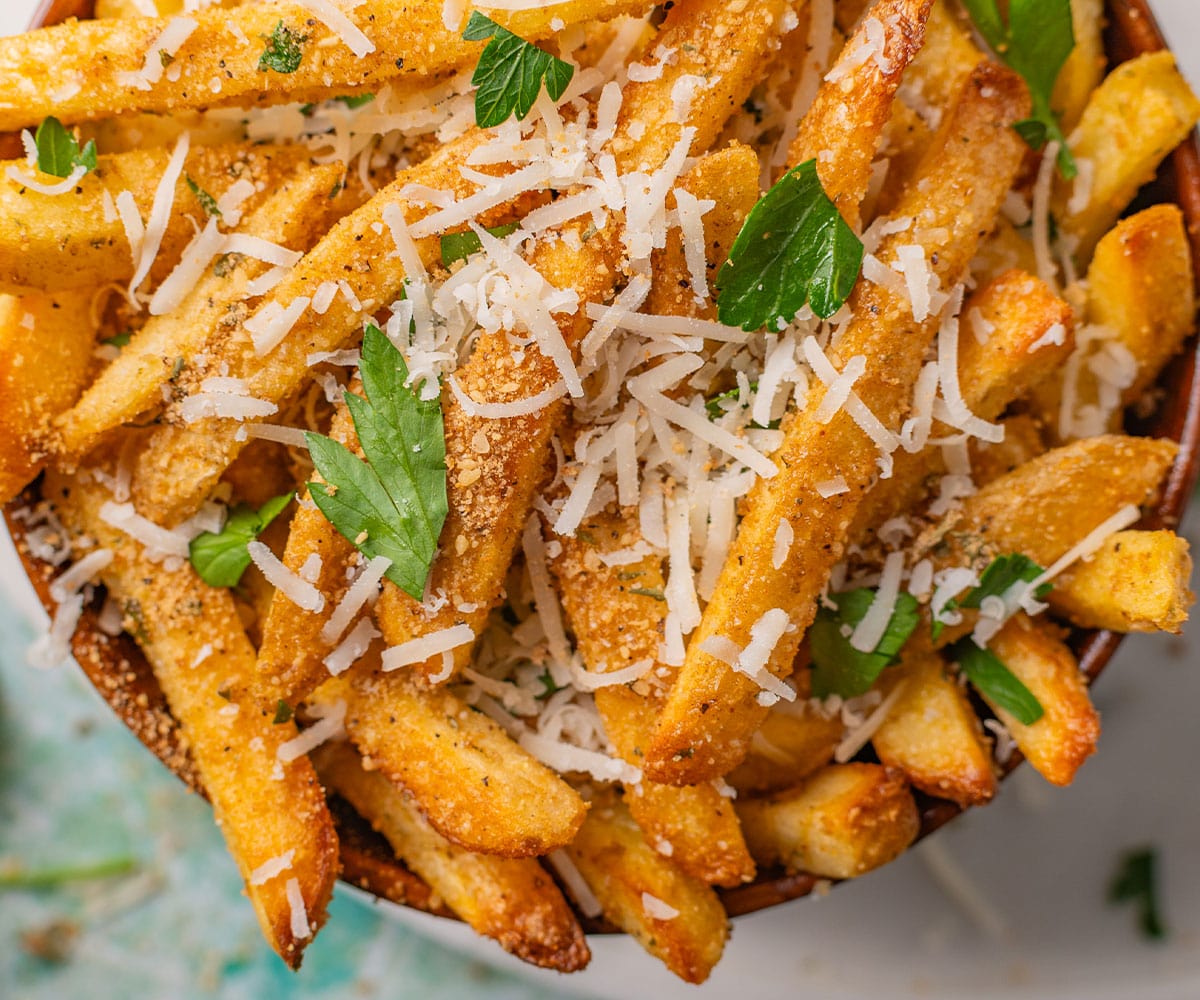
Restaurant fries taste better than yours for two reasons, and only one of them is the fryer. The other is timing.
Seasoning goes on the second the fries come out of the oil, while the surface is still hot and slick, and that window is about thirty seconds wide. Miss it and the seasoning slides off into the bottom of the basket. Hit it and every fry is coated. It is the whole difference, and it costs nothing.
Here’s the timing, then the blends worth reaching for: the everyday shake, the seasoned salts, the flavored options from cajun to truffle to cheese, what actually works on sweet potato fries, and how to mix your own from single spices.
What’s the best way to season french fries?
Immediately. The moment they leave the oil or the oven, into a bowl, seasoned, and tossed. The residual oil on the surface is the adhesive, and once it cools and sets, seasoning has nothing to grab.
Use a bowl, not a plate
Pile the hot fries into a large mixing bowl, shake the seasoning over the top, and toss the whole thing. Scattering seasoning across a flat sheet of fries only seasons the side facing up, which is why the second half of the basket always tastes bland.
Season from a height
Holding the jar eight or ten inches above the bowl spreads the shake wider and more evenly instead of dumping it in one spot. It looks like a chef affectation. It is actually just physics.
Reach for a finer grind
Coarse crystals bounce off and fall through. A finer blend clings to the surface and distributes without you having to use twice as much, which is why a seasoned salt outperforms flaky finishing salt on fries specifically.
Timing Tip: Do not salt potatoes before deep frying. Salt pulls moisture to the surface, which makes for soggy fries and causes the oil to spatter. Season after, every time. Oven and air fryer fries are the exception: toss them in oil and a little seasoning before cooking so it bakes on, then finish with more when they come out.
How do you make fries crispy?
All the seasoning in the world will not save a soggy fry. Crispness is its own problem, and the fix is cornstarch.
Toss cut potatoes with about a tablespoon of cornstarch per pound before the oil goes on, not after, so the starch grips a dry surface instead of sliding around in fat. Two things then happen in the heat. The starch pulls in the surface moisture that would otherwise steam and prevent browning, and it gelatinizes into a thin, brittle shell that holds its crunch far longer than potato starch alone manages. It is the same principle behind the dredge on fried chicken, and it works on deep fried, oven, and air fryer fries alike.
The other half of crispness is space. Crowded fries steam each other, so give them a single layer with room between, and cook hotter than feels necessary.
Sugar Tip: Check your blend for sugar before you put it in a hot oven. Most seasoned salts, cinnamon sugar, and barbecue-style rubs contain some, and sugar scorches long before a fry crisps. Anything sweet goes on after cooking, not before.
What are the best seasoned salts for fries?
If you want one jar that lives next to the stove and handles fries forever, it’s a seasoned salt.
That’s the flavor most people are actually chasing when they say a fry tastes like a restaurant fry, and it’s the reason a shaker of it sat in nearly every kitchen in the 1970s and 80s.
Our Everyday Seasoned Salt is a clean-label take on that American classic, and it has a longer history than you’d guess. It started as a blend we made only for our food service customers, developed after our co-founder noticed that many of the Texas pitmasters making the country’s best brisket were using seasoned salt as the foundation of their rubs. It sat quietly in that lineup for years before we pulled it back into the test kitchen, dialed back the celery, and brightened the color with riboflavin instead of more turmeric.
On fries it’s exactly right: salt, paprika, garlic, onion, turmeric, black pepper, and celery seed. Savory and rounded, bold enough to notice, balanced enough that you’ll use it on everything else too.
Flavor Tip: Seasoned salt isn’t only a finishing shake. Because roughly a quarter of the blend is herbs, spices, and aromatics rather than salt, you can swap it in wherever a recipe calls for plain salt and cut the salt by up to 25% while adding a layer of savory flavor. It works the same way in burgers, meatloaf, roasted vegetables, and soups as it does on fries.
From there, a few single-note salts each take fries somewhere more specific, and all of them are simple enough to shake straight from the jar.
Garlic Salt is the obvious one and better than most, because it combines traditional and roasted garlic powders rather than just one, which gives you sharp garlic and mellow depth at the same time. Supreme Shallot Salt is the one to try if you already like garlic salt and want something more interesting: shallot is sweeter and more delicate than either garlic or onion, and on fries it reads a little French.
Black Garlic Salt is consistently one of our best sellers and it belongs on fries, deeply savory with a mellow, almost molasses-like garlic umami that makes a potato taste meatier than it has any right to. And Salt & Pepper Tableside Seasoning is the quiet workhorse: someone already balanced the ratio for you, which sounds unnecessary until you’ve used it.
Want the savory hit without more sodium? Onion & Garlic Everyday Seasoning is completely salt-free, so you can salt to taste separately and control both independently. It’s one of our best sellers and it’s specifically built for crispy, fried foods.
What are the best fry seasonings?
This is where fries get interesting. Each of these turns a plain basket into a specific thing you’d order off a menu.
Garlic Parmesan and Truffle Fries
Black Truffle Parmesan Seasoning does the work of three ingredients at once, combining black truffle umami with salty Parmesan and garlic, plus it’s built for crispy foods. Toss hot fries with it and finish with fresh parsley and you have the steakhouse version without grating anything. For the purist take, Italian Black Truffle Sea Salt is the move: earthy, aromatic, and a small pinch is genuinely all you need.
Our Truffle Parm Fries recipe is about as easy as it gets and it follows the timing rule to the letter: a bag of frozen fries, air fried at 400 for 15 minutes, then seasoned the instant they come out and finished with grated Parmesan and parsley. Twenty minutes, four ingredients, and it tastes like a twelve dollar appetizer.
Cajun Fries and Old Bay-Style Fries
Cajun Blackening is the one for cajun fries, herbaceous and properly spicy, and because it’s built as a blackening spice it has the paprika backbone that makes fries look as good as they taste. Coastal Bay Seafood Seasoning is our answer to the Maryland-style bay seasoning, and if you grew up dipping crab-shack fries in vinegar, this is the flavor you’re after.
Ranch Fries and Curry Fries
Jalapeño Ranch Seasoning is ranch with a green chile kick and it’s excellent dry on fries, not just stirred into sour cream (though do that too, for dipping). Straight Buttermilk Ranch works the same way if you want the classic without heat. And for something genuinely different, Vindaloo makes the curry fries you get at a good British chip shop: warm, tangy, and hot, and unexpectedly great with a garlicky mayo alongside.
Cheesy Fries
Two directions here. Cheddar Cheese Powder shaken over hot fries gives you dry cheese coating, and whisked into warm milk or cream it becomes a nacho cheese sauce for pouring instead. Cheesy Popcorn Seasoning is tangier and already seasoned beyond straight cheese, which makes it the better shake-on option if you want cheese flavor plus a little more going on.
Dill Pickle Fries
Pickle fries have gone from a state-fair novelty to something you see on real menus, and the dry version is easier than the battered kind and arguably better. Big Dill Pickle Seasoning is bold and tangy with a salty, slightly sweet, slightly spicy edge, and tossed over hot fries it gives you that pickle brine hit without anything getting soggy.
Two things make it land. Go heavier than you think, because the tang fades fast against hot starch. And serve them with a ranch or a garlic aioli for dipping, since the acid wants something creamy across from it. It is also the seasoning most likely to disappear from your cabinet once a teenager finds it.
French Herb Steak Fries
For something more restrained than a rub, our founder Mike Johnston’s French Seasoned Steak Fries go herbal instead of spicy. Thick-cut russets get tossed with olive oil, Minced Garlic, hand-crushed Herbes de Provence, Grey Sea Salt, and Cracked Pepper, then baked at 425 for 35 to 40 minutes and finished with more salt out of the oven.
What is the best all-purpose seasoning for fries?
Besides Everyday Seasoned Salt, we have other all-purpose blends that are especially good on potatoes.
Mt. Elbert All-Purpose Seasoning is the no-overthinking option, a balanced mix of herbs, spices, garlic, onion, and pepper that seasons fries the same way it seasons everything else you put it on. Garden Harvest Seasoning goes herbal instead, with lemony garlic, onion, and thyme, and it is one of the best things you can put on a potato in any form, fried, roasted, or mashed. The lemon is what sets it apart, because a little brightness against hot starch and salt is exactly what a fry is missing.
What are the best seasonings for sweet potato fries?
Sweet potato fries are a different problem, and treating them like regular fries is why they often disappoint. They’re already sweet and they brown faster because of it, so the seasoning has to either lean into that sweetness or push against it with heat and warm spice. A plain seasoned salt tends to fall flat.
They are also genuinely harder to get crisp, and it is not your technique. Sweet potatoes hold more moisture and far more sugar than russets, and they contain much less of the starch that turns into a crisp shell. That combination means the sugars start browning before the inside has finished cooking, so the window between limp and burnt is narrow in a fryer and narrower still in an oven. Expect them to land tender-crisp rather than shatteringly crunchy, and treat the cornstarch step as mandatory rather than optional here.
Lean sweet and Cinnamon Sugar is the classic for a reason. Add it after cooking, never before, since the sugar will scorch in the oven well before the fry crisps.
Go warm and aromatic with Chinese Five Spice, which is the best-kept secret on sweet potato fries: the star anise and cinnamon play into the sweetness while the pepper keeps it from turning into dessert.
Push against the sweetness with Chipotle Chile Powder (Morita), which is the single best pairing on this list. Smoke and moderate heat against sweet potato is a genuinely great combination, and a little chipotle plus salt is all a good sweet potato fry needs. For something more layered, Ras el Hanout brings warm Moroccan spice that suits roasted sweet potato beautifully, and Baharat does the same in a slightly more peppery direction.
Two more worth knowing. Park Hill Maple & Spice is the one people fall for immediately, because maple and sweet potato is an obvious pairing that nobody thinks to do dry, and since it is salt-free you control the salt separately.
Hawaiian Red Gold Sea Salt is the finishing move: earthy, mineral, and a striking rust color against orange sweet potato that makes a sheet pan look like a restaurant plate.Smoked Spanish Sweet Paprika also belongs in this conversation, since smoke against sweetness works the same way chipotle does but without the heat.
For an actual recipe, Tarragon Sweet Potato Steak Fries takes sweet potatoes in a savory, herbal direction instead of a sweet one. Inch-thick wedges get tossed in melted coconut oil and Tarragon Shallot Citrus Seasoning, baked at 400 for 10 minutes per side, and finished with sea salt after. The recipe also gives you a build-your-own version using freeze dried shallots, French tarragon, and granulated garlic if you would rather mix it yourself.
Sweet Potato Tip: Sweet potato fries go soft, not crisp, and the usual culprit is crowding. Do not skip the cornstarch step above, because sweet potatoes are the variety it rescues most, and resist turning them more than once so each side gets time to set.
How do you make your own fry seasoning?
If you’d rather build it yourself, fry seasoning is one of the easiest blends to mix, and the formula barely changes across every commercial version on the shelf.
Basic Homemade Fry Seasoning
- 4 parts Fine Salt
- 2 parts Paprika
- 1 part Garlic Powder
- 1 part Onion Powder
- 1 part Black Pepper
- ¼ to ½ part Cayenne, to taste
Mix and store in a jar. Start with tablespoons as your “part” for a small batch. Taste it on a fry, then adjust: more paprika for color and sweetness, more cayenne for heat, more garlic for punch.
The two ingredients that decide how it tastes are the paprika and the chile. California Paprika is the everyday choice, sweet and vividly red, and it’s what gives commercial fry seasoning that color. Swap in Smoked Spanish Sweet Paprika instead and the whole blend tastes like it came off a grill.
Garlic Powder is the right grind here, since finer sticks to fries better than granulated does. And Cayenne Chile Powder is the heat dial: start at a quarter part and work up, because it climbs fast once fries are hot.
Shortcut Tip: You can skip most of that list. Start with Everyday Seasoned Salt as your base, which already covers the salt, paprika, garlic, onion, and pepper, then add whatever you want on top: cayenne for heat, smoked paprika for smoke, or a little brown sugar for a barbecue-style fry. That’s the same approach pitmasters use when building a rub, and it works for exactly the same reason.
What are the best dips for fries?
Half the point of a good fry is what it goes into, and the same jars you just seasoned with will make the dip too. The formula never changes: pick a base, stir in 1 to 2 Tbsp of seasoning per cup, and give it time.
Spiced Ketchup
The easiest upgrade available, and it takes two minutes. Our quick recipe for Spiced Ketchup stirs seasoning straight into a cup of ketchup. It is servable immediately but keeps developing in the refrigerator, so making it the day before is better.
The seasoning decides everything: Chilean Merquen Seasoning makes it smoky and gently hot, Tikka Masala turns it into curry ketchup, Longs Peak Pork Chop Spice goes sweet and herby, and Black River Creole takes it Southern and spicy.
If you want proof the idea holds up, Elevation Ketchup makes a vindaloo ketchup using our Vindaloo blend. Worth stealing at home: the warm, tangy heat of vindaloo against ketchup’s sweetness is one of the better things you can do to a bottle, and it is exactly the flavor you want next to a plate of chip-shop fries.
Fry Sauce
The Utah original is roughly two parts mayo to one part ketchup, and it becomes something much better with a shake of Everyday Seasoned Saltor a pinch of Smoked Spanish Sweet Paprika stirred in. Add a splash of pickle brine if you want it closer to a burger sauce.
Ranch Dressing
This is where the ranch seasonings earn a second use. Whisk Buttermilk Ranch into sour cream or mayo for the classic, thinner if you want a drizzle and thicker for dunking, or reach for Jalapeño Ranch instead if you want green chile heat in it. Both want at least 30 minutes in the refrigerator, and overnight is genuinely better, because dried herbs and alliums need time in a fatty base to bloom. A dip that tastes thin at dinner will taste right at lunch the next day.
Truffle Aioli or Curry Mayo
Stir Black Truffle Parmesan Seasoning into mayo with a squeeze of lemon and you have truffle aioli for a fraction of what the jarred version costs, and it is the natural partner to truffle parm fries. Vindaloo into mayo gives you the curry mayo that belongs next to chip-shop fries, and a little honey takes the edge off if it runs hot.
Cheese Sauce
Cheddar Cheese Powder whisked into warm milk or cream is a two-minute nacho cheese with no roux and nothing to shred, which makes chili cheese fries a weeknight possibility rather than a project.
Dip Tip: Make dips before you make fries, not after. Every one of these is better with time, and fries are best in the ninety seconds after they come out of the oil. Get the dip in the refrigerator first, then cook.
Always season your fries hot.
If you remember one thing, make it the timing. Hot fries, straight into a bowl, seasoned and tossed within 30 seconds. That single habit does more for a basket of fries than any blend on this page, and it works whether you deep fried them, baked them, air fried them, or pulled them out of a freezer bag.
After that it’s just picking a direction. Seasoned salt for the everyday version, truffle parmesan when you want to show off, cajun or bay when you want heat, chipotle on sweet potatoes, and your own mix when you’d rather build it yourself. Fries are the cheapest possible place to experiment, so try a different jar every time until you find the one your house votes for.
And keep it near the stove, not in the back of the cabinet. A seasoning you can reach without looking is one you’ll actually use, and when the jar runs low, grab a refill. Spices are meant to be used up.
Shop Everyday Seasoned Salt →
Browse Savory Savings, all under $7 →
Previous Article
How to Grill Peaches: Sweet and Savory Recipes for Peak Peach Season
Next Article
Green Chile Season: How to Roast, Peel, and Freeze Fresh Chiles