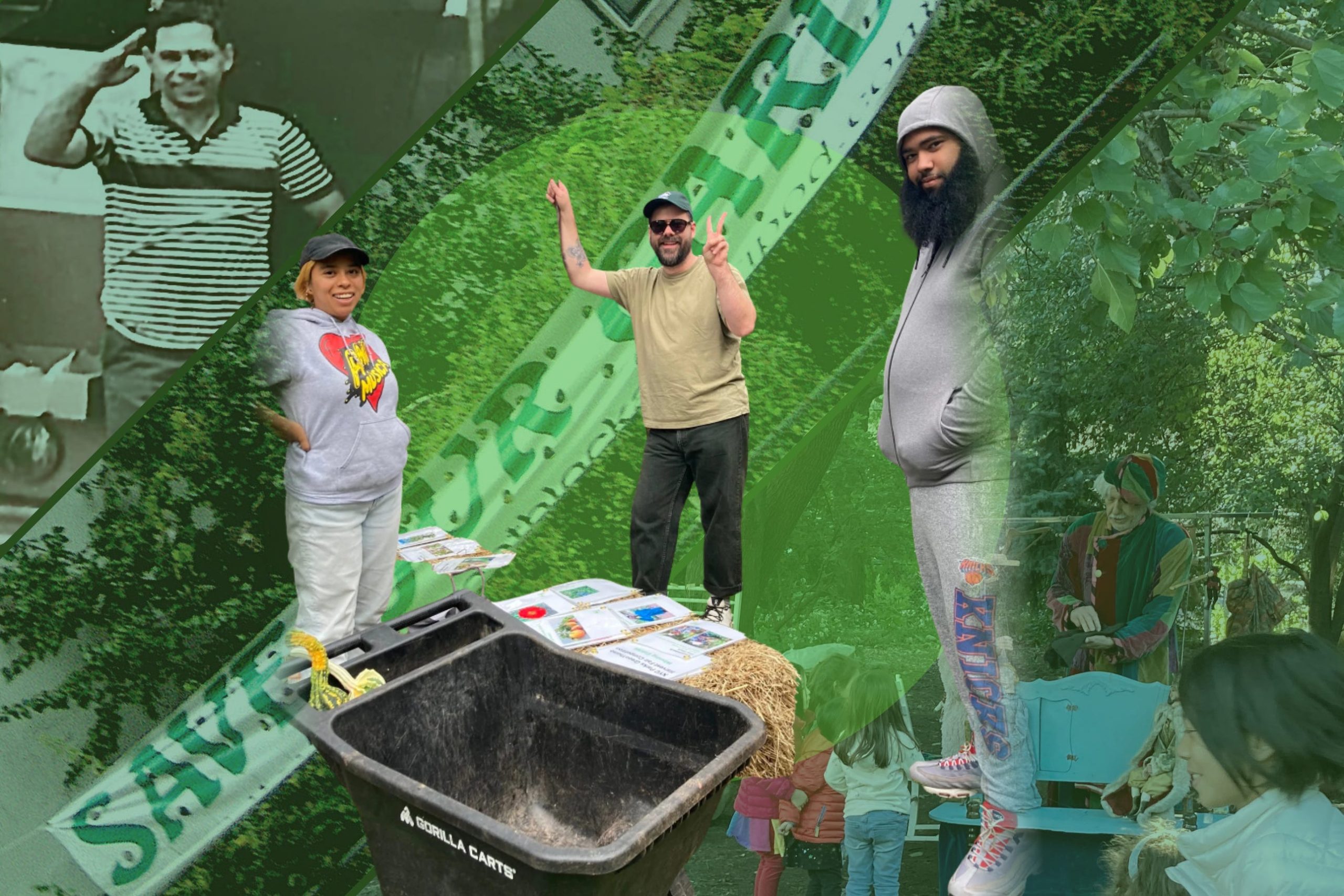
Photos courtesy Jardin del Paraiso, Nelsy Maldonado, and the author.
This story is part of our ongoing series From the Ground Up, a collaboration between Narratively and ScottsMiracle-Gro exploring the lives, memories, and connections rooted in the yards, fields, and green spaces we call home.
My father arrived in Manhattan’s Lower East Side from Puerto Rico in 1968 at 21, and went to work that same day, selling limber de coco — creamy coconut ices — from a cart on an unshaded street corner. There, he quickly earned his first farmer’s tan, one that he has worn ever since like a uniform. For his generation, adulthood wasn’t something to celebrate; it was something to survive, like chrysanthemums coaxed to bloom in unfamiliar soil.
Photo courtesy Nelsy Maldonado.
Within months, despite his degenerative blindness, my father brought over his family, building a life that would grow into four generations of Maldonados — in a neighborhood that was ready to burn. By the 1970s, fires swept through the Lower East Side — not accidents, but arson. The inequalities that journalist and social reformer Jacob Riis documented a century earlier about “how the other half lived” had never disappeared; they had deepened. And by the ’80s, the neighborhood was stratified by who could live where, and under what conditions.
On Avenue D, Riis’s name lives on in the landscape, including the Jacob Riis Houses public housing development where our neighborhood’s “Guardian Angel,” Dr. Joseph Kramer, offered pay-what-you-can healthcare to generations of kids like me.
This era was marked by concrete and chaos: abandonment and austerity policies that reduced entire blocks to blackened rubble and hollowed-out buildings.
And yet, pockets of green kept pushing through the wreckage.
Community gardens took root in those ruins as everyday acts of care and determination. Immigrants, artists and activists transformed vacant, drug-strewn lots into vibrant green spaces where people could gather and grow food in a city that didn’t always make room for them. Below 14th Street, many of those gardens remain today, even as the city changes around them.
Soundtracks, Sunshine and Silences
Photo courtesy Mel Maldonado-Salcedo
Back then, care unfolded outside the spotlight, in sun-warmed green spaces scented with damp earth, cafecitos and cuchifritos — coffee and sizzling pork mingling with fresh-cut grass and Brut 33 cologne. These days were shaped by heat rather than spectacle, and held in the shadow of the AIDS crisis and the crack epidemic that devastated so many families.
Gardens were also places where knowledge circulated. My first safe-sex lesson took place in one, through a local clinic’s harm-reduction programming. At the same time, many storefront churches held services in them too, where we found both shade and the sacred.
I can still remember the smell of damp earth and the wild daisies sprouting through cracked sidewalks in Alphabet City. Even the dispersed cherry blossoms, planted in part to absorb pollution, made spring feel aspirational.
In these gardens, the hum of bees moved in syncopation with congas and the music of Willie Colón and, later, Marc Anthony; dominoes shuffled across cardboard sheets set atop milk crates, makeshift tables built from whatever we had. “Send in the Clowns” drifted from ice cream trucks — all of it announcing spring.
As the heat lifted off the pavement, we begged for piraguas (shaved ice with syrup) to cool off, drawn to flavors that matched our palates: parcha (passion fruit), pineapple and guava. The kids drank quarter-waters, cold and sugary, while the elders passed around mavi (a fermented bark drink), dark and bitter.
We ended most days with sticky hands, sweetness and bitterness lingering in equal measure.
When I think about the gardens, I return to Rafael Hernández’s “Preciosa,” a song for Puerto Rico, for a land and a people who stand without laurels or glory. Yet, in these green spaces, our flags flapped proudly in the wind.
Gardens as Survival Infrastructure
Photo courtesy Mel Maldonado-Salcedo
The gardens persisted because of people like Charles Krezell, president of LUNGS (Loisaida United Neighborhood Gardens), who understood care as an obligation rather than an ideology. When he stepped into the role at the nonprofit organization in 2011, tasked with uniting the volunteer-run gardens of the Lower East Side and East Village, he had no formal organizing training.
In the late ’90s, “Giuliani tried to get rid of all the gardens,” Krezell recalled of then-Mayor Rudy Giuliani’s plan to auction off the city’s community gardens to private real estate developers. “There was a fight — and we lost 200 gardens.”
Nearly twice that number, he noted, were ultimately preserved.
Photo courtesy Jardin del Paraiso
The struggle became personal when the city bulldozed the garden across the street from his home to make way for senior housing. “So, some other people and I on the block decided to take over the vacant lot and change it into a community garden,” he said. The work was deeply D.I.Y. and about building relationships, about “going out and physically talking to people — so people can see your face — and going back again.”
They learned city bureaucracy as they went — securing permits and protections, asserting their right to remain and to care for the space. When loss seemed unavoidable, they didn’t accept it.
These victories felt to residents like acts of resistance. “Parents could sit there and let the kids run wild — and not have to worry about something happening to them,” he recalled, noting how the gardens “gave everybody a sense of community and freedom.”
Krezell also stressed the garden’s therapeutic reach. Through a seasonal C.S.A. program, LUNGS has distributed close to a thousand bags of fresh produce to residents at reduced costs, many of them my neighbors growing up.
Walk into any of these gardens on a summer day, and the structure still holds: narrow paths cut between raised beds of tomatoes and herbs; sunflowers rising above fences softened by vines; residents tending their plots, volunteers watering, and children digging in the dirt while their parents linger in the shade. Before the widespread availability and accessibility of air conditioners in the ’90s, these gardens were the original community cooling stations. Most still operate through a mix of open hours, shared stewardship and collectively maintained tools and visions — less private parcels than negotiated commons.
Culture Lived Outdoors
Photo courtesy Jardin del Paraiso
On a summer afternoon, the garden fills gradually. Aluminum trays and store-bought cake, with balloons loosely tied to the fence as children run past the extra chairs, music low enough for steady conversations and loud enough not to overshadow the laughter. Parents half-heartedly warn kids to be careful with themselves and the vegetation as the boundary between guest and neighbor dissolves and, in a New York minute, time slows.
For Anselm Dastner, an artist and longtime member of La Plaza Cultural on East 9th Street and Avenue C, these gatherings were part of everyday life after his daughter was born. “We’d go in the morning, and suddenly it was five or six,” he told me.
But that sort of escape came with risk. “We found needles sometimes,” he said. Safety was never guaranteed; it depended on people showing up and looking out for one another — a support network reflected in Dastner’s belief that, even as a German immigrant new to the area, he was “never really alone.”
Still, as a white artist, Dastner has long been aware of his role as “the gentrifier.” He told me how a landlord once casually admitted he would not rent to Puerto Ricans and their “big families” — a remark that lingered between us as my Puerto Rican flag hung in the background of our Zoom call.
During that same era, programs like the Fresh Air Fund reflected the city’s tendency to treat green space as something to escape to rather than cultivate within people’s own neighborhoods.
The gardens emerged to interrupt that logic.
Christine Datz-Romero, who arrived on the Lower East Side in 1980, understood green space not as “decorative” but as “necessary infrastructure.” “We amended rubble with compost,” she said, “and created a lush garden.”
What Still Grows
Bonnie Stein, a co-founder and longtime steward of Jardín El Paraíso on East 5th Street near Avenue C, arrived in the neighborhood the year I was born.
“Do you know the red truck?” I asked.
Throughout the ’80s and ’90s, my father sold fruit and vegetables out of his truck after 5 a.m. trips to the Bronx Terminal Market, a fixture in a neighborhood where needs were met with ingenuity and hustle.
“Of course!” she said.
“That’s my dad!”
Just like that, we were neighbors, and friends.
Today, the garden she helped build stretches a full city lot that once had to be cleared of all kinds of debris before anything could grow. Now it’s structured yet improvisational, with planted beds and a treehouse. On weekends, volunteers gather for workdays to turn compost, plant, repair and clean, while, during the week, school groups move through the space, learning to tend the soil and water systems that recycle what the city throws away.
The garden is never still. There are theater rehearsals, puppet shows and the occasional wedding. Kids run through it, putting their phones away. “They call us farmers,” Stein told me, laughing. “It’s an oasis.”
You can feel why. The air softens as you step inside, the ground giving slightly underfoot.
I told her I grew up in the Lillian Wald Houses, a New York City Housing Authority development with waterfront views, and where smaller gardens were finally starting to take root.
In my building, the garden was blessed weekly with holy water from Our Lady of Sorrows Church on Stanton Street. Its gardener lived on the second floor, watching over her flowers and praying to Saint Thérese of Lisieux — La Florecita — for their health. She let us kids pick the dandelions. We blew our wishes into the air through those beautiful weeds, believing they could come true.
I thought of my mother’s windowsills, where her garden unfurled through sun-fed, barred windows, thriving year-round.
“Working on a homestead was a nightmare, but we were building a garden,” Stein said of that first decade creating Jardín El Paraíso from nothing. “People underestimate how much green space keeps a neighborhood alive,” she told me.
I know this truth intimately, raised alongside the gardens of Loisaida, the Lower East Side’s Puerto Rican heart. What grew there was never just food or flowers, but people like me.
Like chrysanthemums, we bloom late.
I write this now from Bushwick, Brooklyn, where the patterns feel familiar, even as my position has shifted; today I am sometimes perceived as a gentrifier. I think about my son and what it means to inherit a sense of belonging.
Lately, I find myself pressing seeds into the soil, brushing dirt from my fingertips, waiting.
What I grow these days are mostly stories, shaped by what came before.
And still, like the flowers blooming through the gardens, I turn toward my son, following the light, even here, in the familiar concrete and chaos.