I was born in Tuzla and grew up in Loznica, on the Drina River, in a part of the world where guests are welcomed with bread and salt. My earliest food memories aren’t about restaurants. They’re about a family table: freshly baked bread, kajmak, homemade cheese and wine, and a family gathered together.
My cousin first inspired my love of cooking. Through him, I understood that food could be a craft, not just a meal. I worked in kitchens while I was still at school and taught myself much of the trade by watching, asking questions, and practicing. In 2003, I cooked my first dish for paying guests: hunter’s schnitzel with veal (lovačke šnicle). It’s a traditional home-style dish that requires patience and doesn’t allow for shortcuts. The sauce needs to simmer slowly, and guests can immediately tell if you’ve rushed it. I still remember waiting for that plate to come back empty.
Three things shaped me most.
The first was starting as a sous chef straight after school. When others were just starting out in professional kitchens, I already had years of experience behind me. A sous chef has nowhere to hide, so you quickly learn that running a kitchen isn’t just about recipes. It’s about organization.
The second was my time at Hotel Daniel in Graz, Austria, in 2004 and 2005, working under my first real mentor, Chef Kristijan Kohner. He was an old-school chef, and from him I learned that working in a kitchen isn’t a nine-to-five job but a way of life. Mise en place finished before service, cleaning as you go, everything labeled and dated, one voice at the pass. I still run my kitchen according to those principles.
The third was running a business. In 2015, I ran a catering company, Gladni Patak (Hungry Duck), with my kum (best man), Vladimir Birčaković. When it’s your own business, every wasted ingredient and every late delivery comes straight back to you. Through Gladni Patak, I developed the menu and cooked for the birthday celebration of Ivica Dačić, then First Deputy Prime Minister and Minister of Foreign Affairs. Over the years, I also cooked for actor Viktor Savić at Detlić restaurant in the Banovo Brdo neighborhood of Belgrade. My experiences in Switzerland, Germany, Portugal, and a year and a half on the Greek island of Thasos added to that foundation. Altogether, I spent almost nineteen years working in European kitchens before moving to Singapore.
I came to Singapore in 2018 through the Culinary Federation of Serbia to open Zorba’s for 1Group. That New Year’s Eve, I cooked for Slobodan Stefanović at Zorba’s on Sentosa, and it felt like a piece of home had traveled with me.
Pano Kato is my ninth restaurant in Singapore. Before that, I worked at Zorba’s, Hannibal at Robertson Quay, a small restaurant in the Botanic Gardens, and The Black Hole Group.
You cannot hide a weak kitchen behind a beautiful story.
Singapore has taught me three things. First, speed and standards must go hand in hand; you cannot hide a weak kitchen behind a beautiful story. Second, teams are multinational, and the real problem is rarely language but unclear expectations. Third, the climate changes everything. The heat and humidity are still the hardest part for me. Dough behaves differently, herbs wilt faster, and dairy products require more careful storage. That’s why I cook in smaller batches, more frequently, and check textures throughout the day.
Singapore is also home in the deepest sense. My wife, Masziana, is Singaporean, and to me, this island is paradise on e
Pano Kato is located in Tanglin Mall and is run by House of AnLi. I’ve been Executive Chef since May 2026, leading a kitchen team of nine people from different nationalities. Our philosophy centers on generous Greek and Mediterranean food that lets the ingredients speak for themselves: olive oil, lemon, and herbs used generously but thoughtfully, simple, honest grilling, and meze made for sharing.
What I bring is a cook’s understanding of the Greek table from the inside. I lived and cooked on Thasos (i.e. an island in the northern part of Greece) for a year and a half, and the Balkan and Greek kitchens are close cousins, both built around shared plates, seasonal produce, and slow-cooked meats. My rule is that every dish is built for the pass: if the team can’t reproduce it consistently on the busiest Saturday night, it isn’t ready for the menu, no matter how good it tasted during testing.
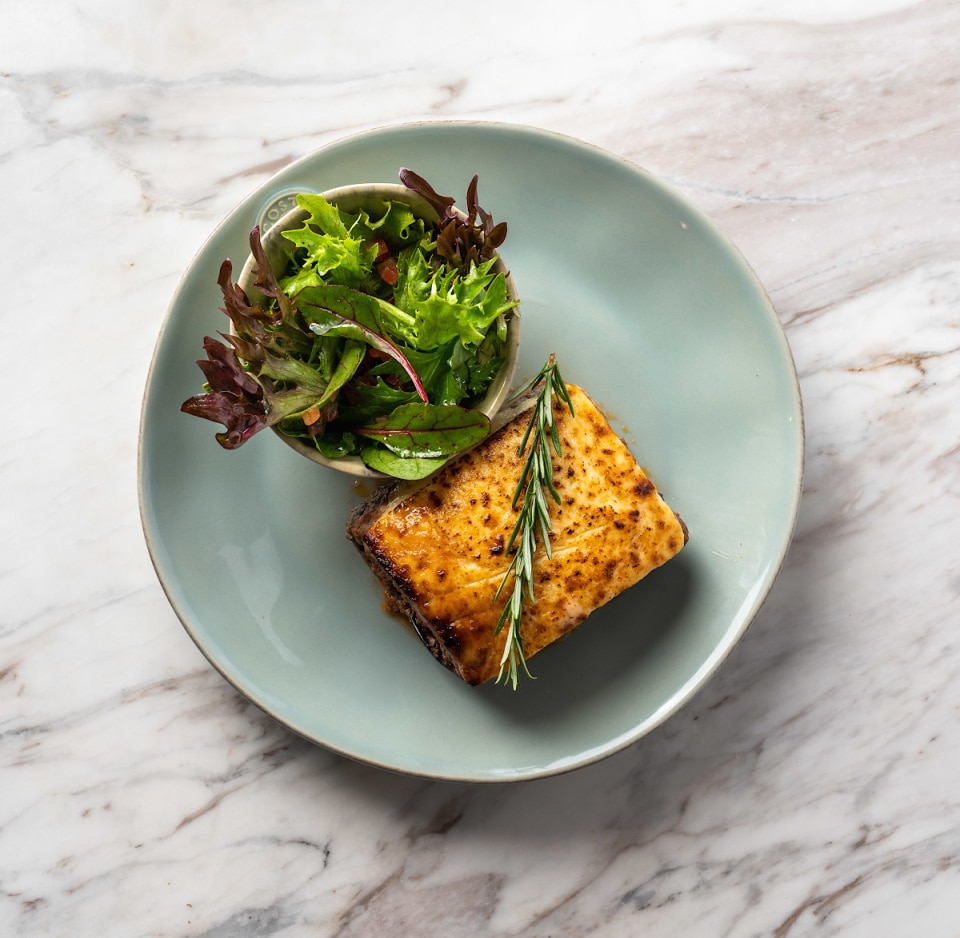
Yia Yia’s Moussaka. Yia yia means grandmother in Greek, and that’s exactly the spirit of the dish: something that should taste like someone cared for it all afternoon. We roast the eggplant and potatoes, cook the Wagyu beef and ground lamb in a tomato sauce, then layer everything with béchamel and Parmesan before baking until golden brown and set. Then comes the step people often skip at home: letting the moussaka rest before cutting it, so each slice holds its shape and the layers remain distinct.
I’m proud of it because it’s a dish that requires patience but delivers consistent results. Every portion is weighed and every step documented, so the moussaka a guest enjoys on a quiet Tuesday is exactly the same as the one served on a busy Saturday night.
The most common mistakes are always the same. Owners buy equipment before they’ve finalized the menu. They create menus that their kitchen teams can’t execute consistently at eight o’clock on a busy Saturday night. They treat food costs as something to worry about after opening. And they build the entire kitchen around one talented person, so when that person leaves, the restaurant falls apart.