Combi cooking is no longer simply a back-of-the-house equipment upgrade. For restaurants, hotels, corporate dining, universities, healthcare kitchens and multi-unit foodservice operations, the combination oven has become a strategic tool for how menus are planned, prepared and executed.
By combining convection, steam, baking, roasting, retherming, holding and other functions into one piece of equipment, combi ovens are changing how chefs think about labor, production timing, consistency, training, menu development, footprint and growth. That shift comes as operators face smaller teams, higher labor costs, tighter kitchens and the need to deliver consistent menus with fewer moving parts. “Labor and footprint have become major issues, especially since COVID,” Chef AJ Schaller, Regional Corporate Chef for Blodgett, said. She noted that, when properly programmed and supported by good prep timing, a combi oven can give teams the flexibility to manage a wide range of cooking tasks within a coordinated workflow.

For operators, the value is not simply in what the oven can cook. It is in how it helps the kitchen operate. The Invoq Combi is designed to optimize energy and water use across steam, convection and cleaning cycles, helping operators manage resources while maintaining reliable cooking performance.
Schaller pointed to how the Invoq Combi can function as both a prep workhorse and a service tool. Recipes can be built around repeatable cooking steps, moisture control, probe cooking, rack timing and holding cycles instead of around separate pieces of equipment. “Having the addition of steam really opens up the possibilities,” Schaller added. “With the menu planner and a la carte style cooking settings, the oven can be used as a prep workhorse, but it can also support service when the kitchen needs speed and consistency.”
For operators, that can mean fewer bottlenecks and more confidence. A restaurant can braise short ribs overnight and free up daytime production. A corporate dining kitchen can retherm and serve with more control. A hotel can plan for banquet volume using roll-in units. A chain can protect standardized recipes across locations.
Training has become another major part of the combi conversation. Many operators are relying on employees with less formal culinary experience, so equipment that requires complicated interpretation can become a barrier. Equipment that works more like the technology employees already use can reduce that challenge. “With Invoq, the interface with a smartphone is simple,” Schaller noted. “If a team member is comfortable pulling a phone out of their pocket, they can become comfortable using the equipment.” For multi-unit brands, it also helps protect recipes. The Quick Select Recipe Mode can lock down predefined, multi-step recipes so a team member cannot casually alter a standardized menu item in the middle of service.

That level of recipe protection is especially valuable for operations that depend on consistency. A guest expects the same item to look, taste and perform the same way every time. A combi oven with locked recipes, cook-cycle data, probe cooking and automatic HACCP cooking curve storage helps make consistency less dependent on one individual cook. “The Invoq, saves everything, including cook cycles,” Schaller continued. “When a product is cooked with the probe, it automatically stores a HACCP cooking curve for 90 days.”
Connectivity is also becoming a larger part of the equipment decision. With every purchase of an Invoq oven, operators receive a one-year subscription to Open Kitchen®, Middleby’s IoT solution for intelligent equipment monitoring. With Open Kitchen®, operators can access their oven anywhere, anytime, creating a more transparent and connected kitchen. Activity insights and service alerts are designed to help eliminate downtime, control costs and keep the operation one step ahead.
As combi oven options expand, operators need to match the right steam platform to their menu while protecting the equipment with proper water treatment. Water quality is critical, and the Invoq Combi’s filtration system helps reduce maintenance issues tied to chlorides, chloramines and other water concerns. Invoq offers both CombiSteam and HybridSteam models. CombiSteam injects water through heating elements to create steam quickly and efficiently. HybridSteam uses a reservoir and sensors to deploy injected steam, boiler steam or both, making it valuable for seafood, rice, pasta and other steam-intensive menus while providing backup protection if unexpected boiler issues occur.
The Invoq Combi also includes features designed around real kitchen problems. Its Hoodini ventless hood system does not require regular replacement of charcoal or HEPA filters. Instead, grease-laden vapor, steam and heat pass through a catalytic converter that burns it off into clean gas and steam before returning it to the cycle. For operators without traditional hood space, that can open new possibilities.

Capacity is another differentiator. Full-size, multi-rack units offer 17% more capacity in the same low footprint, helping operators increase output without expanding their equipment footprint. The Invoq Combi is also designed with field-reversible doors, giving kitchens more flexibility when a layout or service flow changes. “Invoq’s pass-through design gives operators another way to separate cooking from service,” Schaller outlined. “The chef side can manage the cooking process, while the service side can pull finished food and move it directly to display, buffet or table service.”
Menu development is where combi cooking is changing the chef’s role. Testing recipes inside the actual oven is critical because combi cooking can change cook times, yields and moisture retention. Recipes developed for the Invoq Combi can be calibrated to take advantage of its convection, steam and moisture-control capabilities. Once dialed in, those settings can support fast, consistent and profitable production.
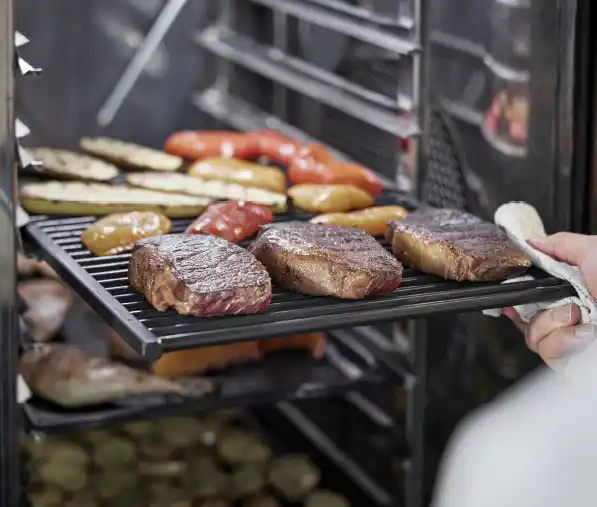
The Invoq Combi’s CombiSense technology uses a lambda sensor to monitor both temperature and moisture. That means a recipe tested with one rib roast can be scaled to a full oven load without the chef rewriting the cooking process. The oven can add or remove moisture to maintain the target cooking environment. For chefs, that control has implications across the menu. Proteins can retain yield. Vegetables can roast without drying out. Steaks can be cooked with moisture and high heat to preserve juiciness while developing a sear. Frozen breaded products can be cooked in open convection as an alternative to frying. Rice, pasta and starches can be cooked with precision.
Cleaning is another area where oven choice affects labor. The Invoq Combi offers six cleaning programs, and the hybrid boiler can be descaled by the operator rather than requiring a maintenance call. Its CareCycle™ tab-based cleaning system is designed to work at the operator’s convenience, eliminating service interruption and helping control costs with 50% less spent on cleaning chemicals than the competition. The oven also features a cool-down mode that can operate without opening the oven door, reducing heat and discomfort in already hot kitchens.
For today’s operator, choosing the right combi oven is not only about what it can cook on day one. It is about what it can help the operation become. A restaurant may want to expand into catering. A hotel may need greater banquet capacity. A commissary may need repeatable production. A school may need labor savings. A multi-unit brand may need recipe consistency across regions. “The most important thing is to test the oven with the food the operator actually plans to cook,” Schaller concluded. “Blodgett’s approach is for you to see how the oven handles your actual food, batch sizes and service demands.”
Restaurant and foodservice operators, consultants and dealers can test the next-gen Invoq Combi to see how its features support their menus, labor needs, kitchen footprint and growth plans. Blodgett offers demonstrations to help operators, dealers and consultants evaluate how the oven can improve menu planning, preparation and execution. To schedule a demonstration or learn more, visit blodgett.com.