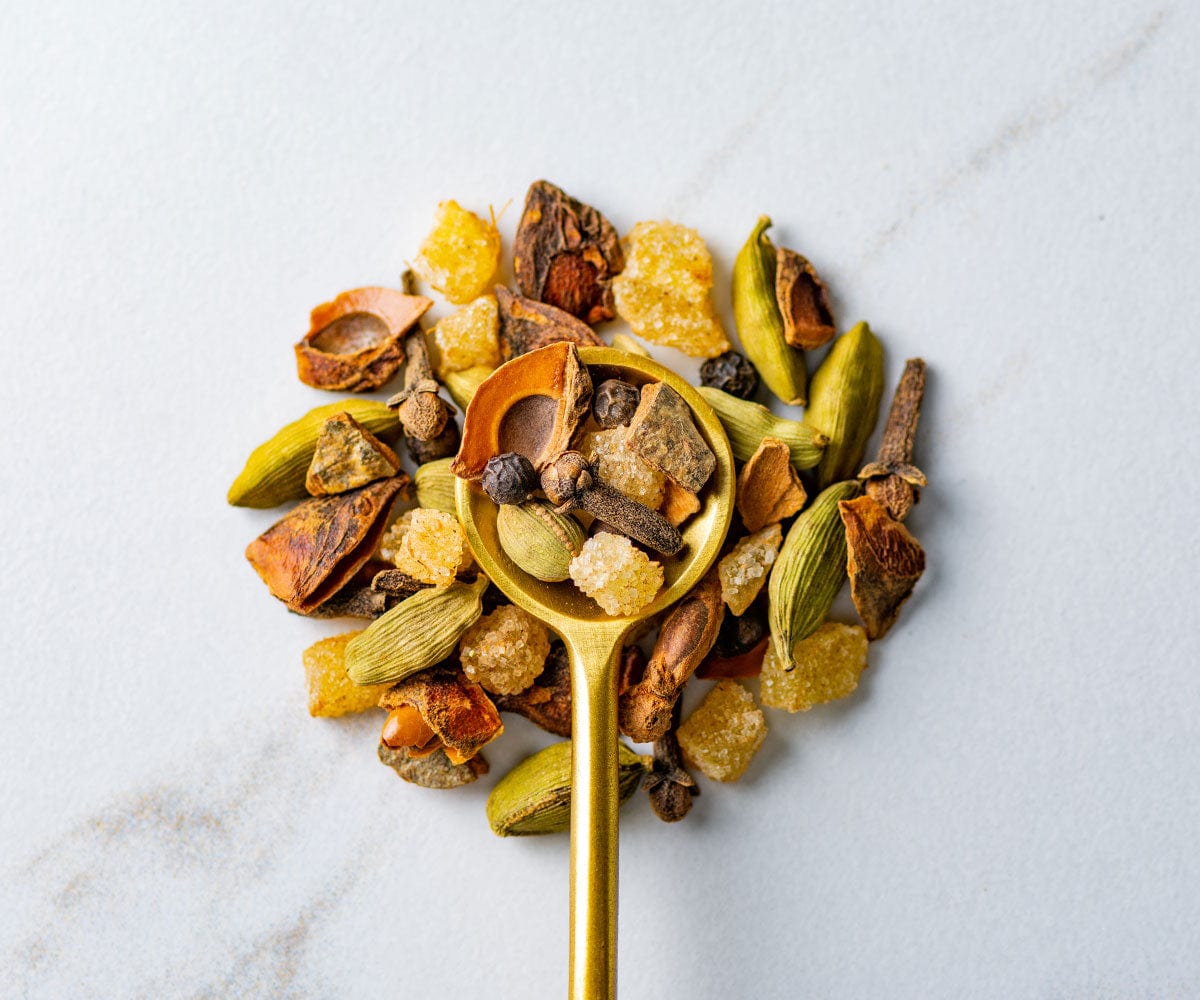
Chai is not just a flavor. It is a blend, and a properly complex one: Cinnamon and Ginger for warmth, Cardamom for a cool floral note underneath, Star Anise for licorice depth, Cloves, and Black Pepper at the finish. Open the jar and you’ll smell all of it at once–sweet and sharp and aromatic.
It is also one of the oldest spice preparations still in daily use anywhere in the world, and the version most Americans know is the youngest part of that story by several thousand years.
What is chai and where did it come from?
The word itself is the first source of confusion. Chai simply means “tea” across much of South Asia, Persia, and parts of Eastern Europe, which makes “chai tea” a redundancy in the same way “queso cheese” is.
What English speakers mean by chai is more precisely masala chai, spiced tea, and what we sell under the name chai is the masala part: the spice blend, without the tea. Those spices are not a fixed recipe and never have been.
Cinnamon, cardamom, ginger, cloves, and black pepper form the recognizable core, with star anise, fennel, nutmeg, bay, or peppercorns appearing depending on where and by whom the blend was made. There is no single authentic formula.
The origin of chai goes back pretty far. Legend places it more than five 5,000 ago, when a king in what is now India ordered a healing spiced beverage created for use in Ayurveda, the traditional system of medicine built on herbs and spices. In that framework, every ingredient was chosen for an effect rather than a flavor.
Ginger and black pepper were believed to stimulate digestion. Cloves were thought to relieve pain. Cardamom was used to elevate mood, cinnamon to support circulation, and star anise to freshen breath. The blend was medicine that happened to taste good, not the reverse.
As the preparation spread across the subcontinent, the spices shifted with geography and availability. Regional variation was the norm, and in many places the specific proportions were a household matter rather than a regional one, passed down and adjusted rather than written down.
The Original Masala Chai Had No Tea In It: For most of its history, this was a spice preparation simmered in water, sometimes milk. Tea leaves, milk, and sugar all arrived much later. Black tea entered the picture in the mid-1800s, after the Camellia sinensis assamica plant was found growing in Assam and cultivated at scale by the British, who governed the subcontinent at the time and had an enormous domestic appetite for strong black tea taken with milk and sugar. The drink most of the world now pictures is roughly two centuries old. The spice blend behind it is ancient.
How did chai become both a blend and a flavor?
Once tea was being grown in India rather than imported, it became cheap enough for daily consumption, and masala chai took the form it holds today: spices and black tea simmered together with milk and sweetener rather than steeped separately. Street vendors, the chai wallahs, made it ubiquitous, and each one’s proportions became a small local signature.
The blend arrived in the West largely through those two channels at once, immigration and tea trading, and then took a strange turn in the 1990s when American coffee shops began selling chai as a latte, usually built from a sweetened concentrate rather than actual spices. That is the version most people encountered first, which is why chai in the United States often registers as a flavor of drink rather than a category of spice.
Most Americans have never tasted chai made from whole spices, and almost nobody thinks to use it in cooking, which is a considerable waste of a blend that’s this versatile.
What’s different about whole chai vs. ground chai?
The same spices behave like two different ingredients depending on whether they arrive whole or ground, and choosing between them comes down to whether they are going into liquid or into a batter.
Chai Spices is the whole blend and the closer descendant of traditional masala chai: crystallized ginger nibs, Saigon cinnamon chips, green cardamom pods, star anise, cloves, black peppercorns, and bay leaves. Whole spices hold their volatile oils until heat and liquid draw them out, which is why this blend rewards a slow steep and why its flavor arrives in layers rather than all at once. It goes into the pot and comes back out.
Mt. Baker Chai Seasoning is the ground counterpart: Saigon and Indonesian cinnamon, ginger, cardamom, black pepper, star anise, allspice, and bay, and it is salt-free. Grinding exposes far more surface area, so the flavor releases immediately and disperses evenly through a dough or a rub. There is nothing to strain out because nothing is left behind.
The practical division: anything you steep and strain wants the whole spices. Anything that bakes, coats, or dissolves wants the ground.
What do chai spices taste like?
Sweet-spiced and warming at the front, licorice running underneath from the star anise, and a genuine peppery bite at the finish.
Cardamom does most of the aromatic work, cool and faintly floral against the cinnamon. Bay leaves contribute an herbal backbone almost nobody can name but everybody notices when it is absent. And the black pepper is the ingredient that separates chai from every other warm-spice blend on a shelf, giving it a slow heat that builds across a bite rather than fading.
That pepper is also why chai works in savory cooking when most baking spices cannot. Compared with pumpkin pie spice, which shares the cinnamon, ginger, cloves, and allspice, chai adds cardamom, star anise, and pepper. Pumpkin spice is warm and sweet and stops there, which is exactly right for pie. Chai keeps going.
A Chai Substitution Worth Trying: Chai swaps one to one anywhere a recipe calls for pumpkin pie spice, baking spice, or even Chinese five spice. The base flavors overlap enough that nothing breaks, and the cardamom and pepper register as a difference people notice without being able to name. It is the lowest-risk way to find out whether you like it.
How do you make real chai-spiced tea?
Start here, because this is what the blend was built for and because one detail separates a cup worth making from a cup that tastes like weak cinnamon water.
Crack the cardamom pods before they go in the water. Use a mortar and pestle, a rolling pin, or the bottom of a heavy cup to split the green pods and expose the seeds inside. An intact pod is effectively a sealed container and will surrender almost nothing in a ten-minute simmer. Cracked, the seeds release immediately. This single step is the most common reason homemade chai disappoints.
From there, Chai Tea is straightforward: two tablespoons of Chai Spices and three black tea bags into three cups of boiling water, reduced to a simmer for ten minutes, then a cup of whole milk and a quarter cup of brown sugar or honey stirred in and brought back to a simmer before straining. Fifteen minutes, three servings.
Recipe by Savory Spice Test Kitchen
Skip the coffee shop and treat yourself to a warm mug of sweet-spiced nostalgia. This chai tea recipe features our…
 All-Purpose Cooking
 Drinks
Yields
3 servings
Prep Time
5 minutes
Cook Time
10 minutes
For a single cup, one to two teaspoons of Chai Spices steeped with a tea bag in water and milk, sweetened to taste, gets you most of the way there.
For something cold, Chai Cranberry Fizz puts the same spice against cranberry tartness and carbonation, which sounds wrong on paper and works on the tongue.
What can I infuse with chai spices besides tea?
Steeping is what whole spices do best, and tea is only the most familiar application of it.
Chai Caramel Sauce is the most instructive recipe on this page, because the order of operations is the entire technique. Four tablespoons of Chai Spices steep in a cup of heavy cream brought barely to a simmer, never boiled, then sit covered until the cream reaches room temperature, at which point the spices are strained out. Only then is the sugar caramelized separately, and the chai-infused cream stirred in a few tablespoons at a time.
Done in that order, the spices never touch hot sugar, which would scorch them and turn the batch bitter. What you get instead is caramel with cardamom and pepper running through it, good on ice cream, over cheesecake, or as a dip for sliced apples.
Chai Spice Infused Sweet Potato Bisque applies the same principle to a savory dish, with the spices tucked into a muslin bag and simmered alongside the sweet potatoes and broth, so the flavor infuses without leaving grit in a pureed soup.
How can I use chai spices in baking?
This is where the ground blend belongs, and where chai most often converts people who only knew it as a drink.
Chai Pound Cake is the one to make first. Dense enough to slice thin, tender enough to eat plain, and close enough to the drink that eating a slice registers as familiar even the first time.
Chocolate Kissed Chai Shortbread Cookies pair the blend with chocolate, which is a real test, since chocolate flattens most spices into vague warmth. The cardamom and pepper hold their own against it.
Recipe by Amanda Bradley, Savory Spice customer
These delicate treats are beautifully flavored with Mt. Baker Chai Spice Seasoning and dusted with Black Onyx…
All-Purpose Cooking Baking
 30-Minute Meals
Yields
2 dozen
Prep Time
15 minutes
Cook Time
12 minutes
Blueberry Chai Chess Pie is a more unexpected recipe with chai. Chess pie is a Southern custard pie, dense and sweet enough that it needs something pushing back, and blueberry against chai does exactly that.
Chai Iced Hermits revive a genuinely old cookie, a soft spiced bar under icing that predates most of what fills a modern cookie jar, and chai suits it better than its original spicing did.
Chai Cookies is the plainest version and the best way to taste the blend with nothing competing, and Chai Chia Pudding is the no-bake recipe that works as breakfast.
Recipe by Lindsey Burcham
This is an easy starter recipe for exploring chia seeds. We recommend a few seasoning options here but it’s a fun…
 Sweet Treats
Yields
1 serving
Prep Time
2 minutes
Do apples and chai go together?
Of all the fruit pairings you can do with chai, this one is one of the best. It’s the reason chai turns up alongside pumpkin and apple in a lot of autumn cooking.
Chai Apple Butter is what to make when you have bought too many apples. Ten large ones, brown sugar, lemon juice, Mt. Baker Chai, vanilla bean paste, and Mayan Sea Salt spend five to six hours in a slow cooker while you stir occasionally and do nothing else. Mash for texture or blend smooth, and it keeps two weeks refrigerated.
Chai-Spiced Apples stops short of butter and leaves the fruit in recognizable pieces, better for spooning over ice cream, oatmeal, or pork, and Chai Apple Turnovers puts the same pairing into pastry.
Recipe by Amber Helm, Savory Spice—Brookside/Kansas City, MO
Pastry-loving spice merchant Amber from our Kansas City store submitted this recipe to honor Kansas City’s apple…
All-Purpose Cooking Grilling & BBQ
Yields
12 turnovers
Prep Time
15 minutes
Cook Time
40 minutes
Can you use chai spices in savory cooking?
Chai reads as sweet because of where most people encounter it, but the pepper, ginger, and cloves are savory spices in almost every other context, and they behave that way here too.
Grilled Chai Pork Chops & Gravy is the recipe that makes the argument. Its marinade is built like a brine: apple cider simmered with Vanilla Bean Sugar, then black tea steeped in it for five minutes and strained out, so there is genuine tea beneath the spice rather than spice alone. Once cooled, oil, soy sauce, Dijon, Mt. Baker Chai, and Onion & Garlic Tableside Sprinkle whisk in. The chops marinate at least two hours, and the reserved marinade reduces for twenty to thirty minutes into an actual gravy.
Chai-Spiced Nuts might be one of the easier entry points on this page and the best use for mixed nuts at a holiday party, and Chai Spiced Party Mix scales the idea up even more for a crowd.
What is golden milk chai?
There is a third chai blend in our family, and it is chai with one significant, golden addition. Golden Milk Chai Spice takes the same cinnamon, ginger, cardamom, black pepper, star anise, allspice, and bay, and puts turmeric in front of all of it.
Turmeric shifts the character more than its position on an ingredient list suggests, earthy and slightly bitter where the chai spices are sweet and aromatic, so the result tastes less like dessert and more like something restorative. The black pepper is doing real work here beyond flavor, since piperine is what makes turmeric’s compounds available to the body at all. The two have been paired for centuries for that reason rather than by coincidence.
The simplest use is a latte, a teaspoon and a half into a cup of any milk, sweetened to taste, hot or chilled. Golden Milk Chai Latte is the full version.
Golden Milk Coconut Ice Cream is the more interesting application, turmeric and coconut against warm spice, and the color alone makes it worth serving to people. Golden Vanilla Chai Tea Cakes use the same pairing in a small vanilla-forward cake, which is the gentler introduction if turmeric in dessert sounds like a stretch.
This turmeric and chai spice blend also works in cookies, muffins, smoothies, and coffee, and holds up in savory territory, rice dishes, sauces, and breads.
How can you make your own homemade chai blend?
If you keep whole spices around, you can build a version of this yourself, and doing it once teaches you more about the blend than reading about it will.
Start with the five that define it:
- Cinnamon
- Cardamom
- Ginger
- Cloves
- Black pepper
A reasonable starting ratio by volume is 4 parts cinnamon, 2 parts cardamom pods, 2 parts dried ginger, 1 part cloves, and 1 part peppercorns. From there, Star Anise and Bay Leaves are what separate a good homemade blend from a flat one, so add a star anise pod or 2 and/or a couple of bay leaves per batch.
Toast the whole spices first. 30-60 seconds in a dry skillet over medium heat, moving constantly, until they smell fragrant rather than dusty. Heat drives the volatile oils to the surface, and the difference between toasted and untoasted is not subtle. Pull them off the heat the moment the aroma comes up, since they go from fragrant to burnt in a matter of seconds.
Decide whether to grind. Left whole, the blend is for steeping, tea, cream infusions, a muslin bag in a pot of soup. Ground in a spice grinder or with a mortar and pestle, it becomes a baking spice that will disperse through a batter. Grind only what you plan to use within a few weeks, because ground spices lose their oils quickly while whole ones hold for a year or more.
Adjust It to Taste, Which Is the Whole Tradition: There is no authentic proportion to get right. Households across the subcontinent have adjusted these ratios for generations, some heavy on ginger, others on cardamom, some adding fennel or nutmeg entirely. Make a small batch, brew a cup, and change it. Wanting more warmth means more ginger and pepper. Wanting it more floral and aromatic means more cardamom. Wanting the licorice note forward means more star anise.
If you would rather skip the sourcing and the grinding, that is what our two blends are for: Chai Spices whole for steeping, and Mt. Baker Chai Seasoning ground for everything else.
What can you use in place of chai spices?
Pumpkin Pie Spice is probably the closest thing already in most cabinets, sharing cinnamon, ginger, nutmeg, cloves, and allspice. What it lacks is the cardamom, star anise, and pepper, so you get the warmth without the complexity or the bite.
Chinese Five Spice covers the opposite half, sharing the star anise, cinnamon, cloves, and pepper while missing the cardamom and ginger, so it delivers the licorice and heat without the aromatics.
Building a version from scratch, cinnamon, cardamom, ginger, cloves, and black pepper are the core five. Star anise and bay are what separate a passable homemade blend from a flat one.
Chai spices: a blend that goes beyond the cup.
Chai spent thousands of years as medicine before anyone added tea leaves to it, and two centuries as a beverage before anyone thought to put it in a pound cake or on a pork chop. The paper cup at the coffee shop is the most recent and least interesting chapter of a very long story.
Start with the tea, made properly with the pods cracked. Then start putting it in things.
Shop Chai Spices →
Shop Mt. Baker Chai Seasoning →
And for more information on our similarly flavored warm spices, go behind the seasoning with: Pumpkin Pie Spice, Mulling Spices, and Salted Caramel Spice.
Previous Article
What to Do With All Those Apples (Beyond the Pie)
Next Article
Cooking with Maple: Recipes Beyond the Pancake Syrup