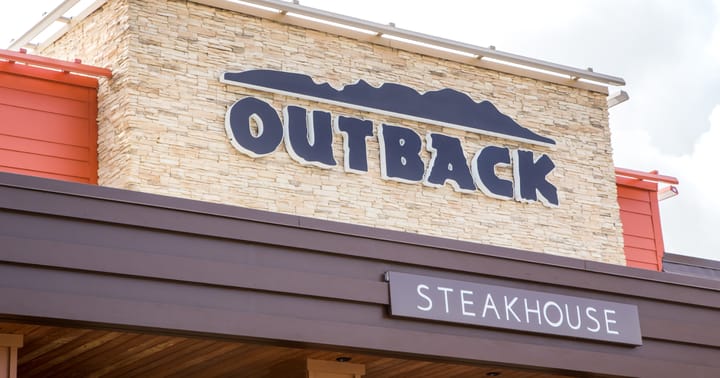
Outback Steakhouse continued to reap benefits from its turnaround campaign in the third quarter, generating same-store sales growth of 1.9% year over year.
Traffic declined 1.5%. But customer satisfaction scores improved for the fifth consecutive quarter, including plus 3 for service, atmosphere, and intent to return; plus 2 for value; and plus 1 for food.
The higher scores follow investments in steak selection and quality and an updated service model that gives servers fewer tables so they can focus more on each group.
However, executives for parent company Bloomin’ Brands warned of more-muted results in the near-term. For the fourth quarter, it’s expecting same-store sales growth of 0% to 1% due to a combination of calendar shifts and pricing and promotional decisions.
Halloween fell on a Saturday this year and Christmas falls on a Friday, and the company will also have one less operating day in the quarter. This is expected to have a negative 2-point impact on traffic.
Outback will also not be running some holiday promotions that drove business but “overmixed” last year, CEO Mike Spanos said, noting the company’s strategy to not “chase dilutive traffic” with promotions and discounts. That will create a tougher comparison.
The company is also holding off on planned menu price hikes at Outback and sister brand Bonefish Grill in the quarter.
Consumers remain resilient but cautious and discerning with their spending, Spanos said. Households earning less than $75,000 a year have shown some signs of curtailing how much they spend.
Prices will already be about 4% higher in the quarter.
“We just don’t feel we need to take more pricing than inflation. It really boils down to that,” Spanos said.
As a result, the company narrowed its full-year expectations for same-store sales growth slightly, to 1% to 1.5%, from 1% to 2% previously.
Turnaround investments at Outback cost the company a bit in profits. Adjusted restaurant-level margins declined 0.2%, to 9.3%. That reflected spending on food quality, service, training, manager compensation, new uniforms, and advertising, as well as food and labor inflation of 4.6% and 3.5%, respectively.
It was offset by better productivity and cost controls, which yielded a 0.6% improvement in restaurant operating expenses.
Spanos credited the HotSchedules software for helping restaurants staff more efficiently and tech that helps managers keep utility and water usage in check. He also called out the supply chain team for securing better deals on things like the toys that go in some of Outback’s drinks.
Elsewhere, Outback continues to refresh some of its locations to improve ambiance and customer experience. It has completed more than 60 of those so far and will do about 85 total this year and 100 next, with plans to touch almost the entire system by 2028. Each one costs about $350,000 to $400,000, and early remodels have yielded a 1- or 2-point traffic lift over 12 to 18 months.
Outback is also shifting more of its marketing to digital channels where it can better target different customer demographics. By the end of the year, it expects to double its digital advertising mix to 60%, with the rest dedicated to linear TV.
Same-store sales results at Bloomin’s other brands were as follows:
-
Carrabba’s Italian Grill: Same-store sales rose 0.6% and traffic fell 2.9%.
-
Bonefish Grill: Same-store sales rose 5.3% and traffic fell 0.8%.
-
Fleming’s: Same-store sales were flat and traffic fell 1.9%.
Across all four of Bloomin’ brands, same-store sales rose 1.9%, and traffic fell 1.8%.
Total revenue grew 1.7%, to $944.3 million. Net income was a loss of $1.7 million, compared to a loss of $45.9 million a year ago.
Bloomin’ stock was down 4% on Friday morning.