This post may contain affiliate links. Please read my disclosure policy.
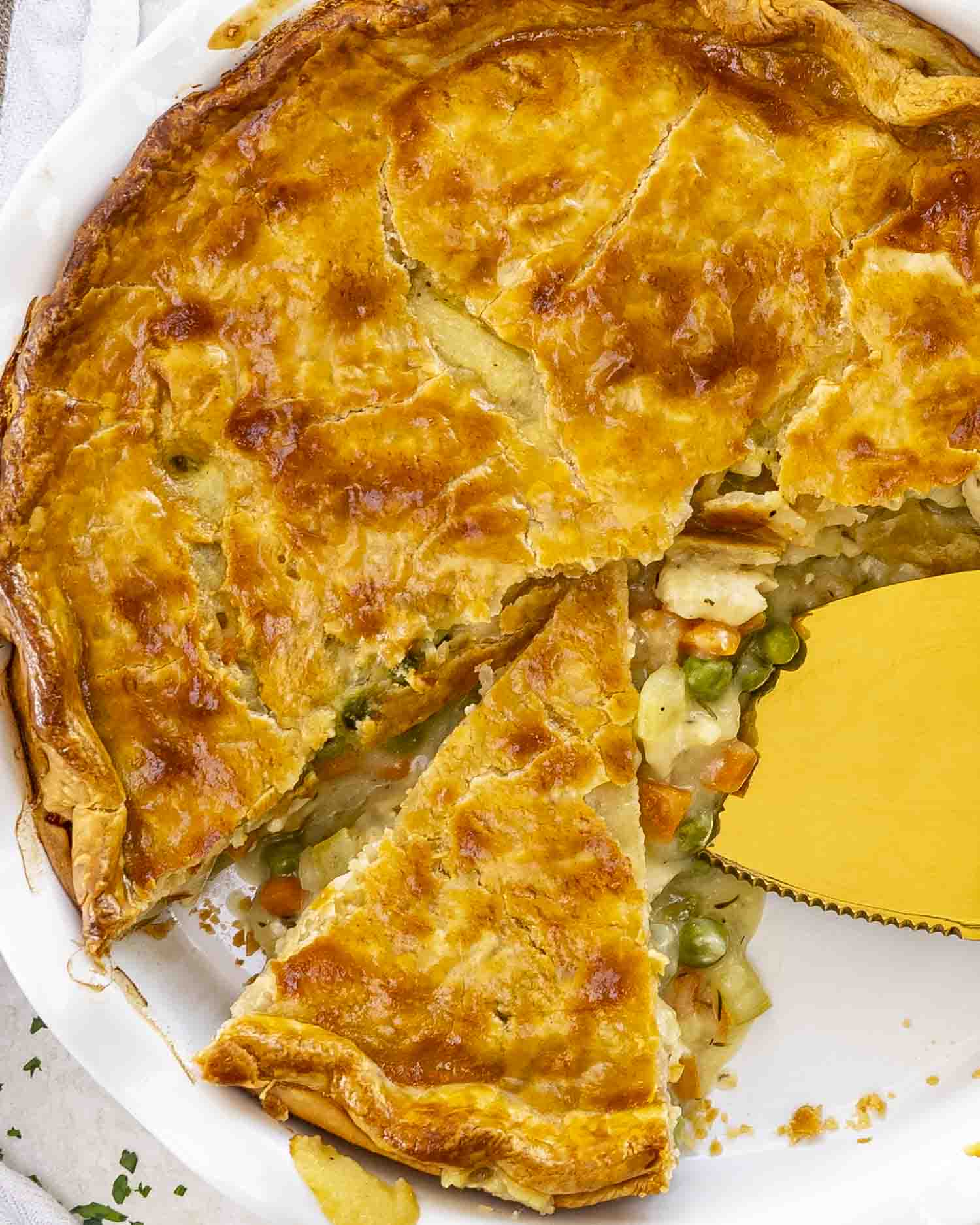
Tender chicken and vegetables in a thick creamy sauce, tucked under a golden double crust with little steam vents cut in the top. This Chicken Pot Pie slices clean, and the 10 minutes it spends cooling on the counter will be the longest 10 minutes of your week.
Table of Contents

Can I tell you the thing that actually makes a pot pie good? It isn’t the crust. Everybody thinks it’s the crust.
It’s how thick you make the sauce.
Pot pie filling has 1 job that soup never has to think about, which is standing up straight on a plate after somebody has cut a wedge out of it. Get it thin and it tastes exactly as lovely and then slumps, and what you’ve made is chicken soup wearing a little pastry hat. I’ve put the actual numbers in the next section so you don’t have to take my word for it.
The crust is homemade, top and bottom, and it’s my pie crust recipe. Store bought is completely fine and I’m not going to say a word about it. But if you’ve got 20 minutes, the homemade one is flakier and you’ll taste it.
One last thing and then I’ll get out of your way. Let the filling cool for 10 minutes before it goes anywhere near the pastry. Hot filling melts the butter in the bottom crust before the oven can set it, and that is the entire reason soggy bottoms exist. Ten minutes. Go put the kettle on.

- Chicken breasts (1 pound, boneless and skinless, cut into small pieces): Thighs work too and they’re more forgiving. Cut them about ½ inch so every forkful gets some.
- Butter (⅓ cup, unsalted): Half the roux. It seems like a lot of butter and it’s the right amount of butter.
- All purpose flour (⅓ cup): The other half, and the reason the filling holds together.
- Chicken broth (1½ cups, low sodium): Low sodium so you’re in charge of the salt, because the sauce reduces and concentrates.
- Milk (1 cup): Whole milk. It softens the broth into something creamy without going as heavy as cream.
- Carrots (1 cup, diced) and celery (1 cup, diced): Diced about the same size as the chicken. Big chunks of carrot don’t fully soften in the bake time.
- Frozen peas (1 cup): Straight from the freezer, in at the very end. They only need the warmth of the sauce.
- Onion (1 small, chopped) and garlic (3 cloves, minced): The base of everything. In after the chicken so they cook in the butter.
- Dried thyme (1 teaspoon) and dried rosemary (1 teaspoon): A full teaspoon of each. Rosemary is assertive, so crush it between your fingers on the way in to break it up.
- Salt and pepper (to taste): Taste the filling before the top crust goes on. That’s your last chance.
- Pie crusts (2, homemade): 1 for the bottom, 1 for the top.
- Egg (1, beaten): For the wash, and the only reason the top goes golden instead of pale.
Heat the oven: Set it to 425°F. That’s hot, and it’s what gets the crust going fast enough to set before the filling soaks into it.

Cook the chicken: Melt the ⅓ cup of butter in a large skillet over medium heat. Add the diced chicken and cook until it’s no longer pink.

Add the vegetables: Stir in the chopped onion, the 1 cup of carrots, the 1 cup of celery and the 3 minced garlic cloves. Cook until they’ve softened.

Make the roux: Sprinkle the ⅓ cup of flour over everything and stir it in. Cook for 1 to 2 minutes so the raw flour taste goes. It’ll look thick and pasty and that’s exactly right.

Build the sauce: Whisk in the 1½ cups of broth and the 1 cup of milk. Keep whisking and let it simmer until it thickens enough to heavily coat the back of a spoon. Stir in the 1 teaspoon of thyme, the 1 teaspoon of rosemary, the 1 cup of frozen peas, and salt and pepper. Taste it.

Let it cool: Take the pan off the heat and give the filling 10 minutes.

Assemble: Press 1 pie crust into a 9 inch pie dish. Spoon the cooled filling in. Lay the second crust over the top, trim the overhang, crimp the edges together to seal, and cut 3 or 4 vent slits in the middle.

Egg wash: Brush the beaten egg over the top crust, including the crimped edge.

Bake: Set the dish on a baking sheet and bake 30 to 35 minutes, until the crust is golden and the filling is bubbling through the vents.
Rest it: 10 minutes on the counter before you cut it.
A roux is just equal parts butter and flour, cooked together until the flour stops tasting like flour. Here it’s ⅓ cup of each, and that’s the whole mystery.
Now the numbers. Those ⅓ cups go up against 2½ cups of liquid, which works out to around 2 tablespoons of flour per cup. A soup would use half that. A gravy sits somewhere in between. Pot pie wants the thick end of the scale, and in the pan it is going to look like far too much flour. It isn’t.
Three things and then you’re an expert.
Cook the flour before any liquid goes in. A minute or 2 is plenty. Raw flour has a chalky taste that butter cannot cover for it.
Pour the liquid in gradually and keep whisking. All at once gives you lumps, and lumps at this stage are genuinely annoying to fix.
Let it get properly thick. Drag your finger across the back of a coated spoon and the line should stay where you put it. If it runs back together, keep going.
Too thick, splash in more broth. Too thin, give it a few more minutes. Both are a 30 second fix right now and completely unfixable once it’s inside a pie.

Homemade, top and bottom, and it’s worth the 20 minutes. Here’s the crust I use.
Store bought refrigerated crusts are a perfectly respectable choice. Let them sit out for 10 or 15 minutes before you unroll them, because a cold crust cracks along the folds and then you’re patching pastry with your thumbs.
A few things that matter either way:
Seal the edges properly. Press the top and bottom crusts together all the way around and crimp them. A gap is a door, and that’s where the filling comes out.
Cut vent slits. 3 or 4 in the middle. Steam needs an exit. Without one it lifts the top crust into a dome and then splits it somewhere you didn’t pick.
Egg wash everything on top, edges included. The only difference between golden and sadly pale, and it takes 15 seconds.
Put the dish on a baking sheet. Something always bubbles over, and you would much rather find it on a tray than welded to the floor of your oven.
And if you’d rather use puff pastry on top, go ahead. It bakes up taller and lighter. Skip the bottom crust if you do, because puff pastry under wet filling never recovers.
Yes, and I think you should more often than you probably do.
Use about 3 cups of shredded cooked chicken. Skip the step where you cook the raw chicken, start by melting the butter and softening the vegetables in it, and stir the chicken in right at the end with the peas.
Leftover roast chicken is the same. So is leftover turkey, which makes this a very useful recipe to have in your back pocket around the end of November.
One small thing: rotisserie chicken comes pre seasoned and sometimes quite enthusiastically, so taste the filling before you add any salt.

- Keep everything about the same size. Chicken, carrots and celery all around ½ inch. It cooks evenly and every forkful gets a bit of everything, which is really the whole point of a pot pie.
- Taste the filling before it goes in the crust. Once that top crust is on, you’ve made your decisions.
- Don’t overfill the dish. Level with the rim, not mounded. An overfull pie pushes its lid off and bubbles down the side, and the sheet pan will catch it but your crust looks defeated.
- Peas go in last, still frozen. Cook them fully and they turn a sad olive color.
- Rest it 10 minutes before cutting. A rested pie gives you a slice. A hot pie gives you a lovely warm landslide.
- Little individual ones. Divide the filling between 4 or 6 ramekins and lay a round of crust over each. Same oven, 20 to 25 minutes. They’re very sweet, and people get unreasonably excited about having their own.
- Skillet version. Leave the filling in an oven safe skillet, drape 1 crust over the top, and bake it in the same pan. No bottom crust, fewer dishes, and the edges go crisp against the hot sides.
- Biscuit topped. Drop Cheddar Cheese Buttermilk Biscuits over the filling instead of pastry and bake until they’re puffed and golden. A completely different dinner and an excellent one.
- Different vegetables. Corn, green beans, diced potato, mushrooms. Anything you like, keep the total around 3 cups so the sauce still has something to hold onto.
- Fresh herbs. Thyme and rosemary instead of dried, and use 3 times as much.
- A little richer. Swap ½ cup of the milk for heavy cream and see how you feel about yourself.
Covered in the fridge, 3 to 4 days. The crust softens overnight, which is the sort of thing an oven exists to fix.
Reheat slices at 350°F for 15 to 20 minutes, uncovered, and the pastry crisps right back up. The microwave gets it warm in 2 minutes and leaves you with a soft crust, and sometimes that’s the trade you want to make. I’m not here to police your Tuesday.
To freeze it unbaked, assemble the whole pie, wrap it tightly, and freeze up to 3 months. Bake straight from frozen at 425°F for 50 to 60 minutes. If the edges brown before the middle is bubbling, tent them with a bit of foil.
To freeze it baked, cool it completely first, then wrap and freeze. Reheat from frozen at 350°F for about 45 minutes.

Before You Begin! If you make this, please leave a review and rating letting us know how you liked this recipe! This helps our business thrive & continue providing free recipes.
Chicken and vegetables in a thick creamy sauce under a homemade double crust. The roux is deliberately heavy so the filling holds its shape when you slice it, and cooling the filling before it goes into the crust is what keeps the bottom crisp.
For the Filling:
- 1 pound boneless skinless chicken breasts (or thighs, cut into small pieces)
- ⅓ cup unsalted butter
- 1 small onion (chopped)
- 1 cup carrots (diced)
- 1 cup celery (diced)
- 3 cloves garlic (minced)
- ⅓ cup all-purpose flour
- 1½ cups chicken broth (low sodium or no sodium added)
- 1 cup milk
- 1 teaspoon dried thyme
- 1 teaspoon dried rosemary
- 1 cup frozen peas
- salt and pepper (to taste)
For the Crust:
- 2 pie crusts (store-bought or homemade)
- 1 egg (beaten )
Before You Begin! If you make this, please leave a review and rating letting us know how you liked this recipe! This helps our business thrive & continue providing free recipes.
-
Preheat your oven to 425°F (220°C).
-
Melt the ⅓ cup of butter in a large skillet over medium heat. Add the diced chicken and cook until no longer pink.

-
Add the chopped onion, the 1 cup of carrots, the 1 cup of celery and the 3 minced garlic cloves. Cook until softened.

-
Sprinkle the ⅓ cup of flour over the mixture and stir to combine. Cook for 1 to 2 minutes to remove the raw flour taste.

-
Whisk in the 1½ cups of chicken broth and the 1 cup of milk. Simmer, whisking, until the sauce thickens enough to heavily coat the back of a spoon.

-
Stir in the 1 teaspoon of thyme, the 1 teaspoon of rosemary, the 1 cup of frozen peas, and salt and pepper to taste. Remove from the heat and let the filling cool for about 10 minutes.

-
Press 1 pie crust into a 9 inch pie dish. Add the cooled filling.

-
Top with the second crust, trim the overhang, crimp the edges to seal, and cut 3 or 4 vent slits in the top.

-
Brush the top crust and edges with the beaten egg.
-
Place the dish on a baking sheet and bake for 30 to 35 minutes, until the crust is golden and the filling is bubbling through the vents.

-
Let the pie rest for 10 minutes before slicing.
- The sauce has to be thick before it goes in. It should heavily coat a spoon. It won’t thicken any further in the oven, so a thin sauce in the pan means a runny pie on the plate.
- Cool the filling 10 minutes before assembling. Hot filling melts the butter in the bottom crust before the oven can set it, and that’s what makes a soggy bottom.
- Rest 10 minutes before slicing. The filling is still setting when it comes out of the oven.
- Crust: Homemade, top and bottom. Store bought refrigerated crusts work, and should sit out 10 to 15 minutes before unrolling so they don’t crack. Puff pastry can replace the top crust, but skip the bottom crust if you use it.
- Rotisserie chicken: Use about 3 cups shredded. Skip step 2, soften the vegetables in the butter, and stir the chicken in at the end with the peas. Go lighter on the salt.
- Peas go in at the end, frozen. They only need the heat of the sauce.
- Bake on a sheet pan. It usually bubbles over.
- Make ahead: The filling keeps 2 days in the fridge. Add 5 minutes to the bake if you’re assembling from cold.
- Freezing: Unbaked and wrapped tightly, up to 3 months. Bake from frozen at 425°F for 50 to 60 minutes, tenting the edges if they brown early.
Serving: 1servingCalories: 546kcal (27%)Carbohydrates: 44g (15%)Protein: 26g (52%)Fat: 29g (45%)Saturated Fat: 12g (75%)Polyunsaturated Fat: 3gMonounsaturated Fat: 11gTrans Fat: 0.5gCholesterol: 106mg (35%)Sodium: 479mg (21%)Potassium: 658mg (19%)Fiber: 4g (17%)Sugar: 5g (6%)Vitamin A: 4697IU (94%)Vitamin C: 7mg (8%)Calcium: 104mg (10%)Iron: 3mg (17%)
Notice: Nutrition is auto-calculated for your convenience. Where relevant, we recommend using your own nutrition calculations.
Why is my filling runny?
Why is my bottom crust soggy?
Can I use rotisserie chicken?
Can I make it ahead?
Can I freeze it?
What if I don’t have a pie dish?
Do I need to blind bake the bottom crust?
Can I use all milk, or all broth?