I first saw Brahna Yassky give a reading at cidery Seminary Hill a few years ago for an event sponsored by my local bookshop One Grand Books.I enjoyed what I heard of her work and so was delighted to see her name come across my desk a few years later. Her essay, the latest in our Personals section, is a tale of adventure, travel and things not always being quite what they seem. —Jesse Sposato, executive editor
In my early 20s, opportunity knocked often. In that, I was not unique. But while for many, it came in the form of job offers, career advancement, even marriage proposals, for me, it came in the form of adventure, which I found much more appealing.
As a generous college graduation gift, my parents gave me a summer-long trip to Europe. It was 1970. I arranged to meet my then-boyfriend, Brian, in Athens — the first stop of the trip. Three years before, I had transferred to San Francisco State from NYU, at just 18. I’d met Brian, a rugged redheaded Irishman 10 years my senior, on a previous visit, and when I returned, he introduced me to the pleasures of womanhood. Yet we were very opposite. I was studying sociology and jewelry design, and he was an ex-football player turned sharp, competitive stockbroker.
It was clear to me that Brian prided himself in being successful in the straight business world. But through me, with my long dark hair and bell-bottoms, and my proximity to the revolutionary changes happening at my school, he enjoyed a window into the counterculture. He tempted me with the kind of fun that boys at my school and at the nonprofits where I volunteered couldn’t, taking me on spontaneous trips to Mexico and out to high-end restaurants, which to a college kid seemed very sophisticated.
He even had a weekend rental house up north in the hills of Marin County. One Saturday, as we were approaching the property, we passed fire engines driving in the opposite direction. When we arrived at the house, all that was left were black embers. Brian turned to me and said, “I was getting tired of my job. This is a sign. Somewhere in the ashes are my Brooks Brothers suits. Time for a hipper gig.” Within the next week, after doing some research on what would sell, he decided to import clothing and jewelry from Afghanistan. I didn’t see him for months at a time. He’d return every now and then and give me soft cotton dresses and silver bracelets. The boutiques in the Bay Area couldn’t get enough of his goods. He knew his market.
When I arrived in Athens, directly from the U.S., Brian was not at our designated meeting place, a little taverna he had suggested steps from the Acropolis. I took a simple room above the café for $1 a night. Since I expected Brian to show up at any moment, it felt like the beginning of a new adventure. After a week of exploring the city, especially the Acropolis, my footprints practically embedded in the shiny worn stone steps, I’d had my fill of retsina, ouzo and octopus stew. I travelled to Istanbul with two brothers I’d gotten to know at the taverna. When I returned to Athens, about to go to Italy on my own, I stopped at communication central, the American Express office, and found a letter from Brian. He apologized for his long delay and wanted to see me right away. Despite myself, I was still in love with my Irishman.
When we met up at the little taverna at last, he said, “Babe, I’m so sorry I wasn’t here when you arrived.” He kissed me and held me close to his muscular chest. “I was in the caves of Matala. Days ran into each other. Really cool international scene, but you look more far out than any of the chicks there. Please let me make it up to you. Take you off the beaten track to a private cove in Mykonos, then Crete, then Beirut. My treat.” Did it sound too good to be true? Maybe. But his charm was like a spell, and I could never resist.
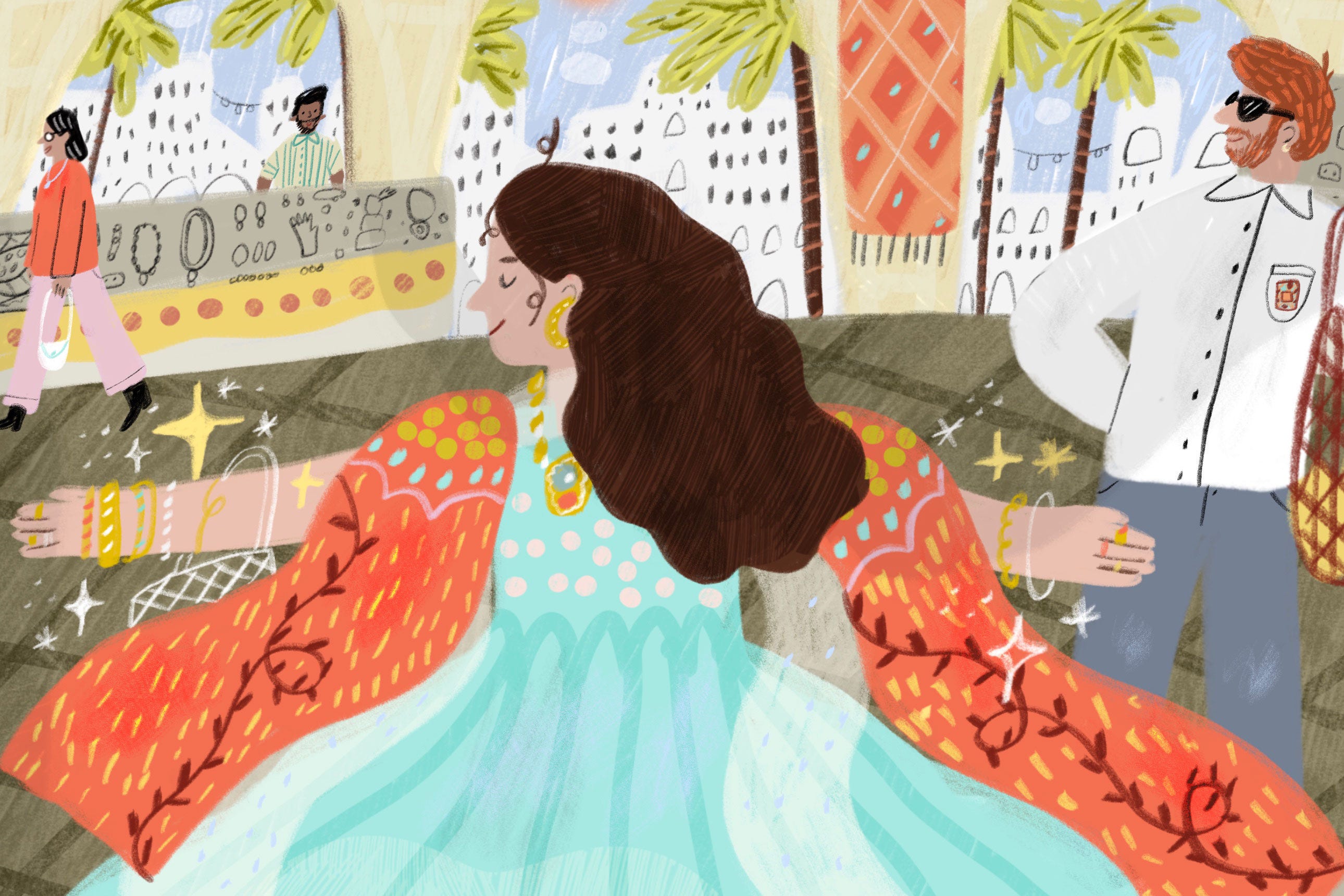
In 1970, Beirut was known as the Paris of the Middle East for its glamour and sidewalk cafe culture. We sat outside looking at the pastel buildings of the city, washed in warm golden light. I felt very sophisticated at 21, in my cerulean blue dress with tiny dots scattered like stars, and polished toenails peeking out of my wedge sandals, like a heroine in a French New Wave film.
One night, a slick man of about 30, wearing a custom-made suit, who was also staying at our hotel, took us to the outskirts of town. On a dirt lot, sprouting sparse blades of grass, stood a Bedouin home, constructed of newspaper and mud, topped with a tin roof. Three generations of men sat in a circle on the floor playing music with hand drums. The women, bearing traditional geometric tattoos, took turns belly dancing in the middle to the men’s drumming. When the oldest woman entered the center of the circle, she nodded at me and crooked her finger seductively signaling me to join her. She appeared to be in her 70s, though it was hard to say for sure. Her body was swathed in fabric, and she moved like a temptress. Caught up in the spirit, I shimmied toward her and received my first belly dance lesson. I was able to transform my freestyle hippie bump-and-grind into a more disciplined movement where my hips and stomach were at the center and I was using muscles I didn’t know I had. The enthusiastic crowd let out high-pitched yelps, their tongues fluttering and tickling the roofs of their mouths. I had found my primordial Semitic roots and felt oddly at home.
The next day we drove to the lush cedar trees Lebanon is famous for. I thought the fragrant groves were our destination, but Brian kept going until we reached a barren region and drove up to a gate. We were greeted by a family of chicken farmers. Brian knew the son, Ahmed, who spoke enough English to communicate with us. I soon learned these were friends of the man with the custom-made suit and the dancers from the night before, an odd coincidence, I thought. As a form of greeting, when we got out of our rental car at the gate, one of the older children slit the neck of a chicken, holding up the dead bird proudly, to show us our upcoming dinner.
Inside a simple brick house, we sat on the rug-covered dirt floor in a circle. As was the custom, everyone ate with their hands. I joined in and when I looked up, I noticed the entire family was staring at me. Ahmed pointed at a photograph of a woman on the wall and said, “That was my mother’s sister. You look exactly like her. We all feel like she has returned to us through you.”
For three days Brian left in the morning with Ahmed, and the family fussed over me, feeding me nuts and roasted chick peas because I looked like their deceased relative. Brian would return in the late afternoon, excitedly sharing that he was making great connections for expanding his import business.
We went to Damascus from there and hit the bazaars, buying armloads of satin striped robes, embroidered dresses, blouses, brass lamps that looked like they contained genies, inlaid mother-of-pearl chests, silver and amber jewelry. “Pick what you want, baby. One of the boxes will be for you,” Brian said. I felt pampered and extremely lucky. If things seemed a bit too smooth, the connections too effortless, I didn’t allow myself to notice.
About a month after we returned to California, the treasures arrived by boat in San Francisco. Brian went to pick them up in his van and brought them to a house he’d been renting in a remote part of Marin County where we’d been living together. I could hardly wait to be reunited with all the beautiful things we’d picked out. I grabbed a hammer and started prying the plywood box loose. Just then there was a knock on the door. Brian looked out the window and told me to go into the bedroom. Before I could protest or even move, two men with sunglasses, leather motorcycle jackets and black work boots stomped into the room.
“Hey man, I see the boxes finally got here,” said the one with long, dark, greasy hair and a skull-and-crossbones tattoo on his hand.
“Yeah. It’s all cool, but can you come back in an hour after I unpack? I want to give my old lady some of these beautiful objects,” Brian said. “She’s been waiting a long time.”
“We’re tired of waitin’ too,” the other guy said, slipping his hand in his pocket.
“Just give me a few,” Brian said.
I was about to ask what was happening when I noticed the middle layer of the plywood was crumbling. It had the familiar sweetish odor of hashish. I walked toward it.
“Step back,” Brian said to me, his freckles seeming to blend into his suddenly red cheeks. “Don’t touch the box.” Once I got closer, I could see that sheets of hashish formed the entire middle layer of each plywood box. Just as I was starting to put the pieces together, he steered me toward the bedroom and closed the door. “I’ll be right back,” he said. “Don’t leave this room.”
I stood by the bedroom door and heard the scraping of chairs. “Here’s a couple of beers,” Brian told them. “Just, please, chill for a few minutes.”
When he came back to me in the bedroom, I shouted in a loud whisper not wanting anyone else to hear me but having a hard time containing my anger, “You’re unbelievable! You used me — taking me on a drug-smuggling scam as your front to make you look like a legitimate businessman!” I despised him at that moment, but I was equally disgusted with myself for being so blindly trusting, gullible and clueless; for being so attracted to him and to the glamorous life he dangled in front of me that I was willing to ignore all the red flags that now seemed so bright. Like many of my generation, I wanted an alternative lifestyle, but not at a price this steep, this dangerous, this illegal.
“You were never my excuse,” he said. “I couldn’t let you know. I didn’t want you to be involved if I got caught.” A smile lit up his blue eyes. “You have to admit, though, it was a clever scam against The Man,” he continued. “Every day I went off with Ahmed we milled the plywood, flattening and inserting sheets of hash into it.” When he looked up, he could see that I wasn’t quite as impressed with his ingenuity. “I thought you would dig the adventures we had and the beautiful things I bought for you,” he offered. “I wanted you to be with me to share these incredible experiences because I love you.”
I stared at him. “Love?” I managed to eke out. “I don’t think that’s what this is.” Maybe this had been love in the beginning, before the fire at his country house, before his eureka idea, but it was clear to me now that that had been replaced a while back by something else — greed, desire, convenience. Maybe for both of us. As soon as the men split with the goods, I drove off leaving behind the lamp, the clothes, the furniture, the jewelry, the boyfriend and some of my innocence.
My relationship with Brian did not turn out how I’d hoped, but what remained was the allure of adventure. Risking my freedom in exchange for a pretty necklace — many pretty necklaces even — wasn’t worth it, but I didn’t want to let this messy chapter destroy my curious spirit either. Rather, I continued to find it during the next, formative decade of my life. While living on a houseboat in Sausalito, I met and fell in love with a handsome, gangly man with an appealing guilelessness. He had just given up his job in the new-to-me field of computer programming and bought an antique, wooden fishing boat. It had always been his fantasy to be a commercial fisherman. Though fishing was not my fantasy, I was smitten by him, and together we spent a few years living at sea.
Holding onto the sides of the bow of his boat I would sway with the waves, and when I found my rhythm, practice my belly dance moves. There was a profound sense of freedom being on the deck, splashed by a salty breeze more than 12 miles off shore where land rules didn’t apply — and no one had broken them, even if they had.
Brahna Yassky’s award-winning memoir, Slow Dancing with Fire, was published in 2022, and she just finished her first novel, The Inseparables. Her writing has appeared in The New York Times, Salon, The Independent, Wired, Business Insider, Lilith and American Writers Review, among others. She lives in Brooklyn.
Jesse Sposato is Narratively’s executive editor. She has also written about feminism, friendship, culture and parenting for a variety of outlets, including Vanity Fair, InStyle, Slate, HuffPost, Memoir Land, The Rumpus and more. She is currently working on a collection of essays about coming of age in the suburbs, discovering punk rock and being boy crazy.
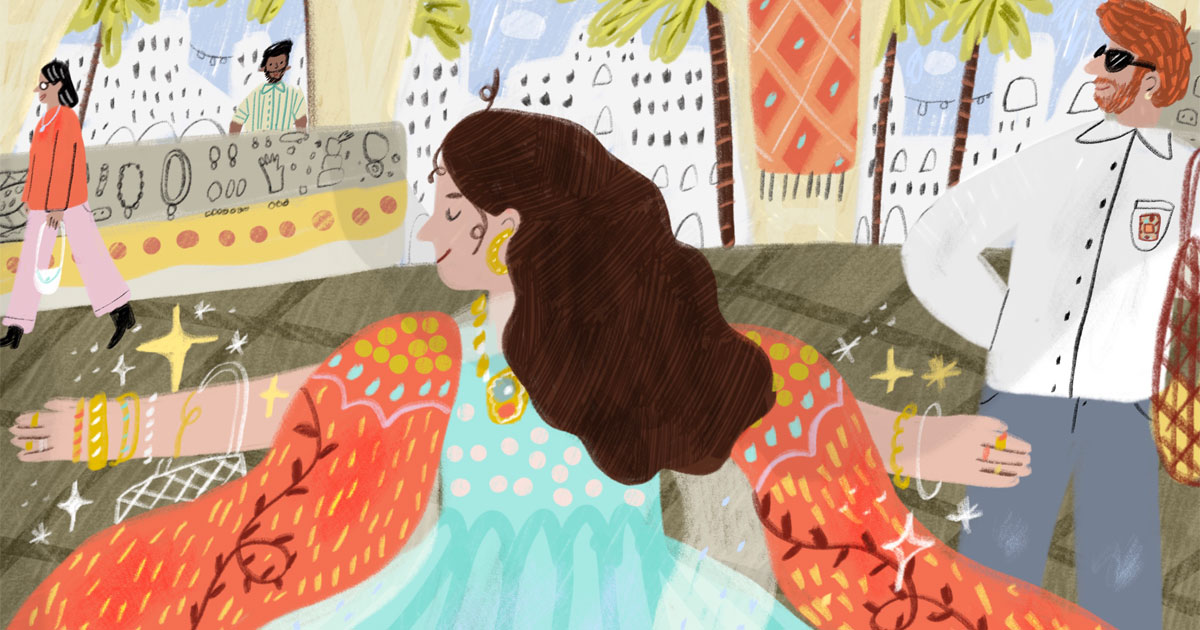
Connie Nobleis an illustrator and animator based in sunny Brighton, England. Her work is inspired by the natural surroundings, textures and colors of living by the sea.