Technomic: Restaurants struggle with traffic and consumer caution

4 Min Read

Robert Byrne shares an industry outlook at CREATE: The event for emerging restaurateursBret Thorn
This year is shaping up to be marginally better than last year for the restaurant industry, but not by much as both operators and their customers are coping with rising costs and muted confidence.
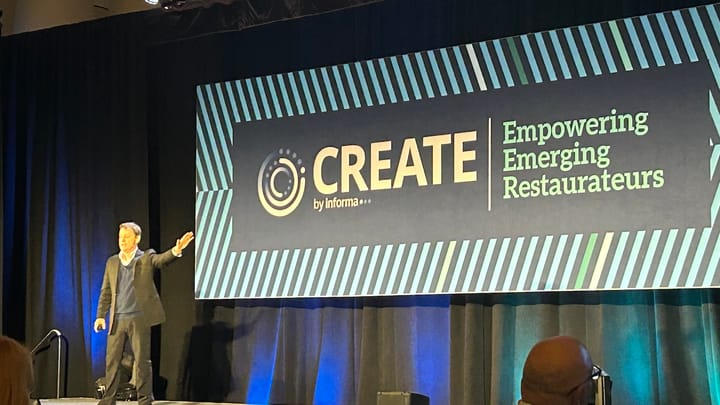
That was the assessment of Robert Byrne, senior director for consumer research at Technomic, who provided a mid-year update on the state of the industry for attendees of CREATE: The Event for Emerging Restaurateurs at the Terranea Resort in Los Angeles on Monday.
He also said that restaurateurs should evaluate their investments in technology, especially as younger consumers push back against AI and other obstacles to human connection.
Traffic concerns
Restaurant traffic has been muted for a couple of years, and it continues to be uneven as consumers, challenged at the gas pump and elsewhere in their expenses, have pushed back against rising menu prices, a necessity for operators as their own costs rise. Although increases in average checks have kept sales from cratering, that’s not ideal for improving traffic, Byrne said.
He said the fast-casual segment is performing marginally better than other segments, but not by much, and not across the board, with chains such as Chipotle and Shake Shack reporting traffic growth while others, such as Panera and Jimmy John’s are struggling.
A similar situation can be seen in full-service restaurants, where steakhouse chains such as Texas Roadhouse, LongHorn Steakhouse, and The Capital Grille are performing well, as are other outliers such as Chili’s and First Watch, and Asian concepts such as Kura Sushi and KPOT, “but overall, the declines are broad,” Byrne said.
Part of the challenge is also the sheer number of restaurants that are currently operating — one for every 400 adults.
“There’s a lot of saturation,” he said, despite the fact that the number of net restaurants is falling, especially among independents, which lost nearly 10,000 limited-service venues and 13,000 full-service ones.
A number of factors besides rising costs are affecting consumer confidence, he said, including anxiety over tariffs and the situation in the Middle East.
Additionally, GenZ consumers — those born around 1995 or later, are cash-strapped, with higher unemployment rates than Millennials had at the same age while the cost of living continues to rise.
Older consumers continue to control most of the nation’s wealth, with 51.4% in the hands of Baby Boomers and another 26% controlled by Generation X.
“Many have been priced out of segments that they once frequented,” Byrne said, adding, “The affordability crisis is absolutely affecting traffic.”
He said that 46% of consumers say they’re visiting restaurants less frequently because of rising gas prices, and even affluent consumers, with annual incomes of $100,000 or higher, are worried, with only 11% of them saying they’re not concerned about the economy.
Shifting demographics
Population growth rates are slowing, and will be close to a standstill in the next five year, when it’s projected to increase by just 0.2%.
As birth rates decline, that could also affect restaurant traffic, particularly since households with children are more likely to eat out than those without children, regardless of their income bracket.
Bringing customers back
Byrne said that food & beverage quality remains the most important factor when consumers decide where to eat out, followed by cost, except for households with annual incomes of $35,000 or under, for whom cost is the deciding issue.
Deals have become increasingly important in their decision-making process, with two-for-one offers, often tied to loyalty programs, being a successful approach.
Menu innovation is also increasingly important as restaurants have sped up the cadence of introducing new menu items, which are up by 13% year-over-year and 134% over the past five years.
Byrne cautioned about adding complexity to operations with new items and limited-time offers, but they can be great for capitalizing on trends, particularly beverages, which younger customers gravitate toward both for their high flavor and visual impact and because they can afford them more easily than a meal.
Tech check
Byrne said that while social media remains a huge boon to restaurant marketing, consumers, especially younger ones, are developing a growing aversion to the “endless doom scrolling” that they find themselves doing. That has led to “tech minimalism” such as switching from smart phones to flip phones, as they come to realize that all the information and commentary that they have at their fingertips might not actually be good for them.
He cited the term “friction maxxing,” which involves doing away with using QR codes, paying with cash, and engaging with actual humans rather than AI voice recognition software or even kiosks.
He said nearly half of all consumers find AI assets to be unappealing, adding that chains that focus on providing great service and human interactions, such as 7 Brew, Dutch Bros, and In-N-Out Burger continue to perform well.
Byrne advised attendees to focus on tech investments that actually improve customer experience.
Forecast for the year
Looking ahead, Byrne said he expects 2026 to be a little better than last year in terms of sales, with 0.7% net real growth, with the fastest growth in limited-service restaurants in Coffee Café and Asian Noodle concepts, followed by chicken and beverage/snack.
Among full-service restaurants, Asian concepts and steakhouses are expected to see the largest growth while seafood concepts are expected to decline.
Contact Bret Thorn at [email protected]