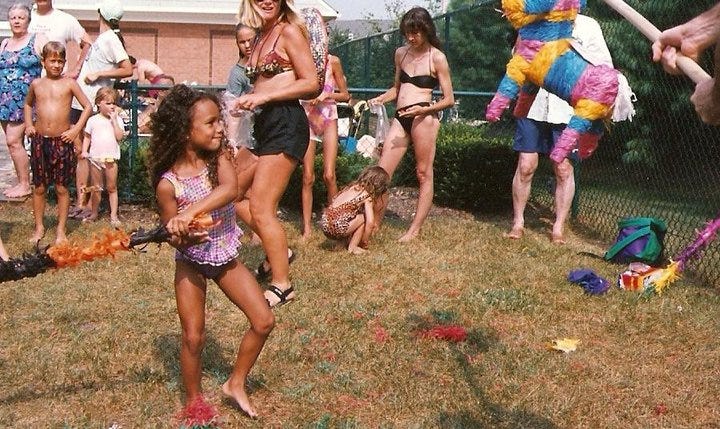
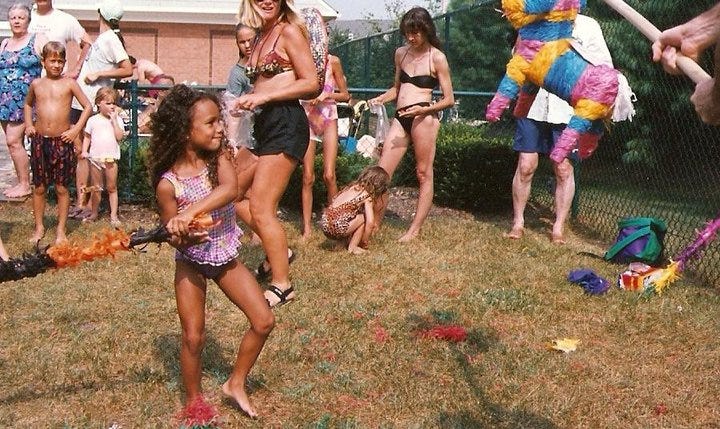
Photos courtesy the author.
This story is part of our ongoing series From the Ground Up, a collaboration between Narratively and ScottsMiracle-Gro exploring the lives, memories, and connections rooted in the yards, fields, and green spaces we call home.
It’s the summer of 1998 — yes, the late 1900s for those Gen Alpha readers — and I’m in my front yard in the humid heat of a Maryland July. My mom has the bay window open so she can hear me. At eight, I’m somewhat unsupervised and it’s not unusual for kids my age to be given a long lead, especially when you’re the oldest of five like me. Well, not quite five.
My little brother hasn’t been born yet.
We live at the end of the cul-de-sac and the other kids in the neighborhood are not out to play yet. I am bored. So bored that I decide to try a few exaggerations that I learned in school: “I’m so bored I could watch paint dry,” or “I’m so bored I could watch grass grow.”
OK, challenge accepted.
I lie belly-down in the green grass of our short patch of front yard and stare at it, at each individual blade and the lines that run up them. I pluck one and realize I can peel it along those lines, then twirl their pointy strands.
Something moves.
Slowly, before my very eyes, the dewy grass comes alive. A roly-poly beetle lumbers in the shade. A small spider clings to the top of a blade, wiggling his pincers. A line of black ants weave through strands. Army-crawling, I follow them.
I slither through clumps of clover, flat leaves where a dandelion will sprout, and a waxy shine of darker green grass in one spot. A small mound of yellowed sand is guarded by army ants ready to defend the nest or builder ants trying to fix something. I wonder what happens when it rains.
I scooch forward and smell onions, so I dig, and out pops a strange-looking bulb that I put in my pocket to give to my mom later. I think that it’s not boring to watch grass grow.

If it’s not obvious, I’m neurodivergent, on the autism spectrum. (Don’t worry, my parents didn’t notice either.) I am a kid who examines, who focuses on the little details, who needs to understand before doing. I am an outdoor kid, full of grass stains and dirty scabs. I laze about at the tops of trees that have no ladders or safety harnesses. Being outside, being bored, is second nature.
I don’t have the language for it yet, but what I’m doing out here — spying on insects, rolling in dirt, letting my mind wander — is exactly the kind of thing researchers now say helps kids like me. Studies have found that time in nature, especially with some structure, can improve sensory, social and behavioral outcomes for those of us on the autism spectrum.
In time, as I get older, the world changes and information is at my fingertips faster than ever. I stay inside more, hiding away from allergies and burdened by adulthood responsibility. Decades pass and I have children of my own — two neurodivergent little ones.
I am the weird parent. When I’m able to get outside, I catch frogs to show off to the neighborhood kids. When a garter snake takes up residence under someone’s home, I carry it to the nearby woods to set it free.
At the very beginning of my kids’ lives, we live in rural Ohio. A main road runs in front of our house with trucks that barrel down it. The idea of letting Emma and Franklin, both still toddlers, out of my sight is terrifying. On top of that, water tests reveal questionable levels of heavy metals, which means my kids will not be slurping from the hose as I once did as a kid.
I realize that I can’t give them the same childhood I had — but at least I can give them pieces of it. The imperfect, messy, outstanding and unquestionably best pieces of it.
Keeping Emma occupied is a full-time job. She pings from one thing to the next impulsively, and it’s clear, by two and a half years old, that she has ADHD.
When we go hiking, she is strapped to my back in a carrier so she doesn’t run off the trail following whatever dopamine goblin grabs hold. I am constantly pointing out mushrooms, the soft way a fallen tree is turning into mulch and dirt, the bugs that live inside it, the colors and shapes of the changing leaves.
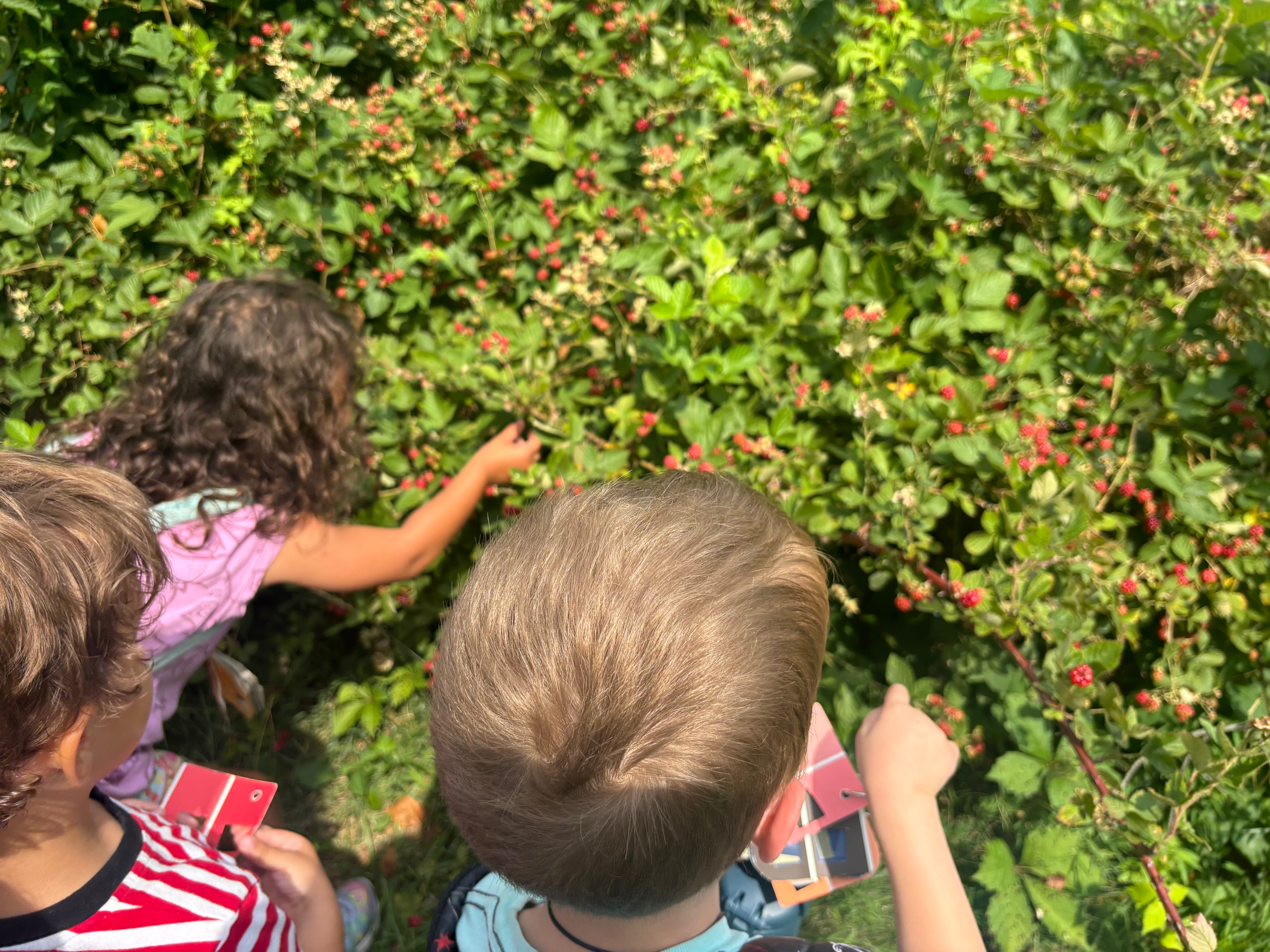
As she gets older, being bored is torture for Emma. The TV becomes her altar. She learns to dance to Vampirina and falls asleep to the sounds of Moana drumming.
Franklin is at the other end of the spectrum, closer to me. Quiet and observant, he lines his cars up by color and size, so focused that he cannot hear us call his name. But he, too, is quickly absorbed by video games. Maybe it’s odd, but I don’t feel guilty about my kids’ screen time. Moms are made to feel bad much too often, but parenting is hard, and doubly so with a special needs child. Although Emma and Franklin spend more time on electronics than I ever did, they also spend plenty of time off them — I make sure of it.
There is a bridge in town where we like to stop and throw rocks. Emma hurries to toss all of hers and they hit the river below like a spray. Immediately, she begins to complain they are all gone. Long after Emma is done, we are waiting on Franklin. He drops some rocks straight down and throws others as hard as he can, captivated by the bloops.
Later, after we resettle in Maryland, the kids attend a nature preschool in the summer, where they spend the day hiking through the meadows and forests of a historic nature conservancy. One of the class pets is a rescued corn snake.
I work hard to continue their outdoor adventures away from school, too. One day, we plant tomatoes, cucumbers, lavender and peppers in my sister’s backyard. Emma scatters the seeds with a toss. Franklin digs meticulous holes. What’s interesting is that this also becomes a balance. Franklin and I do not enjoy eating the vegetables, but Emma eats cucumber after cucumber throughout the summer and fall.
These outdoorsy exploits offer injections of Vitamin D and sensory exposure in controlled environments — good for autism and ADHD — even if dirt is sticky, and it can get muddy, and gritty and infiltrate your nails. Ugh.
Yet, we never wear gloves. We put our hands directly in the soil, brushing the excess against our jeans. I have a lot of allergies so pollen needs to be washed off before I touch my face, or eczema breaks out on my hands. Still, I think it’s important to be uncomfortable sometimes — and my kids know it, and believe it too.
When nature’s imprint becomes too much for us, which it often does, we use the hose to rinse off. The water is cold. A shock. It takes a moment for Franklin to touch it — and only after I widen and soften the spray for him — but Emma dodges in and out, racing with it.
Through the mist, I show the kids rainbows against the fence.
In autumn, we make a habitat for three baby box turtles until we can go to the local wildlife sanctuary.
The kids watch the turtles settle in for a few moments and then, inevitably, wander off to find their Nintendos. Sometimes I mourn that they’re not going to have the same wild childhood, the freedom to get bored. They won’t spend hours digging their own “fox den” — but they’ll also probably not get poison ivy so bad that it requires steroids, or fall face-first into a thorn bush.
Nintendos in hand, the kids take seats next to the baby turtles and turn on their games, games that autosave now, so they can still get outside, get muddy and grass-stained, and let their minds roam free — without having to worry about losing their place.