The best writing is visceral, descriptive in a way that feels unique and specific, and moving. This piece from Chris — the latest in our Personals section — checks all three boxes. Waterproof mascara recommended.
The first time I met Douglas, it was in a hospital that smelled of bleach and overripe fruit cups. The air conditioners rattled in their metal sleeves, pushing out air that felt both cold and stale. It was July in the Bronx in the mid-1990s, and I was a first-year intern — too new to know what I didn’t know.
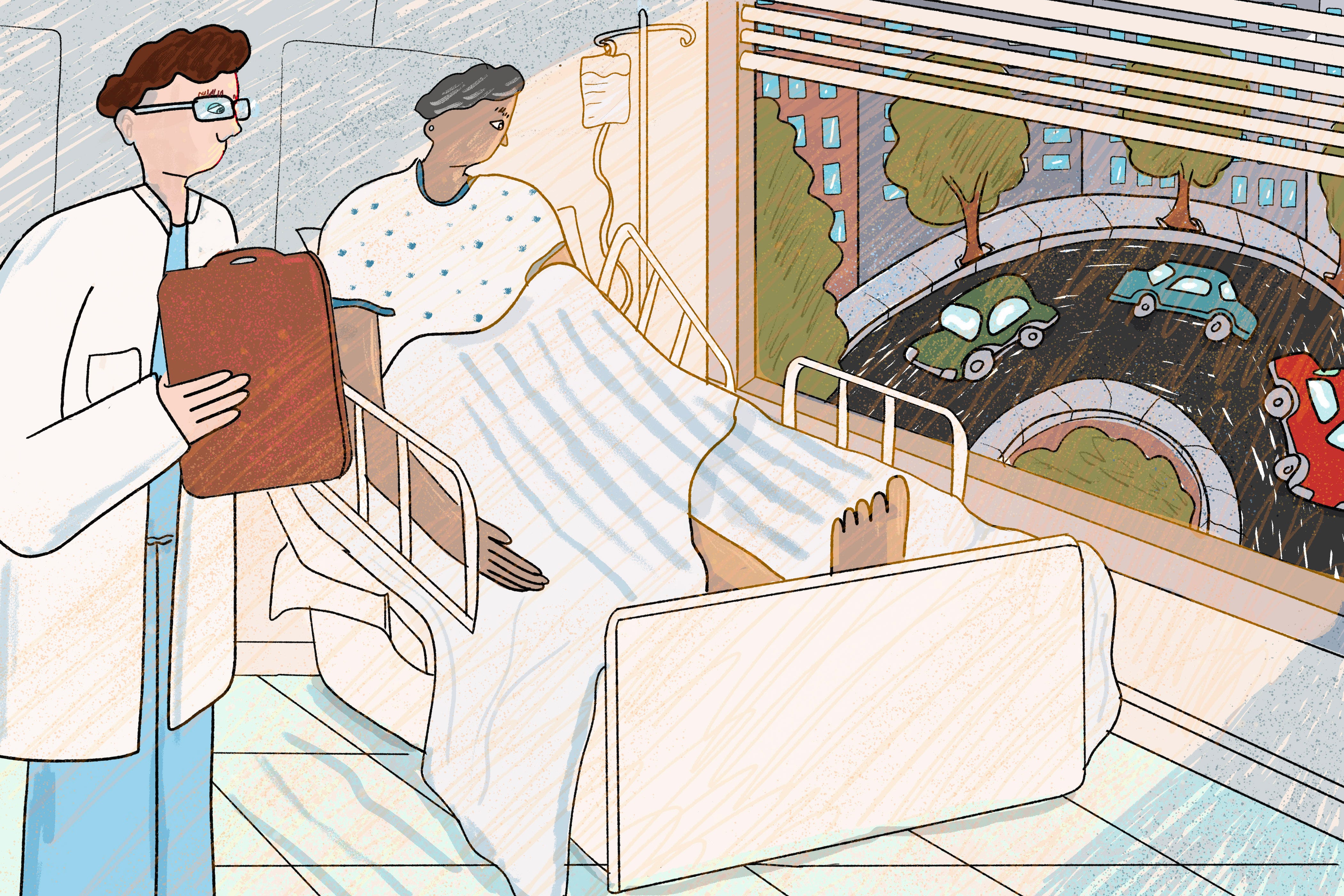
Douglas was my first real patient. When I entered his room, he was sitting upright near the window, watching the traffic circle below. The morning light caught the edge of his face, a halo against the grime-streaked glass.
“Come on, man, move already,” he muttered, not at me but at the chaos of taxis outside. His chart said 47 years old, diabetes, peripheral vascular disease, status post-amputation: first below the knee, then above. The infection had climbed higher again.
“It’s my leg, not my stump,” he said in response to the senior resident when he callously summarized Douglas’ case to me.
That correction stopped me. It wasn’t defiance — it was insistence on personhood. A reminder that he was more than what had been cut away.
When the resident left, I stood there, clipboard in hand, unsure how to begin. Douglas turned finally to look at me.
“You new?” he asked.
I nodded.
“Well, don’t mess it up.” He smiled, the first crack of warmth. Then he gestured toward the gauze wrapping what was left of his thigh. “You ready to see something real?”
I peeled away the dressing. The smell hit first: sweet, metallic, heavy as rust. Then came the sight: the blackened flesh, the yellow line of pus, the red border where living skin fought to hold ground. I felt my throat tighten.
“Keep going till it bleeds,” Douglas said. “That’s how you know it’s alive.”
At the time, I took it as instruction. Later, I realized it was philosophy.

Each morning, I came to change his bandage. The routine became ritual: roll up my sleeves, open the sterile pack, soak the gauze. Douglas would talk as I worked — about the Yankees, about his niece’s baby, about the food the hospital served that he refused to eat. He called the gelatin “fluorescent regret.”
“Doc, what are you doing here anyway?” he asked once. “You look like you belong in a library, not this place.”
“Maybe I got lost,” I said.
He laughed, a short bark that ended in a cough. “Happens to all of us.”
He had been in the hospital for six months. His world had shrunk to the dimensions of that bed: the tray table with its call button, the window, the television that buzzed without sound. Yet every day he found ways to assert control — choosing when to let me touch the wound, when to tell a joke, when to turn away.
Medicine taught me that the body is territory. In Douglas’ case, the borders were collapsing, but he still guarded them fiercely. My job, I was learning, was to cross that border with care.
Some nights, after finishing rounds, I’d sit in the call room reading A Country Doctor by Kafka. In it, a doctor is called to a patient with a terrible wound in which he finds when he inspects it “worms, as thick and long as my little finger…wriggling their white bodies with many limbs from their stronghold in the inner of the wound towards the light.” At the behest of the family and town elders, the doctor ends up lying naked beside the boy, a Hail Mary attempt to heal him.
I didn’t yet understand the story, only that it frightened me — the way the healer becomes the wounded. But the next morning, when I was unwrapping Douglas’ leg, I thought of Kafka’s doctor and realized: There is no way to heal without being touched yourself.
Surgeon and author Richard Selzer once wrote that pain is a kind of solitude, an island only the sufferer can inhabit. I learned that truth beside Douglas’ bed. His pain had its own vocabulary — grimaces, clenched fists, long silences. No number on a 10-point scale could capture it.
Once, during a bad night, he said quietly, “You ever been in pain so long you forget what quiet feels like?”
I hesitated. “Not like that.”
“Good,” he said. “Don’t rush it.”
I tried to fill the space with medicine: IV drips, new dressings, the sterile choreography of care. But pain leaked through every barrier. I could see it in the way his breath shortened, in the tremor that ran through his shoulders as he tried not to cry. The room became a small universe of endurance.
That same week, a patient down the hall coded and died. I helped with the resuscitation — pushing drugs, counting compressions — and afterward, as the team walked away, I stood frozen by the body. The fluorescent lights hummed overhead. Everything felt both too bright and too dim.
When I returned to Douglas’ room, he was awake, watching television.
“You look like you saw a ghost,” he said.
“I think I did.”
He nodded, as if that made perfect sense. “Welcome to the club.”
On my rare day off, I wandered the streets of New York, in and out of museums and bookshops, trying to scrub the hospital smell from my clothes. Once I found myself at the Metropolitan Museum of Art in front of a Caravaggio-esque work in which a man screams as his tooth is wrenched from his mouth, surrounded by faces half-lit, half-shadowed. But the painter’s light falls not on the surgeon, but on the patient — the moment of pain illuminated like revelation.
I stood there for a long time, realizing that medicine and art share the same commandment: Look. Not politely. Not from a distance. But directly, until the thing that horrifies you also becomes the thing that binds you to another human being.
The next morning, back at the hospital, I noticed how the light filtered through the blinds and fell across Douglas’ bed. It touched the sheen of sweat on his forehead, the glint of his eyes when he joked with me. That same Caravaggio-type light — terrible, tender — revealing what most would rather turn away from.
Weeks passed. The infection worsened. Douglas’ kidneys began to fail. Each day, his world narrowed further. Yet he still found humor.
“Doc,” he said once, “when I get out of here, I’m buying you a beer.”
“I’ll hold you to that.”
He smiled. “You better. None of this hospital swill.”
He taught me how to debride the wound more gently. “Not too shallow, not too deep. You want the pink to breathe, not scream.” Sometimes he took the instruments from my hand, showing me how to find the border between dead and living flesh. “You’ve got to keep going till it bleeds,” he reminded me again.
It was strange — he, the patient, teaching me how to heal him. But maybe that was the point. His wound became my education.
In ancient Greek tragedy, there’s a word for this: pathei mathos. It means learning through suffering. The gods, it was said, teach wisdom through pain because it’s the only language we truly hear.
That summer, I became fluent.
One morning, I found Douglas pale and sweating, his sheets soaked. His blood pressure had dropped; the infection had spread to his bloodstream. I called the resident, started fluids, drew labs, ordered cultures. The monitor beeped steadily as we worked.
He looked at me, eyes half-open. “Told you not to mess it up,” he whispered.
“You’re not getting rid of me that easily,” I said, forcing a smile.
But I knew. The line between life and death was thinning. We transferred him to the ICU. I followed the gurney down the hall, the wheels squeaking over the linoleum. The elevator doors closed on his face — eyes wide, mouth set — and I felt a hollow open inside me.
That night, he coded. I ran to the room, adrenaline burning. The monitor screamed flatline. We started compressions, epinephrine, everything the protocols demanded. I remember the weight of his chest under my hands, the taste of metal in my mouth, the way the clock seemed to stop.
After 20 minutes, the attendant called it. “Time of death: 2:47 a.m.”
The silence that followed was total. I removed my gloves, stared at my hands and felt something in me shift — a small, irreversible fracture.
The next afternoon, his niece came to the hospital carrying her baby, a girl in pink overalls. I met her in the family room and told her quietly, “He died last night. He wasn’t in pain.”
She nodded, eyes brimming. “He always said you took good care of him.”
I didn’t know what to say. She began to cry, clutching her daughter, and I took the baby so she could weep freely. The child smelled of powder and milk. The softness of her hair against my cheek undid me.
That scent has never left me. It lives beside the smell of antiseptic and decay, the contrast that defines medicine — the living and the dying sharing one breath.
It reminded me of the closing lines of Raymond Carver’s “A Small, Good Thing.” In the story, a baker who has unwittingly tormented grieving parents finally invites them in, offers them warm rolls, and says, “You have to eat and keep going. Eating is a small, good thing at a time like this.” Holding that baby felt like that — a small, good thing. A fragile gesture against the enormity of loss, a reminder that in the face of death, what we offer one another are not cures, but continuities.
Later, when I walked back through the ward, I passed the empty bed. The sheets had been changed, the window open. Sunlight spilled across the mattress, pale and clean. The air was still. For a moment, it felt like the hospital itself was holding its breath.
For weeks after, I found myself seeing Douglas everywhere: in the patients I treated, in the half-finished conversations I had with almost anyone I spoke with, in the echoes of the monitor beeps that followed me into sleep. I began to dream of wounds — some bleeding, some healed, all luminous.
One night, unable to sleep, I opened up the book Being Mortal by renowned surgeon Atul Gawande. “Our ultimate goal,” he wrote, “is not a good death but a good life to the very end.”
I thought of Douglas’ last days: the laughter, the stubbornness, the insistence on dignity. Maybe that was the good life Gawande meant — the refusal to vanish before you’re gone.
I also thought of a painting of Achilles’ shield I’d once seen in a museum: a circle containing both war and harvest, joy and mourning. Within that border, everything human coexisted. Pain and beauty weren’t opposites — they were reflections. Maybe medicine was like that too — a shield we forge to face mortality, one that mirrors all we hope to protect and all we inevitably lose.
When I think of Douglas now, I remember the light in his room — the way it fell across the sheets, the way it revealed rather than soothed. He used to joke that hospitals were just training grounds for ghosts. Maybe he was right. But not all ghosts haunt. Some illuminate.
I tell new interns about him sometimes, though never his name. I tell them that medicine begins not with knowledge but with humility — with the willingness to sit beside suffering and stay there. That the real art isn’t in curing but in accompanying. That to look away is to lose our humanity.
As Douglas told me several times, “You’ve got to keep going till it bleeds.” He meant the wound, but I’ve come to think he meant life — the work of seeing, of staying present even when it hurts. Sometimes all we can do is trust that somewhere in that act — in the wound itself — there is light.
Christopher Hartnick is a pediatric airway surgeon at Harvard Medical School and Massachusetts Eye and Ear, and the founder of Careways Collaborative, a nonprofit building critical care in children’s hospitals across Latin America. He often thinks about the way his patients have helped shape how he practices medicine. This is his first piece for Narratively.
Jesse Sposato is Narratively’s executive editor. She has also written about feminism, friendship, culture and parenting for a variety of outlets, including Vanity Fair, InStyle, Slate, HuffPost, Memoir Land, The Rumpus and more. She is currently working on a collection of essays about coming of age in the suburbs, discovering punk rock and being boy crazy.
Jane Demarest is an illustrator based in Philadelphia. Some of Jane’s clients include McSweeney’s, Courtney Barnett, Field Meridians, Off Assignment, Phish and Wilco. Their work has been recognized by the American Illustration Awards.