Running a bustling downtown restaurant or a cozy neighborhood café is equal parts art and endurance. It’s one of the toughest businesses to succeed in: operating costs are high, profit margins are notoriously thin, and long-term survival rates trail those of many other industries.
Restaurant owners need every advantage they can get to build a profitable business. And when it comes to managing operations and finances behind the scenes, technology has become indispensable.
The global point-of-sale (POS) terminal market is projected to reach $181 billion by 2030, fueled by cloud computing, mobile payments, AI, and voice ordering. Modern POS systems process vast amounts of data in real time, helping restaurants streamline everything from order taking to payment processing and staff scheduling.
The pressure to adopt these tools is growing.
“The restaurant business, in the best of times, only barely works if you have almost a full house for every meal service. If you can make that happen, you have a good shot at a 3% to 5% profit margin.”
— Sean Kennedy, Executive Vice President for Public Affairs at the National Restaurant Association (via Time)
With rising food, labor, and occupancy costs squeezing operators from every direction, restaurants need systems that eliminate friction rather than create it. A sluggish POS during the Friday night dinner rush can quickly translate into hundreds (or even thousands) of dollars in lost revenue through slower table turns and longer wait times.
Today’s best restaurant POS platforms, such as SpotOn, Toast, and Square, do far more than process payments. They integrate seamlessly with online ordering and delivery services, accounting software, inventory management tools, and customer loyalty programs, giving operators a real-time view of every aspect of the business.
The industry’s direction is equally clear: leading payment technology companies are rolling out AI-powered handheld devices designed specifically for frontline restaurant staff, making mobile, tableside service faster and more efficient than ever.
So which restaurant POS systems actually deliver on their promises? Here are four platforms that stand out.
| Name | Pros | Cons | Pricing | Processing Fee Structure |
| SpotOn | Blackout-proof offline modeRobust Station 15 & Handheld hardwareDeep inventory & accounting integrations | Custom pricing needed for complex multi-unit setups | $0 to $55 / station per month | Custom / Interchange-Plus |
| Toast | Proprietary restaurant-grade hardwareDeeply integrated payroll and HR tools | Hardware costs can add up for large setups | Custom per location / device | In-house Fixed or Custom |
| Square | Simple flat-rate pricing, no hidden feesExcellent free tier for food trucks/pop-ups | Less specialized for large enterprise setups | Free plan available | Flat-rate (2.6% + $0.10 standard) |
| Lightspeed | Advanced AI-powered analyticsIdeal for multi-location brands | Steeper learning curve for advanced features | Tiered software plans | Custom / Competitive Match |
The hospitality industry is in the midst of a rapid digital shift, and POS software is evolving quickly to keep pace. Nearly 500 operators recently told Nation’s Restaurant News that their point-of-sale system is the single piece of tech they’re most actively looking to upgrade.
So what actually matters when picking one?
- Hardware Reliability: Devices need to survive spill-prone, high-heat kitchen environments day after day.
- Offline Capabilities: Orders need to keep firing to the kitchen even when the internet drops.
- Deep Integrations: Seamless connections to inventory tools and third-party delivery services.
- Transparent Pricing: Clear software fees and predictable payment processing rates.
Let’s take a look at some of the best restaurant POS platforms available today.

SpotOn is a cloud-based platform that fits naturally into independent local cafes and high-volume restaurants alike. It pairs durable, restaurant-grade hardware (the large, spill-proof Station 15 and lightweight SpotOn Handhelds) with software tuned for high ticket volumes. Built with independent eateries in mind, its standout feature is an enterprise-grade, blackout-proof offline mode. When the internet drops, stations stay connected, and orders keep firing to the kitchen.
The platform syncs back-of-house data with inventory tools like MarginEdge and Craftable, which saves managers hours of manual data entry every week. It also includes an AI menu assistant that lets operators build and modify digital menus in minutes using simple text prompts. Industry experts note that modern point-of-sale intelligence can spot slow-moving menu items and surface upsell combinations, something SpotOn’s reporting dashboard handles well. Employee management and tip distribution are built directly in, so you’re not paying extra for features that should be standard.
| Feature Category | SpotOn Highlights |
| Hardware | Station 15 (large, spill-proof display) & SpotOn Handhelds |
| Standout Feature | Blackout-proof offline mode with automatic payment sync |
| Key Integrations | MarginEdge, Craftable, Gusto, DoorDash, Uber Eats |
| Pricing | $0 to $55/station per month, transparent rates, no hidden markups |
| Processing Style | Offers custom/interchange-plus options (cheaper for high volume) |

Toast was built from the ground up for restaurants, and it shows. Rather than adapting a general-purpose POS for hospitality, Toast integrates payments, online ordering, payroll, inventory, and workforce management into a single ecosystem powered by proprietary restaurant-grade hardware. From neighborhood cafés to multi-location restaurant groups, it’s one of the most widely adopted platforms in the industry.
Its biggest strength is the breadth of its ecosystem. Operators can manage scheduling, payroll, loyalty programs, gift cards, and marketing campaigns without relying on multiple third-party tools. Restaurant staff also benefit from purpose-built hardware, including spill-resistant Toast Go handhelds and kitchen display systems designed for busy service environments. Offline functionality helps keep orders flowing during connectivity issues, while detailed reporting provides managers with real-time insights into sales, labor costs, and menu performance.
Toast is particularly well-suited for full-service restaurants that want an all-in-one platform and are ready to invest in a tightly integrated ecosystem.
| Feature Category | Toast Highlights |
| Hardware | Proprietary terminals, kitchen display systems, Toast Go 3 with LTE |
| Standout Feature | Unified fintech, POS data, and workforce management |
| Key Integrations | Built-in Toast Payroll, HR workflows, targeted loyalty |
| Pricing | Custom per location/device, based on chosen software tier |
| Processing Style | Exclusive in-house processing required (cannot shop around) |

Square for Restaurants has earned its reputation by making sophisticated restaurant technology accessible to businesses of all sizes. Its intuitive interface, transparent pricing, and free entry-level plan make it especially attractive for independent restaurants, cafés, food trucks, bakeries, and quick-service concepts looking to modernize without a significant upfront investment.
The platform combines dine-in, online, takeout, and delivery orders into a single dashboard while offering flexible hardware options ranging from iPads to Square Register and Square Terminal devices. Despite its simplicity, Square includes features such as table management, customer profiles, sales analytics, loyalty programs, and a large marketplace of third-party integrations. Operators can start with basic functionality and expand the system as their business grows, making it one of the most scalable options for smaller operators.
For restaurants that prioritize ease of use, predictable pricing, and quick deployment, Square remains one of the strongest choices available.
| Feature Category | Square Highlights |
| Hardware | Square Register, Square Terminal, iPad docks |
| Standout Feature | Unified omnichannel order management (dine-in, delivery, takeout) |
| Key Integrations | Native Square Online integration for digital ordering |
| Pricing | Free plan available; flat-rate processing, no hidden fees |
| Processing Style | Flat-rate processing (best for lower volumes, pricey for high volumes) |

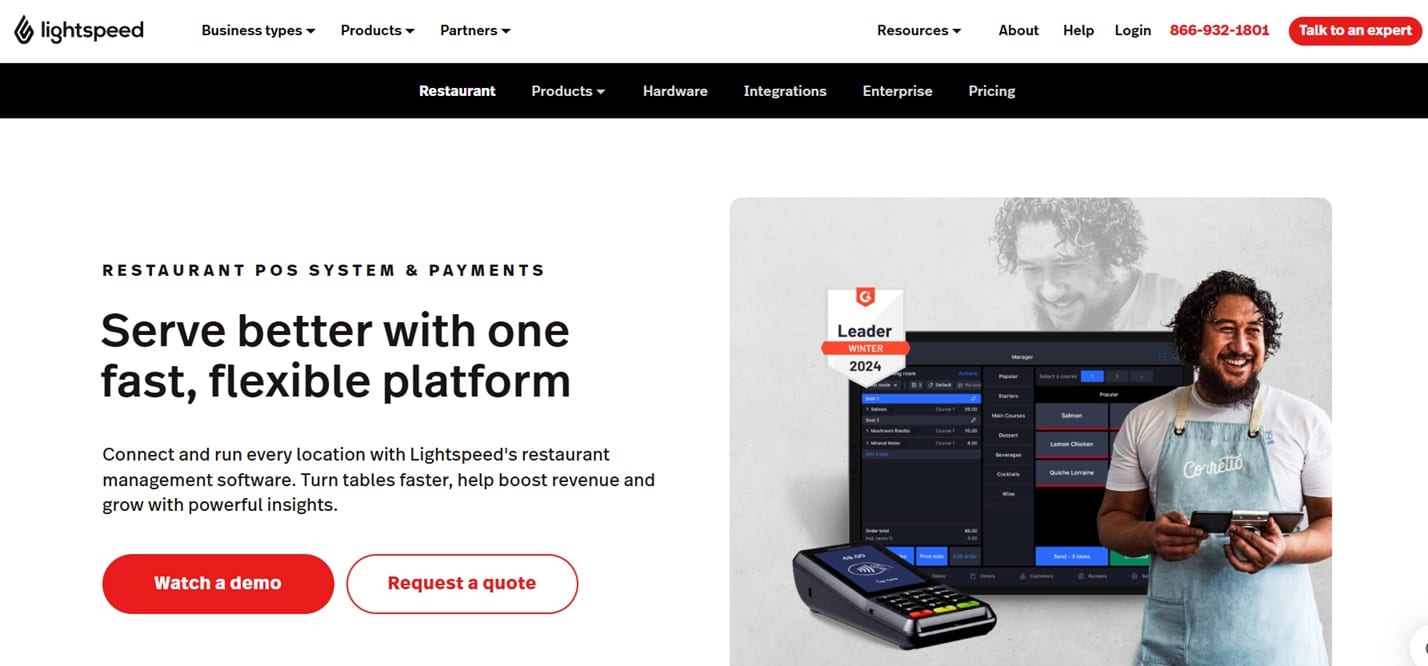
Lightspeed Restaurant is designed for operators who want deeper operational insights and greater control over complex restaurant businesses. Popular among upscale restaurants, hotel dining operations, golf clubs, and multi-location brands, the platform combines advanced inventory management with centralized menu administration and detailed business analytics.
One of Lightspeed’s biggest advantages is its ability to help operators manage multiple locations from a single interface. Inventory tracking, supplier management, menu updates, and performance reporting can all be coordinated centrally, reducing administrative work while improving consistency across locations. The company’s recently introduced AI-powered analytics further enhance reporting by allowing managers to ask business questions in natural language and quickly identify trends affecting profitability.
While Lightspeed offers more advanced functionality than many competitors, it also rewards operators who are willing to invest the time to fully leverage its capabilities. For growing restaurant groups seeking powerful reporting, centralized management, and enterprise-grade operational tools, it’s among the most comprehensive platforms on the market.
| Feature Category | Lightspeed Highlights |
| Hardware | Flexible iPad-based setups with optional proprietary terminals |
| Standout Feature | Conversational Lightspeed AI for natural-language business insights |
| Key Integrations | Embedded payments, inventory, staff/supplier management |
| Pricing | Tiered software plans per location, custom hardware quotes |
| Processing Style | Offers custom/interchange-plus options (cheaper for high volume) |
Each of these platforms excels in a different area:
- SpotOn stands out for its offline resilience and independent restaurant focus.
- Toast offers one of the industry’s most comprehensive all-in-one ecosystems.
- Square remains one of the easiest and most affordable platforms for independent operators.
- Lightspeed delivers the advanced analytics and centralized management that growing restaurant groups require.
The right choice ultimately depends on your concept, budget, and operational priorities.