From the get-go, when we were going through the 2025 Memoir Prize entries, Heather K.M. Lewis’ essay stuck out. And when we let her know her piece was one of three finalists and she shared that it would “be an honor to have it as my first publication,” we couldn’t believe it. An essay this good was her first?! Heather also shared: “It was a healing experience to tell this small part of my story.” We think that will come across as you read — and we’re honored, too, to share Heather’s beautiful piece with you. (To check out the grand prize–winning essay of our 2025 Memoir Prize, by Andrew Printer, head here; and to read the other finalist essay, from James McSherry, head here.)
When I step into the black box theater, I am a few minutes late. My eyes sweep the room to find my fellow castmates in a haphazard circle on the floor, sprawled across each other in an infinite combination of limbs and denim and hair. They discuss weekend plans of Martha’s Vineyard, the Hamptons and Broadway shows as I find my seat, the final link in our human chain. When asked, I share plans to see a movie. There is no movie.
The last time I asked my mother to see a movie, there was a long silence before she said yes. A few days later, she handed me a $20 bill as I left for school.
“This all I got,” she said in her heavy Southern drawl. “I said I wasn’t going back to Larry, but I want you to have fun with your friends.”
My face fell as she laid the crisp bill in my palm. I’d already told her we would lose all our money as long as she kept dealing with Larry, the predatory payday loan man. We’d agreed she wouldn’t go back, but it was my request to see a movie that unraveled our deal. I won’t be asking again.
Rehearsal commences and I lose myself in line recitals and blocking notes. When it ends, the silvery light of dusk has fallen across the grounds of my high school’s sprawling campus. I lift my backpack onto my shoulder and make for the door.
“Do you need a ride to the city?”
My castmate’s eyes are wide and earnest. But I know that while I live in this very borough, just beyond the serenity of our school’s stone walls and perfectly manicured lawns, she doesn’t mean my part of the city.
I smile. “I’m good. Thanks!”
I slide a pair of headphones over my ears, flip to my favorite radio station and walk down to the bus stop on a lonely corner. My friends from the cast wave as they pile into sleek luxury cars or find their drivers rolling up to campus from high-end car services. My bus finally pulls up, too, and I step on, letting the soothing sounds of Boyz II Men lift my spirits.
When I turn onto my block of Gun Hill Road, it’s mostly deserted. But there’s an elderly man set up in a camp chair across from my building, accompanied by a pair of oversized speakers. He’s dressed in a vibrant suit and a neon hat, softly crooning ’80s soul into a microphone.
I tip my head as I pass. “Hi, Sonny.”
He beams, a sparkle flashing in his eye under the yellow light of the streetlamp. “Good evening, young lady.” His words boom through the speakers.
I can’t say I’m exactly fond of Sonny — his daily rendition of “Day-O” at 7 a.m. sharp has seen to that — but I’ve come to associate him with the comforts of home. I’ve never lived in one place for longer than a couple of years. We’re coming up on our two-year anniversary now and I don’t mind Sonny’s eclectic open mic nights.
I amble toward my stoop, reaching a hand into my pocket for my keys. It’s empty, aside from a few coins and a crumpled receipt. I check the other pocket and my finger slides right through a gaping hole in the bottom.
“Hey, Ma,” I call timidly toward my building’s brick exterior. Several beats pass. I try again, and this time I throw my head back and cup my hands around my mouth. “MAAAAA!”
A window on the top story slides open and a set of keys drops down to the sidewalk. I scoop them up and use them to enter the building and walk up the four flights of stairs to our apartment.
The door opens to reveal my mother, and she’s back on the couch. A beefy man with long, flowing hair and his busty paramour smolder in each other’s arms on the cover of an open novel, lying flat on the coffee table. Music twangs and lights flash from the TV western playing quietly in the background. It’s a familiar sight, but something is off. The room is draped in a tense and heavy feeling.
“What’s wrong?” I ask.
It takes a while for my mother to look at me. When she does, I notice her eyes are puffy and her face is wet with tears. “We been evicted.” She presses her hands into her face as if she’s ashamed for me to see it. “We have to go back to the EAU.”
My heart drops at those three letters, and my limbs tingle with a rush of adrenaline. We were clients of New York’s Emergency Assistance Unit for two years before we graduated to this apartment, our prize for enduring the turbulence and trauma of the shelter system. It was an indescribable relief to put the whole experience behind us for good.
I hug her. “We’ll be OK, Ma.”

A bell sounds over the loudspeaker. I rub my eyes and slam my copy of The Odyssey shut.
“A few reminders before you go,” my teacher announces over the sounds of zipping backpacks and scraping chairs. “Don’t forget, your book report on The Odyssey is due in class tomorrow. Typed and printed. You know the drill: size 12 font, double-spaced. Also, don’t forget about our fall food drive! We’re collecting food donations for families in need this holiday season, and the goal is 100 percent participation from the student body. Remember, anything helps!”
I shove the book into my bag and start to rise from my chair.
“What you doing after school, girl?” my friend Camilla* asks, getting up with me. “You want to come over and chill?”
My heart lifts. Camilla and I have been talking more in class these past few weeks. I haven’t had a lot of friendships in my life, and this seems like the perfect chance to build one. But then I remember.
“Sorry,” I mumble hastily, and begin to wind my way through the cluster of students. “I have to finish my essay.”
Camilla looks disappointed, but I don’t linger. After a brief stop at my locker to store a few valuable items, I sit down in the school’s computer lab and open a new document in the word processor.
The cursor blinks at me from a blank white page. I position my fingers on the keyboard and begin to type letters, but they don’t join into words. Sighing, I thumb back through The Odyssey, but the words on its pages feel jumbled and incomprehensible. I type again, just to put something on the page. And then delete it. Type, then delete.
My eyes dart to the analog clock on the wall, and my hands begin to shake. Why won’t my brain just work? And now, my fingers won’t even type. I stare and stare at the white screen as all around me, the computer lab slowly empties out.
Tick.
The hour hand hits four. Shit. I’ve got my name, a book title and my teacher’s name. I don’t have a chance of coming up with the 5,000 words for the book report, and if I don’t get going, I won’t have a place to sleep. I close the document without saving it.
I half-jog down exposed brick hallways, passing students eating Chinese takeout in beanbag chairs and lacrosse stick–wielding athletes on their way to the field. I burst through the back doors and grab my old flip phone as I sprint down to the bus stop. Now that we’re back at the EAU, I’ve been heading to my mother’s job at the Public Assistance Center after school so we can check in together. It’s too late now to make it down to the South Bronx in time.
“Hey, Ma,” I huff into the speaker. “I’m gonna be late. I’ll just meet you at the EAU.”
When I arrive at the intake center in the squat, cinderblock building, a line of people holding suitcases and clear trash bags winds around the block. I cast around for a sign of my mother, but hers is not among the sea of faces.
I take my place at the end of the line as the light chill of fall nips my skin. It’s only early September, so it’s not yet unbearable. My stomach gurgles as I wait.
At 5 p.m., I check my phone again to find I’ve missed a voicemail from my mother. “Hey, girl,” comes the familiar comfort of her deep tones. “You not gon’ believe this. My train got delayed, and now I can’t get there till 6. Don’t stand out there in that cold. Ask them if you can wait inside. Love you.”
Trepidation knots my stomach, but I move with the others toward the entrance. Eventually, I step inside and a bored woman greets me from the other side of a scuffed and dirty pane of glass. I offer my name.
The worker types in my information and frowns as she reads her computer screen. “You got a parent or guardian with you, hon?”
My heart beats faster. “No. My mom got stuck on the train. She’s not here yet.”
“Then I’m sorry, sweetie, you gonna have to wait outside for your mom. We don’t let unaccompanied minors on the premises.”
“OK,” I say obediently. “Thank you.”
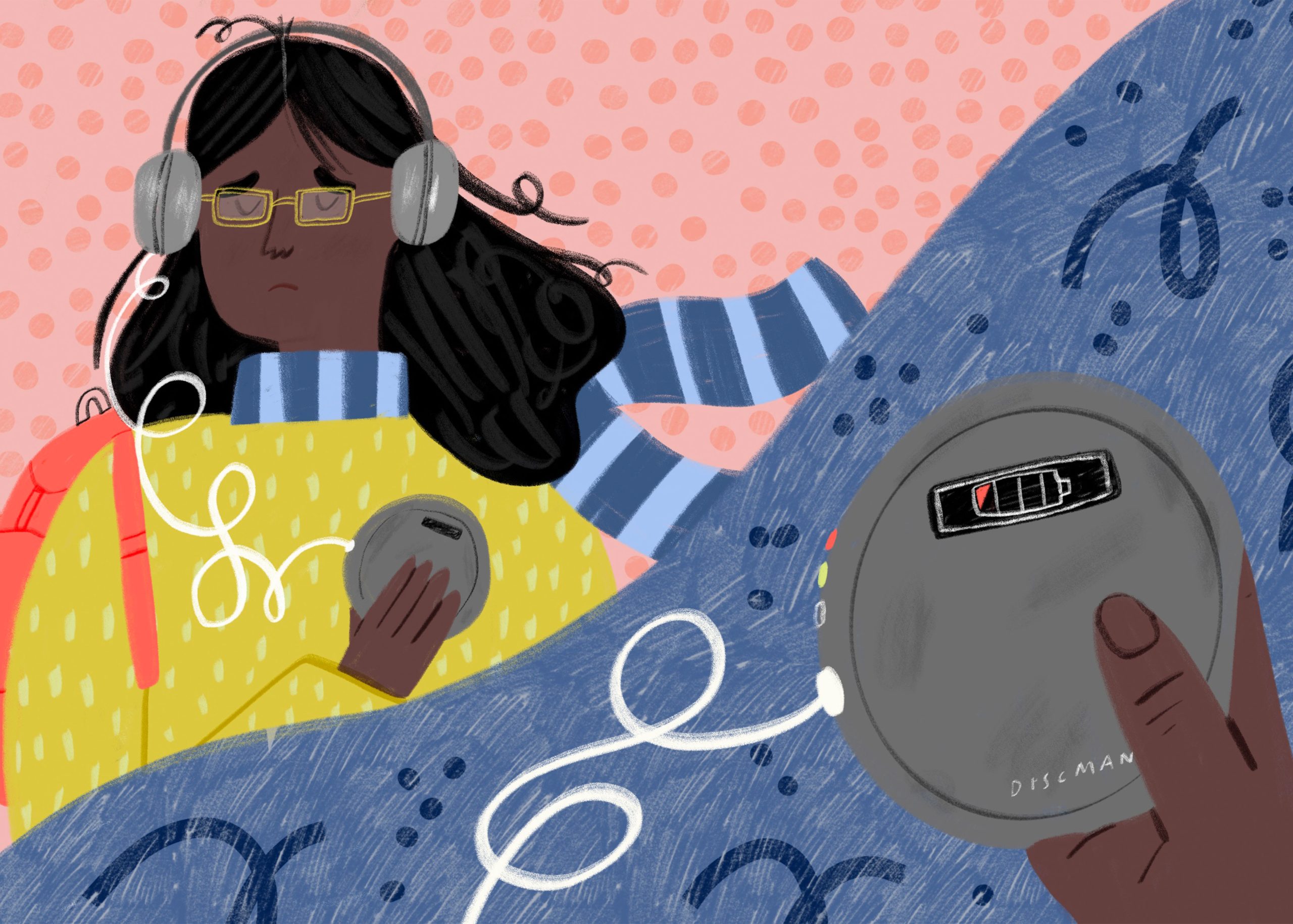
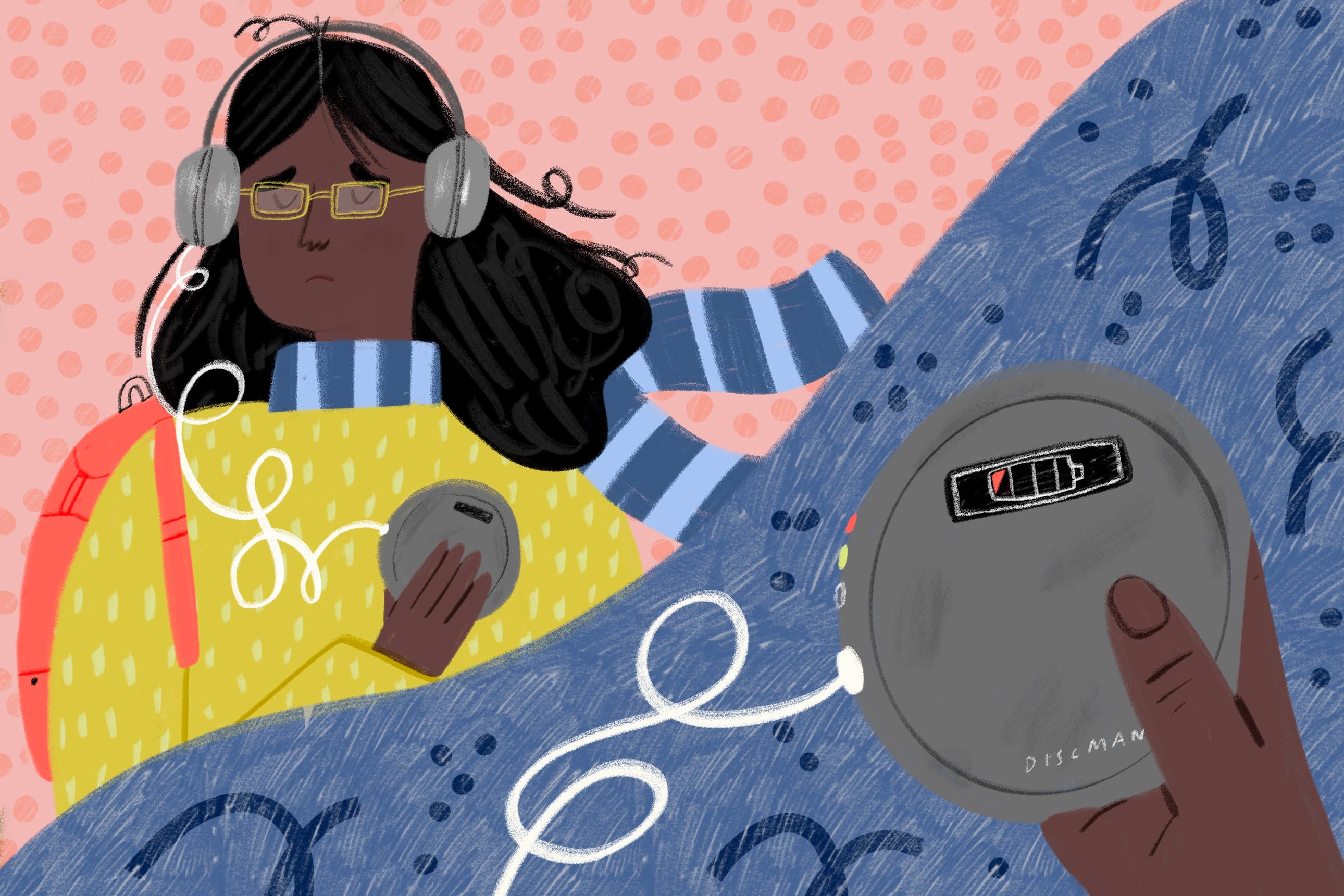
I pick a patch of sidewalk that isn’t covered in dark gum spots or gleaming globs of spit and I sit down, wrapping my arms around my knees. It feels a little cold now. I slip my headphones back on and hit play on my Discman, but nothing happens. When I try again, an empty battery icon flashes across the screen. I toss the thing back in my bag and sing show tunes.
By the time my mother arrives, I know any hope of a decent placement is lost. We deposit our belongings into clear plastic bags and are directed to wait in hard wooden seats surrounded by the sounds of crying babies, loud phone conversations and sporadic bus announcements.
Ma pulls out her romance novel and I pull out my notebook. If I can draft my essay by hand, I might have time to type it up in the computer lab before school in the morning.
An hour passes. A voice comes over the loudspeaker, announcing the bus to the Pineview shelter.* I know better, but I still set my pen down and strain my ears to hear each name. We’re not on the list.
I pick up my pen again, but the words still aren’t coming. Another hour passes. The bus is loading for Edgemont now. We’re not on the list.
“G’on and get you something to eat,” Ma says. “I’ll wait here.”
I head down to the basement cafeteria, and I’m offered a cellophane-wrapped tray and a box of juice. I peel off the cover to find a rubbery burger patty between two anemic buns. The whole thing emits a smell not at all reminiscent of a burger, but I lift it to my mouth. As my teeth sink into it, I notice the patch of mold beneath my thumb.
I spit the whole thing out and dump the tray into the trash. When I tell my mother, she hands me cash for McDonald’s across the street. The one silver lining of being at the mercy of New York’s emergency housing system is that we don’t have to pay rent. Our only financial commitment is our phone bill, and the tiny sliver of school tuition that isn’t covered by financial aid. We split a Quarter Pounder and fries.
Once dinner is done, I officially declare my book report dead and decide to put my pen to better uses. Like the fantasy-adventure novel I’ve been dreaming up during class. Somehow, those words spill right onto the page.
It’s two in the morning when the announcement comes for Maple Hills. Ma has made a makeshift bed for me using some of our clothes, but I’m too uncomfortable to sleep. All I want is a real bed, but my mind is a constant refrain: Please not Maple Hills. Please not Maple Hills.
But sure enough, when the names of families assigned to Maple Hills are read over the loudspeaker in a lifeless drone, our names are on it. We board a bus in the pitch dark with 30 other exhausted clients, and it’s almost three when we pull up in front of a high-rise with a broken “hotel” sign on top.
The rooms smell like mold, and roaches scatter when we turn on the light. We’re handed new plastic bags with scratchy towels and thin sheets for the beds. Ma makes the bed and promises to stay up and watch for rats so I can sleep.
Just a few hours later, I’m pulled from sleep by a series of knocks. “The bus is here!” yells an employee through the door.
I decide not to get on it, because I’ve seen a train stop on the corner that will cut my commute to school in half. My mother hugs and kisses me, and I promise to leave school on time today so I can meet her at work like I’m supposed to.
It’s only 7 when I arrive at school. I head for the computer lab again and sit back down with Odysseus. I vomit 5,000 rambling, sleep-deprived words onto the page, and then the morning bell rings.
“Come on in.”
I squeeze my mother’s hand, and we walk together through the open office door. My assigned college counselor, Gary, an elderly man with a weary face, waits behind a large, mahogany desk. My mother and I take seats in the empty chairs in front of it.
Gary clasps his pale hands together and fixes me with a piercing gaze. “So, what’s on your list?”
I unearth the sheet of paper from between textbooks and crumpled worksheets, and slide it across the desk. He accepts the paper and studies it carefully, pushing his glasses higher up the bridge of his nose.
“These are the only schools you’re considering?” he asks. “Ordinarily, these would be reliable safety schools for someone of your intelligence. If you’re looking for a liberal arts school, a place like Haverford College might be a better fit for you. Or maybe Davidson, if you’re looking to go south.”
I shift in my seat. “I don’t meet the GPA requirements.”
“You don’t meet the GPA requirements?” he repeats, surprised.
I shake my head. I know, because I’ve spent the last several school days off reading guidebooks in the college admissions aisle of Barnes & Noble while my mother works. We’ve been upgraded to temporary housing while the EAU reviews our case, which has meant an end to the late nights and the uncertainty. But I’m not allowed to sign in to our new building without a parent. So now, I know the GPA and SAT score requirements of every top college in the country.
I haven’t ever been a straight-A student. But the weight of the Bs and Cs that will stain my report card in permanent ink this quarter hangs heavy. My high school is known as one of New York’s “Ivy Prep” schools, so it’s no wonder that most of my peers are preparing their applications for the real Ivy League colleges. Others are polishing their portfolios for the top-tier of liberal arts schools. My chest tightens with a pang of regret.
I leave Gary’s office feeling decidedly worse than when I walked in. As we take the bus back to the shelter, I tune out my mother’s long-winded appeal to consider a Georgia state school near the rest of our family. Or can’t I just join the military, like she did? I don’t bother to remind her that she raised a sensitive book nerd who came up on the streets of New York City. We’ve already had this conversation too many times to count.
“Anyway, I got us some stuff for Thanksgiving,” she says, and my ears finally perk up. “Since we got that little oven in the apartment, I bought some pans to make turkey and dressing and sweet potato pie.”
I grin widely, excited for this small gift of normalcy. We sign in at the front desk of our building and pass through the metal detectors to the stairway. The stairs lead up to a long terrace, where there’s outdoor access to each of the tiny apartment units. As we approach ours, I’m filled with a cold horror as two full trash bags come into view against our door.
Ma and I don’t look at each other, but the seconds it takes to reach that door feel stretched and taut. We stop in front of it, and there’s a stack of papers taped to it, stamped with bright red letters: INELIGIBLE.
My heart plummets. Ma steps around the bags and desperately jams her key into the lock, but it won’t turn. We both knew it wouldn’t. Her face starts to crumple.
I force my shoulders into a shrug, and when I speak, it feels like my voice is coming from someone else. “I really thought we’d be eligible this time. Oh, well.”
Ma doesn’t speak. Silently, we each pick up a trash bag filled with our belongings and leave the apartment for the last time. The bus ride back to the EAU is a blur. I try not to wonder whether we are an odd sight, on a city bus with bulging trash bags in tow as the people around us go about their normal lives, commuting to their normal homes from a normal day.
When we arrive, my mother presents our papers to the worker at the front door, and we are ushered to a back office to meet with a case worker.
“Why are we ineligible?” my mother demands. Her thick southern accent is suppressed now by professionalism and the threat of tears. “I gave y’all the pay stubs, the eviction notice. What more do y’all want? I can’t have my daughter here anymore. We just need a place to live.”
“You have a cousin whose address is registered at a zip code less than 15 miles away,” the case worker explains in an exasperated tone. “And unlike a lot of people here, you have a job, Ms. Munford. Surely you can just stay with your cousin for a couple of months until you can get your own place.”
“We already tried that,” Ma says weakly. “We can’t go back.”
The two-month period we spent sharing Evelyn’s 600-square-foot apartment in Co-op City was rough. It took me two buses and a train to get to school from there, and I hated having to wake up at dawn to fold up the rickety sofa bed Ma and I slept on so Evelyn could do her morning workout tapes.
The women argued a lot, reaching a fever pitch as Evelyn’s landlord became suspicious about unauthorized tenants. When Evelyn found out how long it would take my mother to save up first, last and security on her minimum-wage salary, she quickly made it clear we had to find another arrangement.
“Well, Ms. Munford,” the case worker says, “you can ask her again or we can refile your case and go through this entire process all over. I have to warn you that you’re likely to get the same result.”
“We have nowhere else to go,” my mother says firmly.
With a brisk nod, the man walks us through the process of reopening our case. After, we take our seats on the wooden benches that are becoming more familiar than any home I’ve ever had.
A weight threatens to crush my chest, but I can feel my mother’s stare. I won’t let her see. An abandoned bucket of Legos has spilled across the bench next to me, and I pick up the colored plastic blocks.
“I am so sorry,” Ma says, as if she can see right through me. Her voice breaks. “I never wanted to put you through this. I prayed we would have somewhere to stay for Thanksgiving and Christmas.”
“It’s not so bad,” I say, and my voice has that tinny, not-quite-real quality again. I click two blocks into place. “We can still have a nice holiday. We can get a few different dishes from KFC on Thanksgiving. And if we’re still here on Christmas, maybe we can look at decorations and go window shopping. My friends from school say the shops are nice on the Upper West Side.”
Ma smiles, and the corners of her eyes crinkle with affection. “That sounds fantastic.” She reaches across the bench and takes my free hand into both of hers. “I am so proud of you, Heather. You are so strong.”
A warm glow breaks through the cloud of dysphoria. “I don’t care about Christmas trees or presents,” I tell her, and I want her to know I mean it. “We can just spend time together and make the most of it.”
As if to reward my undying optimism, we’re assigned the first bus of the night to my favorite overnight placement, Pineview. Our streak of good fortune continues as we’re given another 10-day assignment the very next day. Treetop Towers are a beautiful pair of buildings with huge, skylit apartments outfitted with kitchenettes. Ma and I have our Thanksgiving after all, with some of the friends she’s made at the shelter.
The staff come around and take Christmas wish lists from each of the families. I doubt we’ll still be here come Christmas, but I scribble a quick note anyway asking for a new young adult fantasy novel.
At school, an invisible cloak of shame drapes over me, pressing me downward into isolation, but no one is any the wiser. I smile and laugh as if life as I know it hasn’t fundamentally shifted, but I’m never fully there. I can’t talk to anyone, because I don’t know how. I’m homeless at one of the top private high schools in New York City, and no one knows. Camilla and I barely speak now.
“You look great,” someone says in passing one day, and confusion pierces the bubble of my dissociation. “Have you lost weight?”
I do a double take. Without realizing, I’ve been slowly losing touch with reality, and this is the first sign in months that someone can actually see me. The buzz shakes me out of the cloud.
“Oh, I don’t know,” I say. “Thank you.” We exchange smiles and that brief moment of connection feels exhilarating. Somehow, the more I’ve shrunk, the more visible I’ve become. I decide to skip lunch.
We’re out of the clutches of the EAU for the next week, and I now have a stable place to sleep every night. But my grades continue to tank as I develop a singular focus on measuring my food intake, and rack up tardies from weighing myself in the school gym between classes.
It feels wrong, but I know no one will care because I’m overweight and besides, Black girls don’t get eating disorders. I feel seen again now and the compliments I get from my classmates feel like moments of connection. And I don’t think about the EAU when I’m hungry.
On the last day of school before winter break, report cards get passed out during our advisory period. I slide the cardstock out of its envelope and my body begins to shake. D. I’ve earned a D in math. Nestled at the bottom of my bag is the reworked list of colleges I made after my meeting with the counselor, and now I may as well rip it to pieces.
My breath quickens — this can’t be real. My eyes land on the date printed across the top of the report card, and I realize that today marks our 10th day at Treetop. Today is the deadline for the EAU to make a final decision about our case. The thought of arriving back at Treetop this afternoon with my D-marked report card, only to find our things in bags again outside the door, is too much to bear.
I lock myself in a bathroom stall. It’s the first time I’ve cried in the months since we lost our apartment on Gun Hill Road. Every time I see the pain on my mother’s face, my instincts go into a protection mode so fierce that they would shut my body down before I shed a tear in front of her. But she’s not here now, and the emotions are pouring out of me so hard that I’m scared I will completely break. There’s no one to help me put myself back together, so I’ll have to do it myself. I take a deep breath, wipe my eyes and plan out my meals for the 300 calories I’ve allotted for the next day.
When I make it to Treetop, Ma is spilling over with a rare joy. She can’t contain herself. “The EAU just called,” she squeals, her eyes shining. “We’re eligible!”
“What?” My head rings with the improbability of the words I’ve just heard.
“They called Evelyn. And she cursed them out and told them I am never, ever allowed in her apartment again. Now we’re eligible. We can stay here for six months until our housing benefits get approved. We have a place to stay for Christmas!”
We hug each other and cry and cry. Christmas comes with a home-cooked meal from Ma and a brand-new boxed set of the Wrinkle in Time series. We even put up a little Christmas tree in our unit. Still, we decide to do our holiday window shopping on the Upper West Side.
In the new year, the euphoria of finally escaping the EAU begins to subside, and the grim reality of my college prospects settles in its place. My friends are starting to schedule campus tours and fill out early decision applications for the fall. I feel lost.
My former college counselor, Gary, has retired, and I’ve been reassigned to a kind, bubbly woman named Liza. I fiddle with my hands in the waiting room, filled with existential dread.
“Heather?” Liza calls from her office.
I claim an empty chair inside. Her office is much cozier than her predecessor’s. The chairs are upholstered, the lighting is soft and there’s art on the walls.
She looks down at me with smiling eyes. “It’s nice to meet you, Heather. Have you had a chance to start looking at any colleges yet?”
I almost laugh. Start. I know them all inside out now. “Yes,” I tell her nervously. “I thought about applying to some liberal arts schools, like Haverford or Davidson.”
She sighs, and the smile falters. “Well, unfortunately, your transcript is going to present some challenges for schools like those. You earned quite a few Cs and even a D on your report card last quarter. With those grades, those schools won’t be possible even as reach schools, unless you have some kind of an extenuating circumstance that would explain them.”
I hesitate. Maybe I have an extenuating circumstance, but I’m convinced it isn’t the real reason I’ve done so poorly. When it all comes down to it, I’ve simply missed too many assignments, spent too much time in class daydreaming, and skipped class too often to hide in the bathroom. I think of all the wasted time spent in the computer lab staring at a blank screen instead of doing my work.
I hang my head. “No.”
Liza’s smile returns, but this time it’s sad. “Well then, we’re going to have to think about other options for you.”
I leave her office with a list of new schools, but I can’t bring myself to look at it. I’ve spent too much time now flipping through the other schools’ viewbooks and picturing myself on their campuses. I’ve picked out majors and made lists of courses I hope to take. I’ve started to imagine living in their dormitories and never needing an announcement to tell me when and where I could sleep.
How can I have let myself earn that D? I think about my mother and all she’s been through. The Army veteran who grew up picking cotton with her siblings under the hot Georgia sun, scrimping and scraping to make a better life for us in New York on an impossible salary. She did it because she always believed I would go far. That I would be the one to accomplish the wildest dreams of our ancestors. Was I ready to let it all go that easily?
I didn’t turn in some assignments. I missed a lot of classes. But I survived the EAU twice, and it never broke me. Couldn’t that be enough to earn the chance to live out my own wildest dreams?
I turn on my heels and make my way back to the college counselor’s office with long, quick strides. For those moments, the truth of my worth rings clear, drowning out the self-doubt and the shame.
Liza is moving to close her office door when I arrive, and she pauses to look me over. “Hi, Heather. Did you forget something?”
“No,” I say breathlessly. “You asked if I had any extenuating circumstances to explain my grades, and I do. I’m…” I take a deep breath, my gaze trained on the floor. “I’ve been homeless.”
Liza’s mouth falls open as she surveys me. I must look crazy, I think, shaking all over and more vulnerable than I’ve ever felt. But she adjusts her stunned expression and lays a gentle hand on my shoulder.
“Come on in,” she says with a smile.
*Some names of people and places have been changed to protect privacy.
Heather K.M. Lewis is a Philadelphia-based writer and educator. When she’s not wearing a dizzying number of hats at her job in academia, you’ll find her snuggling with her spouse, wrangling her adorable 4-year-old and writing speculative fiction (often at the same time!).
Connie Nobleis an illustrator and animator based in sunny Brighton, England. Her work is inspired by the natural surroundings, textures and colors of living by the sea.