According to the history books, stone fruits—including my beloved peaches—originated in the Far East more than 4,000 years ago. From there, they traveled the Silk Road and other ancient trade routes, eventually making their way to Persia and Greece around 300 BCE. I am so grateful they did, because I truly love stone fruits.
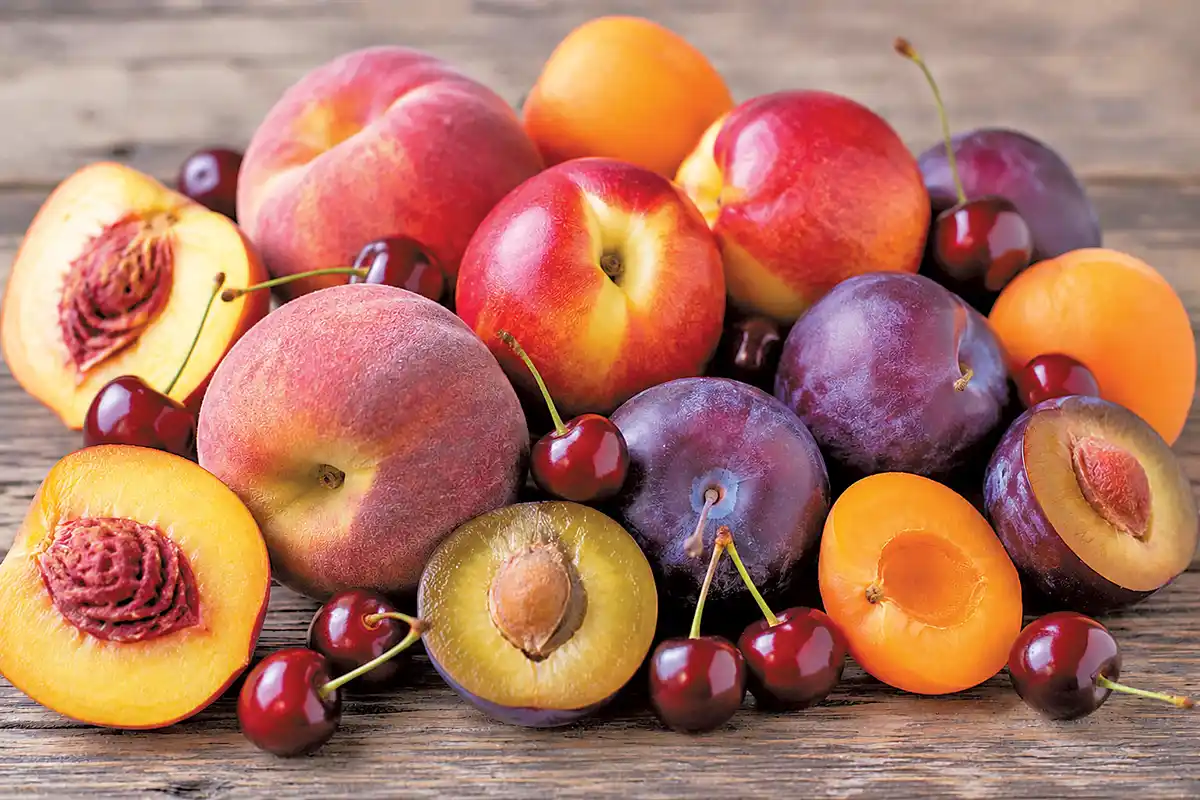
Stone fruits are any fruits that have a hard “stone” (or pit) in the center, with a seed tucked inside that stone. The broad family of stone fruits includes many delicious varieties—cherries, peaches, apricots, plums, nectarines, and, surprisingly, even olives are considered stone fruits.
It’s worth noting that while stone fruits continue to ripen after they’re picked, their shelf life is short, so you’ll want to enjoy them while they’re at their seasonal peak. Store them at room temperature and keep them out of direct sunlight. Refrigerating stone fruits can change both their taste and texture, so leave them on the counter until you’re ready to eat them.
Peaches, apricots, plums, nectarines, cherries—you really can’t go wrong eating any, or all, of them. Almost all stone fruits are high in dietary fiber and potassium, along with vitamin A, which supports your immune system, heart, and lungs. They also contain vitamin C, which helps your body produce collagen and keeps your skin healthy. And because they’re naturally sweet, and relatively low in calories, they make for a wonderful guilt-free treat.
When summer arrives in Greece, the air shifts. You smell it before you see it—that warm, honeyed perfume drifting down from the orchards of Macedonia, where peaches and apricots ripen under a sun that has been doing this exact work for thousands of years. I have to tell you: there is simply nothing in the world quite like a Greek stone fruit.
The magic begins with the sun and with the rare meeting of mountain altitude and mineral-rich earth in Northern Greece. Our peaches develop a deep, floral aroma and a sugar-acid balance that makes them taste alive; our apricots are golden and almost impossibly fragrant. These are little jewels of sunshine, carrying generations of know-how from the farmers who tend them.
And no one has carried that gift to the world more beautifully than Kronos. Founded in 1971 in ancient Macedonia by Eleftherios Saitis—and now led by his daughter Konstantia Saiti alongside Nikolaos Tzimourtos—Kronos has grown into Europe’s largest yellow fruit processor, working hand in hand with more than 10,000 farmers across Pella, Imathia, Thessaly, and the Peloponnese, and bringing Greek peaches and apricots to over 90 countries. Their advanced steam-peeling, preserves every bit of natural aroma and nutrients, while peach pits and sunflower husks fuel more than 80% of the factory in clean biomass steam, alongside solar parks that make Kronos a quiet leader in sustainability.
And this is where my Greek heart fills up. Because of Kronos, a child in a snow-bound city, a family in a desert kitchen, a grandmother far from any Mediterranean orchard—all of them can open a jar and taste the same sun, the same Macedonian soil, the same generations of care that I grew up with. Greek stone fruits are no longer a secret of the Mediterranean—they are a love letter from my homeland to every kitchen that welcomes them.
Stone fruits shine in both sweet and savory cooking—from simple spoon sweets and rustic pies to rich, slow-simmered stews where their natural sweetness rounds out meat and spice. Here are a handful of my favorite ways to bring them to the Greek (and Mediterranean) table:
The crown jewel of the Greek pantry—perfect over yogurt, ice cream, or simply on a small plate with a glass of cold water.
2. Quick Apricot Marmalade with Vanilla
Thick, golden, and perfumed with vanilla—beautiful on toast, on a cheese board, or swirled into Greek yogurt.
3. Grilled Peaches with Greek Yogurt and Thyme Honey
A five-minute summer dessert that tastes like a vacation in Greece.
4. Rustic Peach Phyllo Pie
A free-form Greek-style pie—golden, crackly phyllo wrapped around fresh, juicy peaches. Easier than it looks and always a showstopper.
5. Greek Pork with Prunes (Hirino me Damaskino)
A traditional Greek winter stew—tender pork, sweet prunes, and red wine come together into something deeply comforting. Serve over rice, orzo, or with crusty bread.
6. Mediterranean Lamb and Apricot Stew
Inspired by my travels through the Emirates and the bridges between Greek and Middle Eastern cooking—the apricots melt into the sauce and balance the warm spices beautifully.
So, this season, embrace the bounty—and let yourself taste a little piece of history and a lot of Greek love with every juicy bite.